
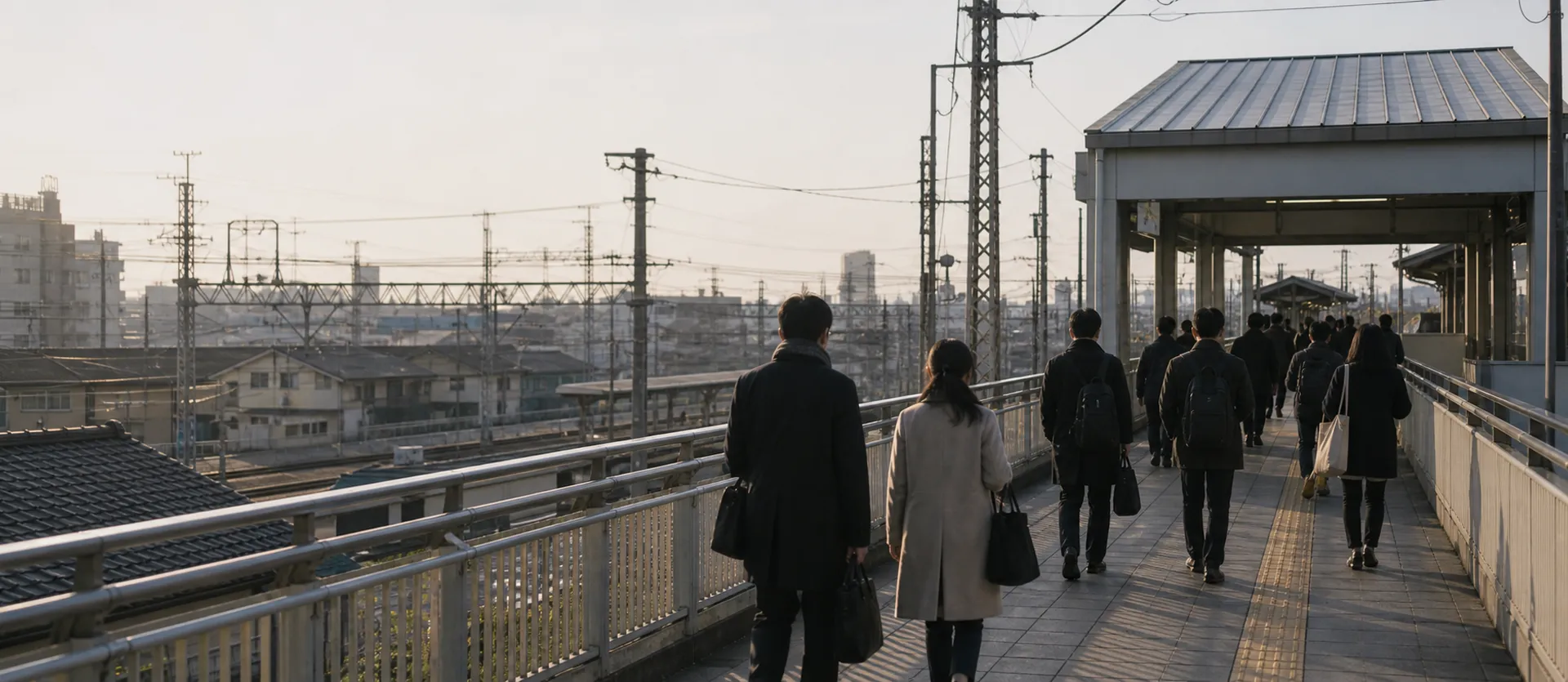
Commuting zones: judging city boundaries by lines, transfers, and daily cost
A neighborhood is not good just because it is cheap or close. Compare commute time, crowding, transfers, last trains, rent, facilities, and commuter passes.
ARTICLE MAP Reading Map
In Japanese cities, “near the office” and “good to live in” are different questions. Moving far out can cut rent, but a 1.5-hour one-way commute with 2 transfers can cost more energy than the money saved. Judge neighborhoods by time, route, last train, rent, and daily facilities together.
Real cost of commute time
Within 30 minutes is the ideal long-term range: walking plus one direct line. In the Tokyo area, rents are high, often around ¥80,000-130,000 per month for a 1R, but overtime and last-train stress are lower.
30-60 minutes is the common compromise, often with 1-2 transfers. Tokyo-area 1R rents in this range often run ¥50,000-80,000, but rush-hour crowding depends heavily on the line.
60-90 minutes can work when the company pays the commuter pass, often ¥15,000-25,000 per month. The hidden costs are fatigue, earlier mornings, and reduced flexibility after work.
Over 90 minutes is hard to sustain unless remote-work days, family reasons, or a specific lifestyle make the tradeoff acceptable.
Lines matter more than districts
The same area may have JR, private rail, and subway options. Travel time to the same office can differ by 10-30 minutes, and monthly cost by ¥5,000-15,000.
For Shibuya, Tokyu Den-en-toshi Line can be extremely crowded, while Odakyu may feel different depending on destination and transfer. For Shinjuku, JR Chuo Line is fast but crowded, while Keio can be steadier. For Ikebukuro, JR Saikyo Line and Tobu Tojo Line may be similar in time but different in fare.
Check 3 things before choosing: crowding rate, direct service or transfer count, and the last train from the central station after work.
Last trains and rent
| Tokyo-area example | Last train from center | 1R rent guide |
|---|---|---|
| Inside Yamanote, Minato / Shibuya | 00:30-01:00 | ¥90,000-150,000 |
| Jonan, Shinagawa / Ota side | 00:00-00:30 | ¥75,000-100,000 |
| Kanagawa, Kawasaki / Yokohama | 23:30-00:15 | ¥55,000-80,000 |
| Chiba, Funabashi / Matsudo | 23:30-00:00 | ¥50,000-75,000 |
| Saitama, Saitama / Kawaguchi | 23:30-00:00 | ¥50,000-70,000 |
The key is not the last train at your home station. It is the last train you can catch from the office-side center after real overtime, dinner, or bad weather.
Daily facility checklist
Within 10 minutes on foot, look for at least 2 supermarkets or convenience stores, a coin laundry if the apartment lacks a dryer, bicycle parking, and a station within a practical walking distance.
Slightly farther away, confirm drugstores, clinics, post offices, and libraries. Two neighborhoods both listed as 45 minutes by train can feel completely different if one has 5 convenience stores and a 24-hour supermarket while the other has only one small grocery store.
Commuter pass and rent balance
Commuter passes are cheapest when bought for 6 months. In Tokyo, Shibuya to Osaki may cost about ¥11,380 per month, while Shinjuku to Tachikawa can be about ¥22,310 per month.
Ask whether your company reimburses all transport or caps it, such as ¥35,000 per month. If two apartments differ by ¥20,000 in rent but one adds ¥15,000 in self-paid commuting, the real difference is only ¥5,000.
Common mistakes
Do not judge by map distance. A place within 10 km can still take 50 minutes if it requires 2 transfers and waiting time. Use a transit app for actual rush-hour departures.
Do not compare rent without transport cost. Add rent, commuter pass, bicycle parking, and the occasional taxi after the last train.
Do not sign before checking late-night access. Viewings happen in daytime, but the station-to-home route after 23:00 is what you will use after overtime or dinner.