
Fine Dining Culture: Counter Etiquette, Issei Start, and Rating Systems
How to read Tabelog scores, choose OMAKASE or Pocket Concierge, arrive for counter courses, handle photography, payment, allergies, and service charges.
ARTICLE MAP Reading Map
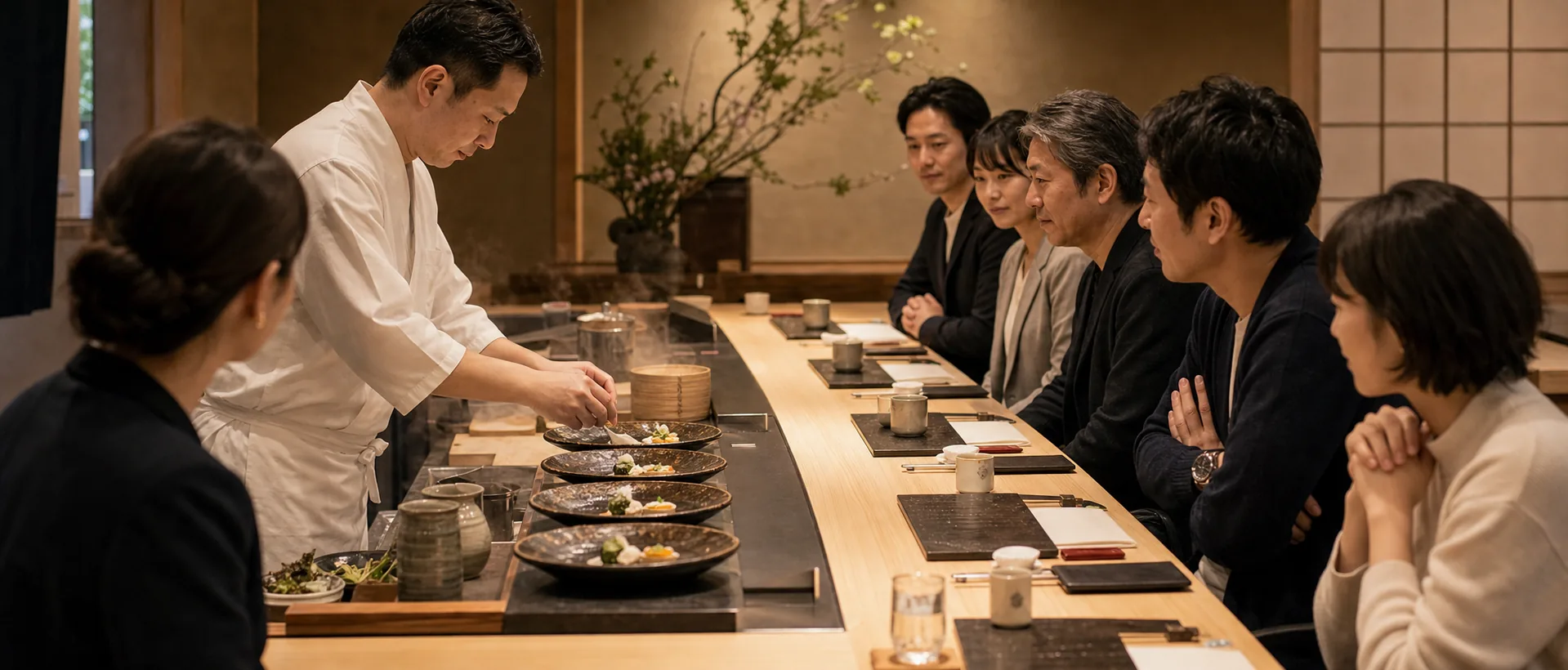
High-end dining in Japan often means 8 to 12 counter seats, one chef and 1 or 2 assistants, and an omakase course around ¥15,000 to ¥50,000. The food is only one layer. Reservation route, arrival time, scent, photography, and payment all affect whether the evening goes smoothly.
Reading Tabelog scores
Tabelog uses a 1 to 5 score, but the distribution is compressed. A 3.5 shop can already be in the upper slice of Japanese restaurants, 3.7 is excellent, and 4.0 is a serious high-score threshold.
The score is not a simple average. Tabelog weights reviewers by history and reliability, so anonymous one-off praise does not move a shop much. A Japanese user’s “ordinary good” can sit near 3.0, while 3.5 is closer to “worth recommending.”
For a specific neighborhood, filter by budget, genre, and 3.5 or higher before reading comments. Tabelog Premium, ¥330 per month by credit card or ¥400 via in-app purchase, unlocks ranking details and sort functions.
Source: Tabelog: Score help, Tabelog Award.
Reservation platforms
For ¥20,000-plus sushi, kaiseki, French, or teppanyaki, OMAKASE and Pocket Concierge are the main high-end portals. OMAKASE often charges a per-seat service fee around ¥390 and uses strict cancellation rules. Pocket Concierge has Japanese and English interfaces and many prepaid reservations in Ginza, Azabu, Kyoto, and similar areas.
For ¥10,000 to ¥20,000 restaurants, Ikkyu Restaurant and TableCheck are common. Ikkyu often has weekday discount plans and point returns. TableCheck covers many new restaurants and same-day openings.
For ¥5,000 to ¥10,000 casual or mid-range dining, Gurunavi, Hot Pepper, TableCheck, Tabelog reservations, and Google Maps can work. Some high-end shops still accept only phone reservations; if Japanese is difficult, ask a hotel concierge to call.
Source: OMAKASE, Pocket Concierge, Ikkyu Restaurant, TableCheck.
Arrival and counter rules
Arrive about 5 minutes early. Ten minutes early can be too early because the shop may still be cleaning or setting the counter; 10 minutes late can be treated as a no-show at strict omakase shops.
Avoid strong perfume. Sushi, dashi, charcoal, and seasonal ingredients rely on aroma, and heavy scent can bother both the chef and other guests. Large bracelets, long necklaces, and bags on the counter are also poor fits for a narrow workspace.
Many ¥15,000-plus courses use 一斉スタート, where all guests begin at the same time. If one table is late, the first course, rice temperature, or grilled item timing can be affected for the entire counter.
Photography, phone, and voice
Most high-end restaurants allow food photos, but flash is not acceptable. Ask 写真撮ってもいいですか at the beginning. If the chef’s face or hands are included, ask separately.
Do not make phone calls at the counter. Step outside or near the entrance if a call is unavoidable. Keep the phone, wallet, tissue, and camera off the counter unless the shop clearly permits it.
Voice volume should stay at the level of the neighboring seat, not the whole room. In a 10-seat counter, one loud table changes the atmosphere immediately.
Payment and allergies
At payment, say お会計お願いします. If the course was prepaid through OMAKASE or Pocket Concierge, only extra drinks or supplements may remain.
Credit cards are common at high-end restaurants, but some Ginza sushi counters still prefer cash or have card limits. Ask カードは使えますか? during reservation. Japan has no tipping culture; leaving cash on the table can confuse or offend staff. Service charge, often 10 percent, appears on the bill when used.
Allergies and disliked ingredients must be sent at reservation. Omakase purchasing is based on the number of guests and the day’s course. Saying on the day that shellfish, raw fish, or dashi is impossible can leave both the shop and guest with a broken course.
Useful terms
- おまかせ: chef’s course
- カウンター: counter seat
- 一斉スタート: all guests start together
- お会計: bill
- おしぼり: wet hand towel