
Fireworks festivals: major shows, paid seats, yukata, and the route home
Compare Sumida River, Nagaoka, Omagari, and Tsuchiura fireworks by crowd size, paid seats, yukata rental, stalls, rain decisions, and train strategy.
ARTICLE MAP Reading Map
JAPAN CULTURE
Entering A Japanese Summer Night
Prayer On The Sumida
Light That Vanishes
Water, Bridges, Boats
Before The First Burst
Yukata As Summer Outing Wear
Motifs, Accessories, Geta
When Everything Comes Together
An Atmosphere Only Here
Entering A Japanese Summer Night
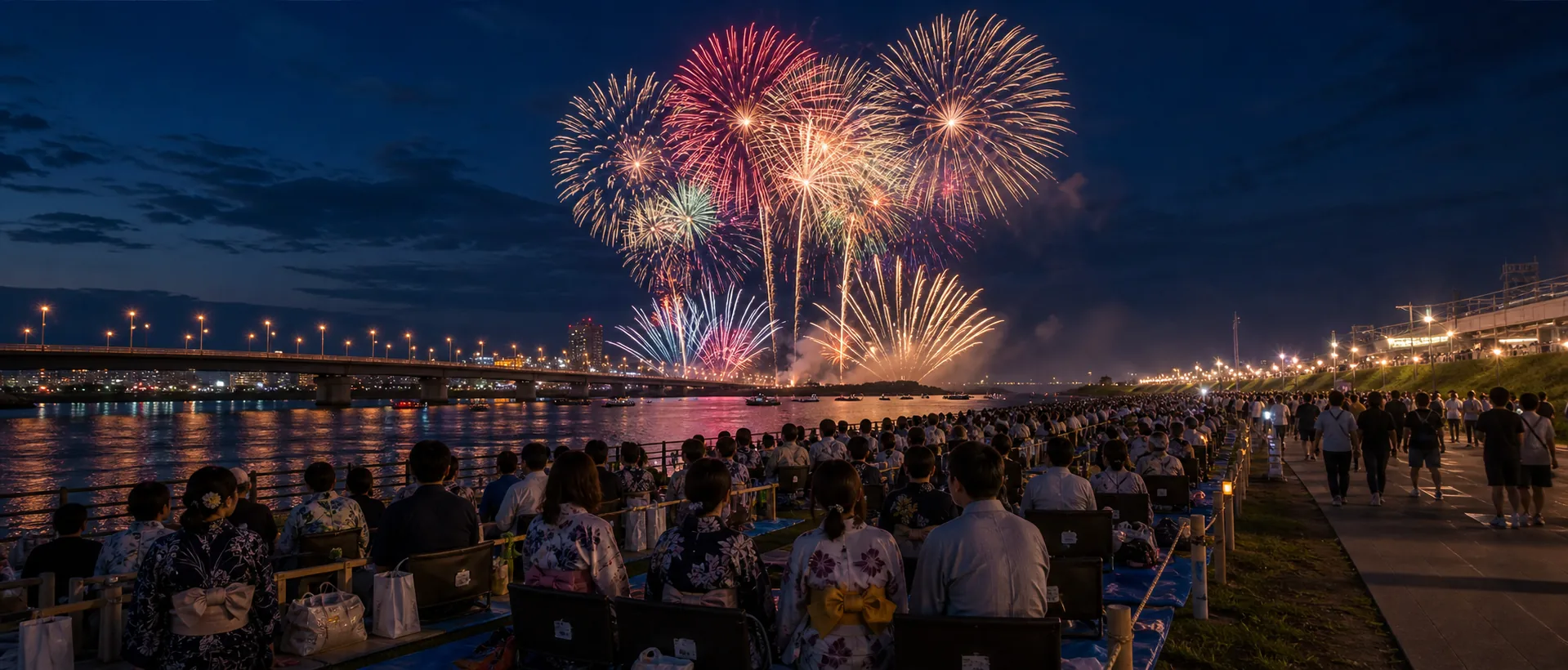
Fireworks festivals and yukata together form one of the clearest images of summer in Japan.
The story begins where night sky, riverbank, crowds, food stalls, and summer clothing meet.- The theme is Japanese summer culture
- Fireworks and yukata naturally belong together
- The riverbank becomes a night theatre
Prayer On The Sumida
The history begins about 300 years ago, tied to Edo-period memorial feeling and disease memory.
Fireworks on the Sumida River are said to have honored the dead and prayed for calm among the living.- The origin is not pure entertainment
- Firelight carries prayer for the dead
- Looking up together keeps a ritual shape
Light That Vanishes
A firework flashes and quickly disappears, and that briefness fits the feelings people place on it.
When tens of thousands look up and become quiet together, an old form of prayer still remains.- Brief light concentrates memory
- Silence turns a crowd into a community
- Modern viewing still keeps the old prayer
Water, Bridges, Boats
Many festivals are held by rivers because water, bridges, and boats expand how fireworks are seen.
Look up and there are fireworks; look down and there are reflections. The whole city becomes a theatre.- Water creates a second layer of fireworks
- Bridges become natural gathering points
- Boats extend viewing into the river
Before The First Burst
The experience starts before launch time, with saving a spot, eating from stalls, talking, and waiting.
Everyone looks up together, reacts together, and then goes home together; the whole sequence is the event.- Arriving early becomes the first act
- Food stalls turn waiting into festival time
- The way home completes the experience
Yukata As Summer Outing Wear
Yukata began as clothing after bathing, then spread in the Edo period as summer clothing for going out.
Fireworks festivals and yukata expanded in the same era, so they naturally became a pair.- The origin is after-bath clothing
- Light fabric fits humid summer nights
- Putting it on shifts the mood to festival
Motifs, Accessories, Geta
Morning glory, goldfish, obi, kinchaku, and geta turn yukata into a language of summer night.
Geta make a crisp sound as people walk, and the body naturally slows down to match the evening.- Patterns make the season visible
- Obi and small bags complete the silhouette
- Geta sound slows the walking rhythm
When Everything Comes Together
Yukata, stalls, waiting by the river, reflected fireworks, and crowd reactions make the Japanese scene.
Other countries have fireworks events, but this complete atmosphere is difficult to reproduce elsewhere.- Clothing, food, and place work together
- The way people wait is part of the culture
- Water reflections deepen the summer night
An Atmosphere Only Here
The appeal is the chance to feel an atmosphere that belongs to this country.
From choosing clothing to waiting and going home, the night carries Japanese seasonality and public rhythm.- The event is more than fireworks
- City and crowd complete the mood
- It is worth experiencing while living in Japan
Fireworks festivals are one of Japan’s biggest summer events. More than 200 shows take place in July and August, and large events can draw 300,000 to 1 million people, so viewing strategy matters as much as the fireworks.
Major shows
Nagaoka Matsuri Grand Fireworks is held in Niigata on August 2 and 3. It was revived as a memorial after the 1945 Nagaoka air raid, draws about 1 million viewers, launches about 20,000 fireworks, and is known for the 90 cm “shosan shakudama” and the 5 km Phoenix sequence.
Omagari in Daisen, Akita, is a national fireworks competition dating to 1910. It is held on the last Saturday of August, draws about 700,000 people, and launches around 18,000 fireworks. Paid seats are effectively necessary, with A and S seats often around ¥18,000 to ¥25,000.
Tsuchiura in Ibaraki is a major autumn competition held on the first Saturday of November. The Sumida River show in Tokyo, usually held on the last Saturday of July, draws about 900,000 people and is tied to the Edo-period Ryogoku and Asakusa waterfront.
Viewing places and seats
Free riverside areas require an early start. At popular shows, people begin claiming space around 5:00 to 7:00, and better spots may fill by 8:00 to 10:00. Toilet and food queues can take 30 to 60 minutes near the venue.
Paid seats usually cost from about ¥3,000 to ¥50,000, with premium boxes at some festivals rising higher. They give a fixed view, chairs or marked space, and often better toilets, but lotteries open 1 to 3 months ahead and popular events can be 5 to 20 times oversubscribed.
Hotels facing rivers or lakes may need to be booked a year ahead. For Sumida River, Asakusa hotels sell out quickly; for Nagaoka, rooms near the station and river can rise to ¥30,000 to ¥80,000 per night.
Crowds and the ride home
There are 2 crowd peaks. The first is about 1 hour before the show, when station exits and bridges slow down. The second is immediately after the finale, when the nearest station may restrict entry for 30 to 60 minutes.
The safer strategy is to arrive 2 to 3 hours early, leave 10 to 15 minutes before the finale if you need a train, or walk to a station 2 or 3 stops away. For Sumida River, Kuramae or Tawaramachi can work better than Asakusa depending on police controls.
Taxis rarely solve the problem inside the controlled area. You often need to walk 20 to 30 minutes beyond traffic restrictions before a car can even reach you.
Rain, yukata, and stalls
Most festivals continue in light rain but stop for strong wind, lightning, or river danger. Cancellation decisions are often posted around 14:00 to 16:00 on the day through official websites or X accounts; paid-seat refunds depend on each organizer’s rules.
Yukata rental usually costs ¥3,500 to ¥7,000 for a basic plan, or ¥6,500 to ¥12,000 with obi, geta, bag, hair setting, and dressing. Reserve 3 to 7 days ahead in Asakusa, Kyoto, Osaka, or Fukuoka shops during July and August.
Stalls sell takoyaki, yakisoba, okonomiyaki, shaved ice, beer, chocolate bananas, squid, and yakitori. Expect about ¥500 to ¥900 for many items, and buy drinks before reaching the venue because convenience stores nearby can run out 1 hour before the show.
Common mistakes
Arriving 30 minutes before a famous show is too late. At Nagaoka, Omagari, Sumida River, or Yodogawa, you may not even reach a standing view before police redirect the flow.
High heels and leather shoes are poor choices on riverside gravel. Sneakers or geta with blister patches are safer, especially if you rented yukata for the first time.
Bring a battery pack. Route search, photos, official cancellation updates, and train checks can drain a phone before the return trip begins.
Useful terms
- hanabi taikai
- yukata
- basho-tori
- yatai
- paid seating
- free area