
Japan Transport First Guide
Understand JR, private railways, subways, local and express trains, IC cards, Shinkansen tickets, last trains, and common transfer mistakes.
ARTICLE MAP Reading Map
The confusing part of Japanese transport is that one city can contain many rail companies. JR, private railways, and subways are separate businesses with separate fares. IC cards make the gates feel unified, but discounts, commuter passes, and fare rules do not always merge across companies.
Rail operators
JR comes from the old national railway and is now split into regional companies such as JR East, JR West, JR Central, JR Hokkaido, and JR Kyushu. Major trunk lines such as the Yamanote Line, Chuo Line, Tokaido Line, limited express trains, and the Shinkansen are JR-related.
Private railways connect suburbs to city centers and often compete with JR. In Kanto, examples include Tokyu, Odakyu, Keikyu, Seibu, Tobu, Keio, and Sotetsu. In Kansai, Kintetsu, Hankyu, Hanshin, and Nankai are important.
Subway systems are another layer. Tokyo has Tokyo Metro with 9 lines and Toei Subway with 4 lines, and they are separate operators. Osaka uses Osaka Metro, while Nagoya uses Nagoya Municipal Subway.
Source: MLIT: Railway operators.
Train type and stops
The same track can carry local, semi-express, express, rapid, and limited express trains. 各駅停車 or 普通 stops at every station. 準急 skips some smaller stations. 急行 stops at major stations and can be 20 to 40 percent faster than local service.
JR often uses 快速 for rapid service, while private railways often use 急行. The names do not guarantee the same stopping pattern across companies. Limited express, 特急, is usually the fastest and may require an extra limited-express ticket.
When a navigation app says “Express bound for X,” check whether the destination station is a stop. If the express skips the station, stay on the platform for a local train or transfer at a major stop.
IC cards
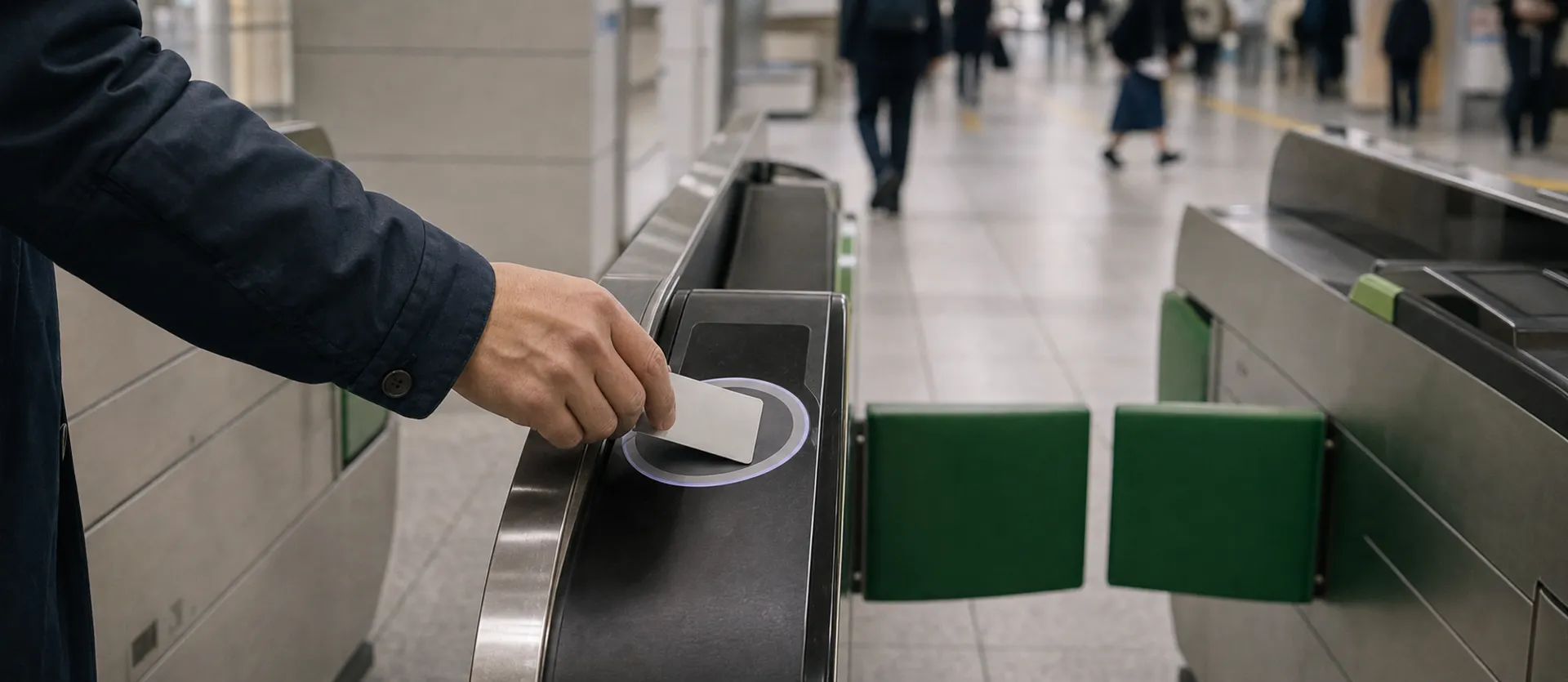
Suica, PASMO, ICOCA, manaca, nimoca, and Hayakaken have been mutually usable across most major rail, bus, convenience-store, and vending-machine systems since the 2013 interoperability expansion.
Physical Suica or PASMO cards are usually bought from ticket machines at major stations with a ¥500 deposit, though anonymous-card sales have changed during supply shortages. Mobile Suica and Apple Pay Suica avoid the physical-card issue when the phone supports them.
Charging can be done at ticket machines, convenience stores, Seven Bank ATMs, and mobile apps. The maximum stored value is ¥20,000. IC fare is often ¥10 to ¥20 cheaper than a paper ticket on short urban rides.
Source: JR East: Suica.
Shinkansen tickets and large luggage
Shinkansen uses a separate ticket structure: a basic fare ticket, 乗車券, plus a limited-express ticket, 特急券. Reserved seats, non-reserved seats, and Green Car seats change the price. On the Tokaido Shinkansen, Nozomi is fastest, Hikari is mid-speed, and Kodama stops at more stations.
Tokyo to Osaka on Nozomi takes about 2 hours 15 minutes. A non-reserved seat is around ¥13,320 in common fare examples, making the city-center-to-city-center trip competitive with flying.
IC cards alone do not solve every Shinkansen trip. Many users buy through Midori-no-madoguchi, reserved-seat ticket machines, or Smart EX / EX App. Luggage with total dimensions over 160 cm needs a seat with oversized-luggage space on Tokaido, Sanyo, and Kyushu Shinkansen routes; failing to reserve can trigger a ¥1,000 fee.
Source: JR Central: EX service, JR Central: Oversized baggage.
Last trains
Last trains shape evening plans. Major urban terminal departures often fall around 23:30 to 00:30, while suburban lines can end around 22:30. Missing the final train leaves taxis, capsule hotels, or waiting for the first train.
Tokyo taxi fares after midnight can easily reach ¥5,000 or more for a medium city-to-residential trip. A 20 km night taxi in a large city can land around ¥4,000 to ¥6,000 or higher depending on time and route.
Yahoo! Transit and NAVITIME both have last-train search. For concerts, fireworks, New Year’s events, and sports crowds, check the last train before arrival because walking time from the venue to the platform can be longer than the app’s ordinary estimate.
Source: Yahoo! Transit.
Common mistakes
Boarding the express train on the same platform can skip the destination. When the app says express, rapid, or limited express, check the stop list or in-car display before boarding.
An IC card with low balance stops at the gate. The stored-value limit is JPY 20,000, so keeping at least JPY 2,000 to 3,000 before longer rail or bus days avoids fare-gate trouble.
Some Shinkansen trips do not work with only a local IC card. Check the base fare ticket, limited-express ticket, EX app route, and oversized-luggage reservation for bags over 160 cm before reaching the station.
Useful terms
- 各駅停車: local train
- 急行: express train
- 特急: limited express train
- チャージ: IC card top-up
- 終電: last train