
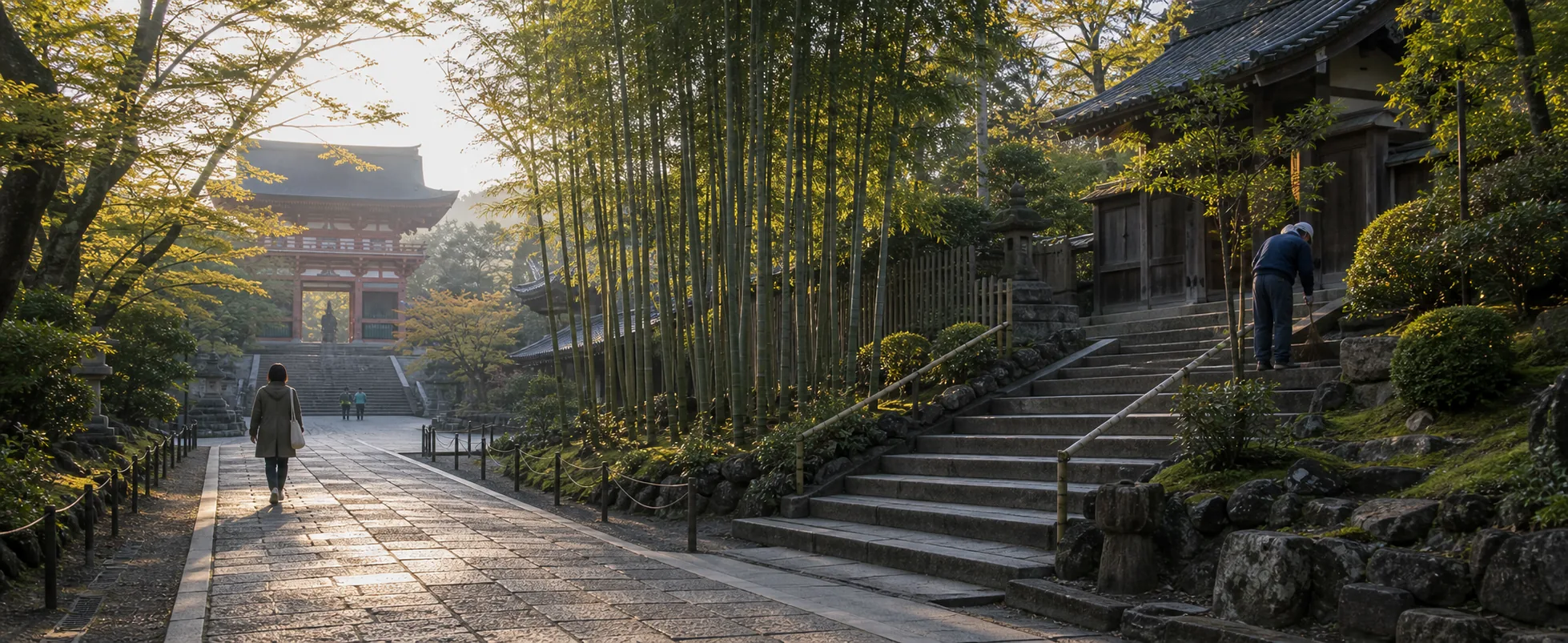
Avoiding Kyoto crowds: timing, route choices, and quieter substitutes
Kyoto received about 53.52 million visitors in 2023. To enjoy Kiyomizu-dera, Fushimi Inari, Arashiyama, and Nishiki, plan by time and route.
ARTICLE MAP Reading Map
Kyoto received about 53.52 million visitors in 2023. Kiyomizu-dera, Fushimi Inari, and the Arashiyama bamboo grove carry the heaviest pressure, and weekend 10:00-15:00 crowds can change both photos and walking speed. In Kyoto, timing is often more important than adding another sight.
Use time shifts first
| Place | Quieter time | Crowded time | Difference |
|---|---|---|---|
| Kiyomizu-dera | 06:00-07:30 | 10:00-15:00 | Very quiet just after opening |
| Fushimi Inari | 06:00-08:00 / after 16:00 | 09:00-14:00 | Upper shrine paths thin out |
| Arashiyama bamboo grove | 07:00-08:30 | 10:00-16:00 | Early photos are easier |
| Kinkaku-ji | 09:00 opening | 11:00-14:00 | First 30 minutes matter |
| Nishiki Market | 10:00 opening | 11:30-14:00 | Less blocked walking |
Fushimi Inari is open 24 hours and has no admission fee. Most visitors turn back around Yotsutsuji after about 30 minutes, so continuing toward the Inariyama summit for about 60 minutes quickly reduces crowds.
Substitute routes
The standard Higashiyama route from Kiyomizu-zaka to Ninen-zaka, Nene-no-michi, and Yasaka Shrine is the most crowded. A quieter alternative is Tofuku-ji, Sennyu-ji, Imakumano Kannon-ji, and Chishaku-in. Admissions are about ¥600, ¥500, and ¥500 for the main paid sites.
For Arashiyama, Daikaku-ji is a strong substitute. Admission is about ¥500, and Osawa Pond is beautiful in autumn with far fewer people. Another option is to take JR one stop to Hanazono and walk Myoshin-ji, a huge Zen temple complex with 46 sub-temples and free grounds.
Season and weekday effects
Kyoto’s main peaks are late March to early April for cherry blossoms, mid-November to early December for autumn leaves, and Golden Week from April 29 to May 5. January-February and the June rainy season are quieter.
Tuesday to Thursday are usually easier than weekends. Crowds start rising on Friday afternoon, and Saturday is the hardest day. Some museums close on Monday, but temples and shrines often remain open, making Monday useful for temple routes.
Transport choices
City bus routes 100 and 101 from Kyoto Station toward Kiyomizu-dera, Gion, Ginkaku-ji, Nijo Castle, and Kinkaku-ji can fill immediately in peak season. Taking the subway to Higashiyama or Keage and walking can beat waiting for 3 buses.
For Arashiyama, JR Sagano Line is often easier than the Hankyu route from Kawaramachi, which gathers tourists. From Saga-Arashiyama Station, entering the bamboo area from the north side is calmer than starting from Togetsukyo Bridge.
Where to stay
Shijo-Kawaramachi is convenient if you want to walk to Gion and Higashiyama at night. Kyoto Station is best for shinkansen and JR trips, but it adds transit for eastern Kyoto. Sakyo Ward, including Demachiyanagi and Kitayama, is quieter and works well for stays of 3 nights or more.
For short stays, choose Shijo-Kawaramachi. For rail-heavy plans, choose Kyoto Station. For a slower daily-life version of Kyoto, choose Sakyo Ward and plan mornings around 06:00 temple openings.