
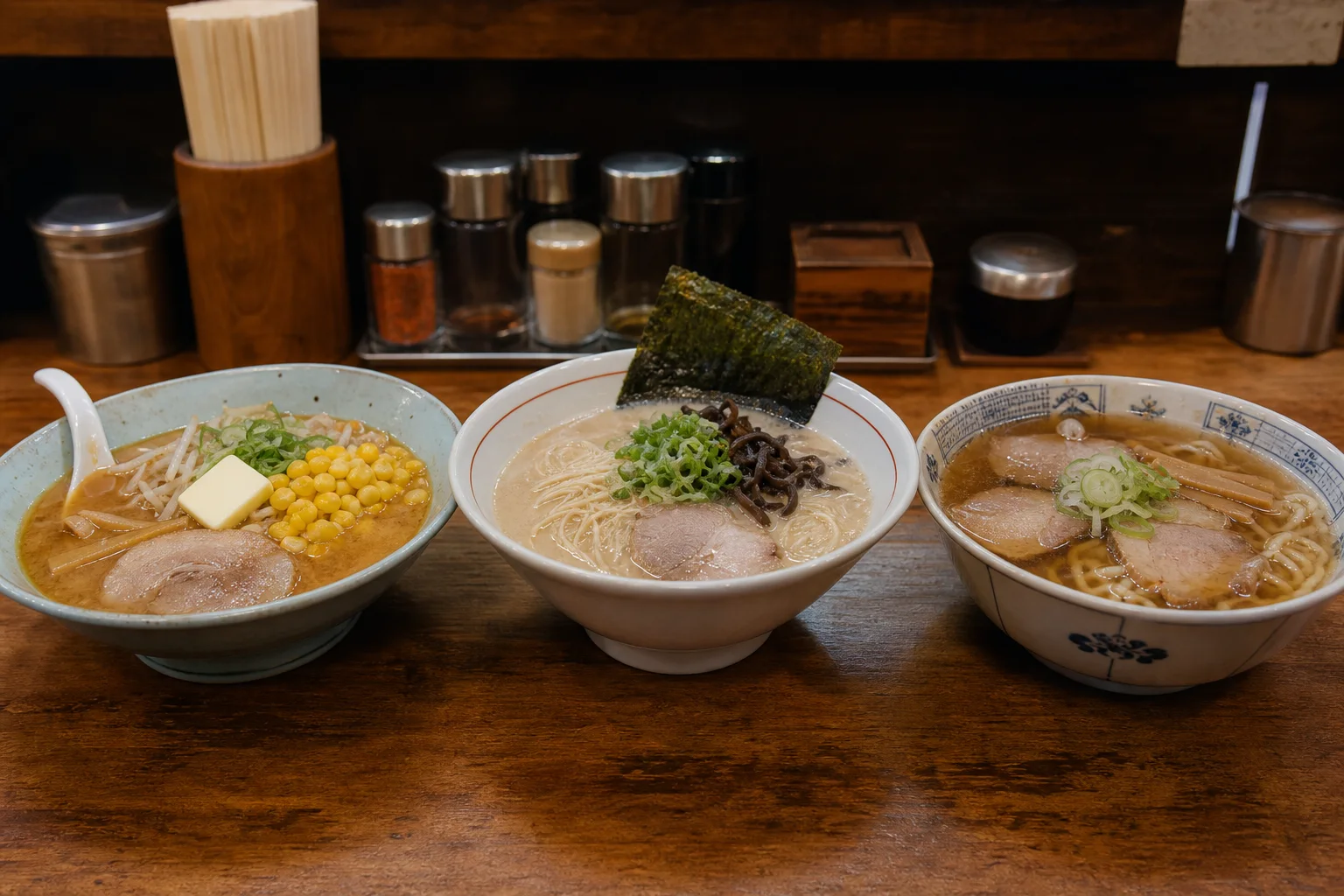
Ramen regions: Sapporo miso, Hakata tonkotsu, and Kitakata shoyu
Compare 3 ramen styles by broth, noodles, toppings, ordering rules, and local shop rhythm.
ARTICLE MAP Reading Map
Japan has hundreds of local ramen styles, but 3 bowls give a useful map: Sapporo miso, Hakata tonkotsu, and Kitakata shoyu. Read them through soup, noodle thickness, toppings, price, and the way the counter moves.
Sapporo miso
The Sapporo miso style is usually traced to Aji no Sanpei in 1955. The bowl uses miso tare with pork or chicken bones, stir-fried vegetables, and enough oil to keep the surface hot in a Hokkaido winter that can fall below -15 C.
Medium-thick curly noodles hold the heavy soup. Common toppings are chashu, bean sprouts, corn, butter, and negi; “corn butter miso” is a standard Sapporo order, not a novelty topping. Expect about ¥900 to ¥1,200 in central Sapporo, and closer to ¥1,000 to ¥1,400 at Hokkaido-style shops in Tokyo.
Susukino has more than 20 ramen shops around the ramen alley area. Some stay open late for drinking crowds, but lunch and dinner queues still move quickly because counter seats turn over in about 15 to 25 minutes.
Hakata tonkotsu
Hakata ramen starts with pork bones boiled until the soup turns pale and sticky. The noodle is ultra-thin and straight, often around a 26 to 28 ban cut, so the shop asks about firmness: “kata” is firm, and “barikata” is very firm.
The second bowl of noodles is called kaedama and usually costs ¥150 to ¥200. Order it while about 1/3 of the soup remains, then adjust the bowl with beni shoga, karashi takana, sesame, or extra tare. Do not add everything at the start; the soup balance changes fast.
Around JR Hakata and Tenjin, names travelers see often include Ippudo, Ichiran, Daruma, Ikkosha, and ShinShin. Ichiran’s booth system is unusual, but the written order sheet is useful for first-time visitors because firmness, garlic, spice, and richness are separated line by line.
Kitakata shoyu
Kitakata in Fukushima is known for clear shoyu soup made with pork bones, niboshi, and chicken bones. The noodles are flat, wide, high-hydration, and often close to 40 percent water before maturing, so the texture is soft but springy rather than thin and sharp.
A basic bowl usually has chashu, menma, negi, and naruto. Prices around town often sit near ¥700 to ¥1,000, and morning ramen is normal at shops that open between 7:00 and 10:00.
Bannai, Makoto, and Genraiken are useful names for orientation, but the bigger point is the 7:30 breakfast rhythm. Kitakata ramen is not built around late-night drinking in the same way as Hakata or Sapporo counter culture.
Other regional bowls
Tokyo shoyu ramen is the classic clear soy-sauce bowl, while Yokohama ie-kei is usually dated to 1974 and uses pork-bone soy soup, thick noodles, spinach, and seaweed. Wakayama, Onomichi, Tokushima, and Jiro-kei each change the balance of soy, fat, garlic, pork, and noodle weight.
For a first trip, choose 2 or 3 styles and compare one variable at a time over a 20-minute counter meal. Soup base, noodle cut, tare, and topping culture tell you more than a shop ranking on a map app.
Ticket machines and ordering
Many ramen shops use a ticket machine near the entrance. Buy 1 ticket first, hand it to staff, then answer any questions about noodle firmness, oil, or flavor strength. If you do not know what to choose, “futsu de onegai shimasu” means normal.
Common mistakes are sitting before buying a ticket, assuming kaedama is free when it may cost ¥150 or more, dumping karashi takana or beni shoga into the bowl before tasting, and ordering barikata because it sounds expert. Barikata is close to raw in texture; it is not the default for everyone.
Useful terms
- miso tare
- tonkotsu
- kaedama
- kata
- barikata
- morning ramen