
Shrine Visit: Torii / Temizu / Two Bows-Two Claps-One Bow / Goshuin Step by Step
Bow at the torii, walk to the side of the path, temizu left-right-mouth, offering ¥5-100, two bows-two claps-one bow (Izumo Taisha uses four claps), goshuin ¥300-500. Meiji / Fushimi Inari / Izumo / Ise differences, shrine vs temple differences, taboos and photo boundaries.
ARTICLE MAP Reading Map
The sequence of visiting a Japanese shrine is essentially uniform nationwide: pause at the torii, walk to the side of the approach path, purify at the temizuya, queue before the haiden, throw the offering, ring the bell gently if accessible, then two bows, two claps, one bow. This flow is documented in Jinja Honcho’s (Jinja Honcho) official guides and repeated on the on-site information boards of Meiji Shrine and Ise Shrine. This article splits it into “torii → temizu → haiden → goshuin → great shrine exceptions → temple differences,” with concrete actions and typical examples.
1. Torii: entrance to the sacred precinct + walk on the side
The torii (鳥居) is the boundary between the secular and sacred. Bow lightly before entering (about 15 degrees; no need for a deep bow). Bow again on exit; this is called “ichihai.” It’s the minimum action priests perform every day on entering and leaving.
After passing through, walk on the sides of the approach rather than down the center. The center is “seichu” (正中), the path of the deities. This explanation appears in Shinto Ceremonial Procedures (formalized by Jinja Honcho in Showa 23/1948), and is repeated on the precinct boards of Meiji Shrine, Ise Shrine, and Izumo Taisha. When crowd flow is heavy, follow on-site guidance — forcing yourself to the side and blocking those behind is more rude. Adapt flexibly.
The number and form of torii also matter: Fushimi Inari Taisha’s “Senbon Torii” (in reality ~10,000) is the representative landscape of Inari belief. The red is vermilion lacquer; the raw material is mercury sulfide, traditionally used for preservation and ward against evil. Meiji Shrine’s “Otorii” (1920s style, cypress, 12 m) is one of Japan’s largest wooden Myojin-style torii. Ise Shrine’s torii are renewed every 20 years together with the main shrines (Shikinen Sengu system). Old torii’s timber is distributed to other shrines nationwide for reuse.
Sources: Jinja Honcho: Worship Procedures, Fushimi Inari Taisha Official, Meiji Shrine Official.
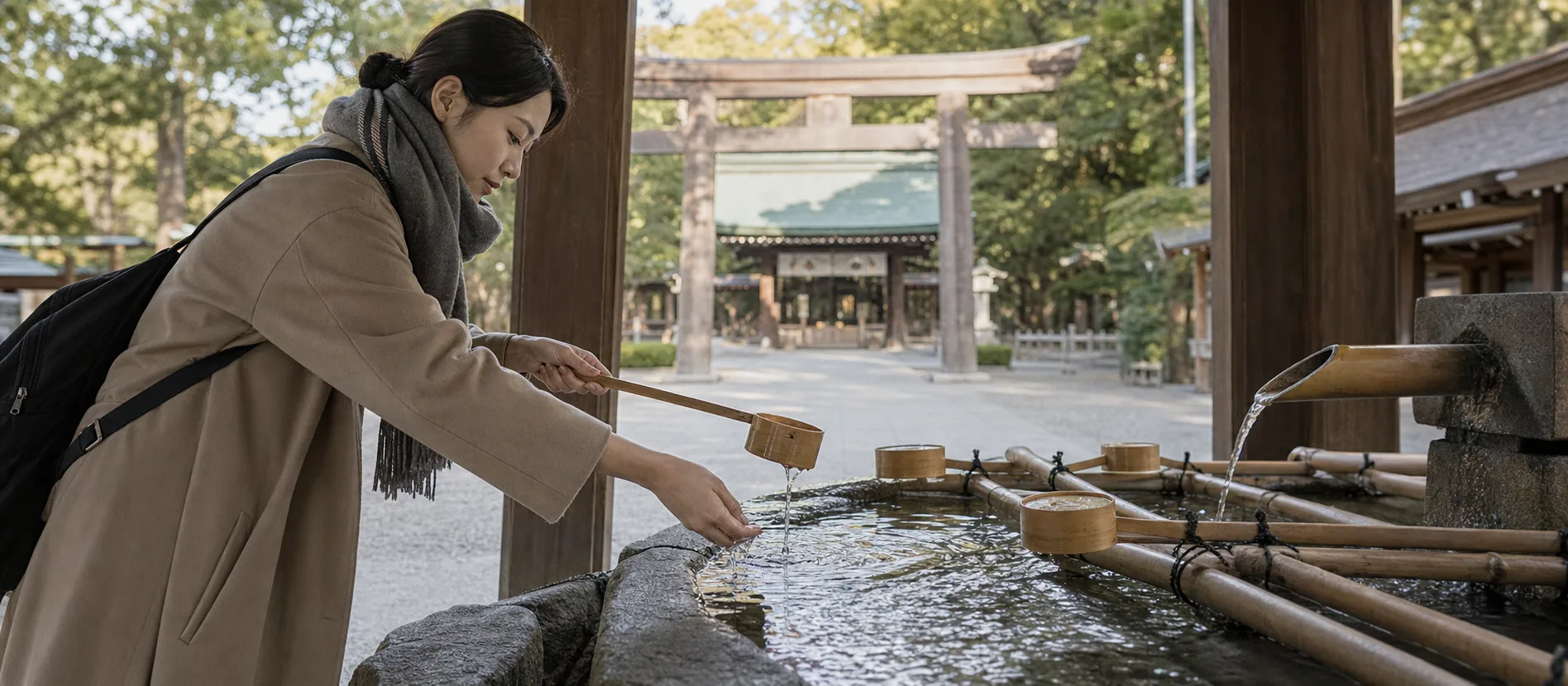
2. Temizuya: left hand → right hand → mouth → handle
The standard temizuya (手水舎) action is 4 steps: hold the ladle in your right hand and scoop water (about 8/10 full); wash the left hand (water flows to the ground, not back to the basin); switch the ladle to the left hand and wash the right; pour water onto your left palm and lightly touch your mouth (don’t sip; symbolically); stand the ladle upright so remaining water flows down the handle (sterilizing the handle). One scoop covers the entire sequence; don’t refill.
Major changes since COVID: many shrines removed ladles, switching to flowing water or mist sprays. In these cases follow on-site instructions: flowing water skips the mouth step (just hands); mist sprays activate automatically. Meiji Shrine, Ise Shrine, Atsuta Shrine, and Izumo Taisha all switched to flowing water; Kyoto’s Fushimi Inari and Yasaka Shrine keep ladles.
Why this action: Shinto places “seijo” (cleanliness, 清浄) at the highest priority. The temizuya is a simplified “misogi” (purification, 禊), aimed at removing “kegare” (impurity, 穢れ) before entering the haiden. It’s not a performance, so doing it quickly, quietly, and without splashing matters more than perfectly memorizing every step.
Sources: Jinja Honcho: Temizu Procedure, Meiji Shrine: Temizu Procedure.
3. Haiden: offering + bell + two bows-two claps-one bow
The queue at the haiden (拝殿) is the core action. The offering (saisen, 賽銭) has no fixed amount; common are ¥5 (the pun “go-en” / “good fortune” + “five yen”), ¥10, ¥50 (“five yen layered”), ¥100. ¥10 is sometimes avoided as a homophone for “fortune going away”, but officials clarify the amount doesn’t affect divine response — intent is what matters. Ise Shrine’s Naiku officially states “the offering can be decided by heart.”
Bell rope (suzuo, 鈴緒): If reachable, shake gently once (don’t yank); the sound is to notify the deity. When there’s no bell or queues are long, skip it.
Two bows-two claps-one bow (二礼二拍手一礼): First two deep bows (~90 degrees, no clasped hands, hands on thighs); then two claps (raise both hands to chest level, right hand slightly lower, produce a crisp sound, hands together to pray); finally one deep bow to close. The full sequence takes 15-20 seconds.
What to pray: The current Jinja Honcho standard is “name + address + wish.” For example: “From Shinjuku Ward, Tokyo, [name] bowing in gratitude, asking for safety of the household.” There’s no required length; 5 seconds short or 30 seconds long are both fine.
Sources: Jinja Honcho: Worship Procedures, Ise Shrine: Worship Procedures.
4. Goshuin / omamori / ema: rules at the juyo-jo
Goshuin (御朱印) is proof of a visit, not a memento stamp. Originally it was the “nokyo-in” (sutra-copying seal) given after copying scripture; in the late Edo period it was opened to general worshippers. The honoraria (hatsuho-ryo, 初穂料) is typically ¥300-500; special goshuin (limited periods, seasonal patterns, sets with a goshuin book) run ¥500-2,000. Worship first, then go to the window is the basic procedure.
The actual flow: after worship, go to the shrine office or juyo-jo, open your goshuin book to the page to be written, pay the fee, wait 3-5 minutes. During busy times “kakioki” is provided (paper format, pasted into the book later). This isn’t a downgrade; it manages queues and protects the writing tempo. Popular shrines like Meiji, Fushimi Inari, and Dazaifu Tenmangu are almost all kakioki at busy times.
Omamori (御守): Receive at the juyo-jo, ¥500-1,500. Themes include traffic safety, academic success, health, en-musubi (relationships), safe birth, business prosperity. Recommended return after 1 year (return to the original shrine, place in the “kofuda-nojo”). Never throw it away: Shinto sees the omamori as an emanation of the deity; discarding is disrespectful.
Ema (絵馬): Write your wish on the wooden tablet and hang on the designated rack. Don’t look at others’ ema or take photos clearly showing others’ names or wishes (privacy violation).
Goshuin books are first bought at a shrine (¥1,500-3,000; each shrine has limited designs). Shrine and temple goshuin books are increasingly being separated lately; mixing them in one book may cause some temples to refuse to write.
Sources: Jinja Honcho: About Goshuin, Dazaifu Tenmangu: Goshuin.
5. Great shrine exceptions: Izumo / Usa / Yahiko
A few major shrines use different clap counts. Izumo Taisha (Shimane) and Usa Shrine (Oita) use two bows-four claps-one bow — four claps instead of two. Yahiko Shrine (Niigata) also uses two bows-four claps-one bow. This tradition dates from the medieval period.
Ise Shrine has the old custom of “shihei kindan” (no private offerings): personal prayer is prohibited at the main shrines of the inner and outer shrines (personal wishes go to the auxiliary shrines instead). The main shrines are only for “gratitude visits”; personal wishes go to auxiliary shrines (Aramatsuri-no-miya, Tsukiyomi-no-miya, etc.). Special worship (shoden-sampai) requires advance application, tamagushi-ryo from ¥10,000, formal dress.
Meiji Shrine has more than 3 million visitors during the first three days of New Year — the most in Japan. Hatsumode flow is controlled by time slot; at Meiji Shrine, between late evening 22:00 on New Year’s Eve and 17:00 on January 1, one-way traffic is enforced from Harajuku Station to Yoyogi Station along a fixed line.
Fushimi Inari Taisha’s climb past the Okusha Worship Hall to the Inari Mountain summit is about 2 hours on foot; avoid dusk and thunderstorm seasons. The “Omokaru-ishi” (heavy/light stone) just before the Oku-no-miya is a divination on wish realization, judged by the perceived weight of the left vs right stone (feels light → wish will come true).
Sources: Izumo Taisha Official, Ise Shrine: Worship Heart, Meiji Shrine: Hatsumode.
6. Temple differences and common mistakes
Temples (tera) and shrines have completely different actions. At Buddhist temples like Sensoji, Kiyomizu-dera, Todaiji, and Kinkakuji, palms together for worship; no clapping. At the incense burner, palms together, fan smoke onto your head and body (health and warding off evil), then worship; at the main hall, offering → palms together → one bow. Temples have no torii; instead a sanmon / mountain gate marks the boundary.
Common mistakes:
Applying shrine worship to temples. Temples don’t clap; clapping at Sensoji, Kiyomizu-dera, or Todaiji is disrespectful. Shrines use two bows-two claps-one bow; temples use palms together-one bow.
Forcing yourself to the side of the path in crowded times. When crowd flow is heavy, follow on-site guidance; forcing yourself to the side and blocking those behind is more rude. Meiji Shrine New Year and Fushimi Inari’s Senbon Torii constantly run this way; priest guidance takes priority.
Treating goshuin as a “tourist stamp.” Worship first, then the window is the basic procedure, not “I see goshuin ¥300, let me queue.” Busy times are all kakioki; don’t demand on-the-spot writing. Don’t knock on the door after the window’s reception time ends.
Avoiding ¥10 offerings because of the “fortune going away” pun. Officials state “the amount is decided by heart”; caring about amount matters less than performing the two bows-two claps-one bow seriously.
Sipping water at the temizuya. Touch your mouth lightly, symbolically; sipping or spitting back into the basin is disrespectful. After COVID, flowing water has become common — follow on-site signs.
Looking at others’ ema or photographing their names. Privacy violation + Shinto etiquette violation, both. Photograph only your own ema or publicly displayed ema.
Continuing when staff say “this is as far as you go” or “please refrain from photography.” Stop immediately: priestly boundary judgment takes priority over individual photo wishes.
Japanese key terms
- 鳥居 (torii, shrine entrance)
- 手水舎 (temizuya / chozuya, purification basin)
- 拝殿 (haiden) / 賽銭 (saisen)
- 二礼二拍手一礼 (two bows-two claps-one bow)
- 御朱印 (goshuin) / 御守 (omamori)
- 正中 (seichu, the center of the approach path)