
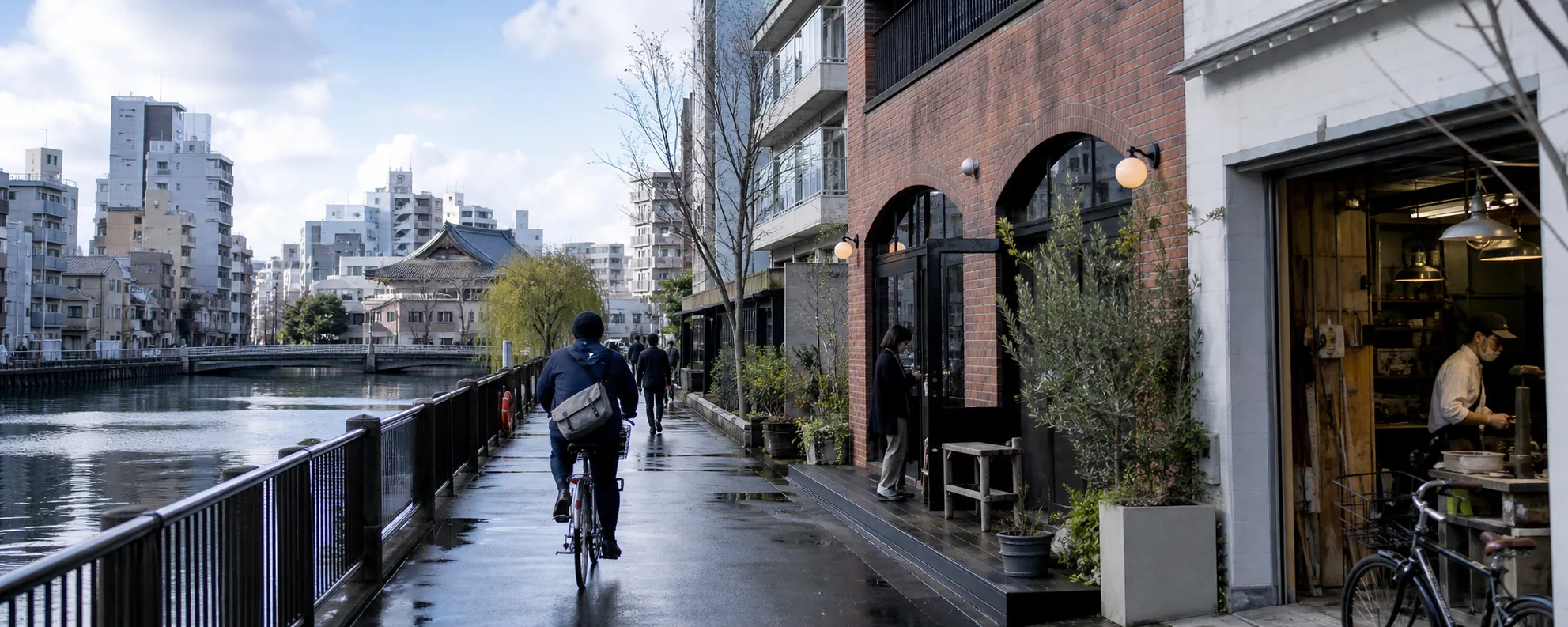
East Tokyo: Asakusa / Kuramae / Kiyosumi-Shirakawa / Kinshicho: How to Live
Seven East Tokyo districts on the east bank of the Sumida River: 1LDK ¥110,000-160,000, Tozai Line congestion 199%, coffee and workshop density, nighttime quiet ratings, and where flood-risk maps say to avoid.
ARTICLE MAP Reading Map
East Tokyo is built around the Sumida (隅田) and Arakawa (荒川) rivers and the canals between them. Seven districts, Asakusa (浅草), Kuramae (蔵前), Kiyosumi-Shirakawa (清澄白河), Monzen-Nakacho (門前仲町), Ryogoku (両国), Kinshicho (錦糸町), and Kita-Senju (北千住), share Edo-era shitamachi survivals, rents 30-40% lower than inside Yamanote, and easy walks to the riverside. They differ in which line reaches which CBD, supermarket tier, nighttime quiet, and flood risk. Each section below gives 1LDK rent, best-fit workplace, and a safety note.
1. Asakusa / Tawaramachi / Iriya: residences behind the tourist area
Senso-ji, Nakamise-dori, Kaminarimon, and the Sumida riverbank fill the daytime Asakusa. Residents actually live in Iriya (入谷), Tawaramachi (田原町), and Inaricho (稲荷町), two alleys behind the main street. 1K is ¥85,000-115,000 and 1LDK is ¥130,000-160,000, 35% cheaper than inside Yamanote.
Transit: Toei Asakusa Line (to Shimbashi, Shinagawa, Oshiage direction), Tokyo Metro Ginza Line (to Ueno, Shimbashi, Shibuya), Tsukuba Express (Akihabara in 3 min, Kita-Senju in 7). Haneda Airport via Asakusa Line direct in about 45 min for ¥720. The sightseeing buses around Kaminarimon are easy to confuse with Toei city buses; residents need to remember that the Toei “Ueno 26” and “Toh 08” buses actually board from the side of Matsuya Asakusa, not from Kaminarimon.
Living costs are low: OK Store Asakusa, Gyomu Super Iriya, multiple Maibasket branches. Clinics open Saturday are common (a side effect of the tourist density). Weekend Senso-ji surroundings are nearly impassable; Inaricho and Tawaramachi avoid this. The Sumidagawa Fireworks Festival (last Saturday of July) closes nearby subway stations for crowd control; windows facing the firework side can watch for an hour.
Sources: Taito Ward: Tourism Statistics, Sumidagawa Fireworks Official.
2. Kuramae / Asakusabashi: workshops and wholesale
Kuramae (蔵前) and Asakusabashi (浅草橋) sit between Asakusa to the north and Akihabara to the south. 1K is ¥90,000-120,000, 1LDK ¥140,000-180,000. The character of this stretch is leather, stationery, toys, washi wholesale streets, joined recently by independent coffee shops and renovated workshops (Nakagawa Masashichi Shoten, Kakimori fountain pens, Coffee Wrights are all within 800 m). Residents tend to be designers, advertising, and publishing professionals.
Transit: Toei Asakusa Line (Kuramae Station), Toei Oedo Line (Kuramae Station, but the same-named transfer is 350 m apart, not a same-gate transfer), JR Chuo-Sobu local (Asakusabashi). First-time visitors often assume the two Kuramae stations are connected; they are not. Tokyo Station in 12 min, Shinjuku 23 min, Shibuya 25 min.
Living density is low but selective: supermarkets are Maibasket and Niku no Hanamasa, no cheap OK Store. Most workshops and coffee shops are closed Sundays; for groceries go toward Asakusa or Akihabara. Nighttime is quiet; Asakusabashi Station has almost no tourists after 9 PM.
Sources: Taito & Sumida Ward: Wholesale Street Map, Toei Subway: Station Layout.
3. Kiyosumi-Shirakawa / Monzen-Nakacho / Kiba: warehouse-renovation district
Kiyosumi-Shirakawa (清澄白河) became the “East Tokyo SCAA coffee mecca” after Blue Bottle Coffee opened its first Japan store in 2015. Kiba (木場), Fukagawa (深川), and Monzen-Nakacho (門前仲町) lie between the Sumida and Onagigawa canals. 1K is ¥95,000-125,000, 1LDK is ¥150,000-200,000.
Transit: Tokyo Metro Hanzomon Line (Kiyosumi-Shirakawa to Otemachi in 7 min, Shibuya in 15 min), Tozai Line (Monzen-Nakacho, Kiba to Otemachi in 5 min, Nihonbashi in 3 min), Toei Oedo Line (Monzen-Nakacho to Tochomae in 17 min). The Tozai Line peak section (Kiba → Kayabacho) averaged 199% congestion (MLIT 2023 data) with 2-2.5 minute headways; for a seated trip, walk to Kiyosumi-Shirakawa for the Hanzomon Line instead.
Cultural density: Museum of Contemporary Art Tokyo (MOT, special exhibits ¥1,300-2,000) faces Kiyosumi Garden. Tomioka Hachimangu, Fukagawa Fudo-do, and Kiyosumi Garden are all walkable. Weekend lines at Blue Bottle, Allpress Espresso, and ARiSE Coffee run 30-60 minutes; weekday visits are most comfortable for residents. Supermarkets are Maruetsu Petit, Life Kiba, Bunkado.
Sources: MLIT: Tokyo Area Congestion 2023, Museum of Contemporary Art Tokyo.
4. Ryogoku / Kinshicho: JR Sobu + major commercial
Ryogoku (両国) is where sumo, JR Sobu Line (toward Tokyo Station and Shinjuku), and Toei Oedo Line meet. Kinshicho (錦糸町) is a major east-side hub at the intersection of JR Sobu Line rapid/local and Tokyo Metro Hanzomon Line. 1LDK: Ryogoku ¥140,000-180,000, Kinshicho ¥130,000-170,000.
Kinshicho has two faces. The north exit is offices, Arcakit (electronics + miscellaneous goods building) and Parco, with daytime salaryman traffic. The south exit retains 1990s nightlife district remnants: Philippine pubs and girls’ bars still operate at 1-3 AM. Window direction matters: a north-exit residential street is relatively quiet; south-exit main road windows are lit all night by karaoke signs.
Commute: JR Sobu Rapid (Tokyo Station 8 min, Shinagawa 19 min), Hanzomon Line (Otemachi 11 min, Shibuya 22 min), Toei Oedo via Ryogoku (Tochomae 25 min). Kinshicho → Shinjuku has two equivalent routes (via Hanzomon then Chuo, or via Sobu Rapid to Tokyo then Chuo); both about 24 min.
Sources: Sumida Ward: Ryogoku-Kinshicho District Planning, JR East: Sobu Rapid Line.
5. Kita-Senju: 6 lines converging, cheapest rent
Kita-Senju (北千住) is in Adachi Ward, where 6 lines converge (JR Joban, Tokyo Metro Chiyoda, Hibiya, Tobu Skytree Line, Tsukuba Express, Keisei Main). 1K is ¥75,000-95,000, 1LDK ¥110,000-140,000, the cheapest among 23-ku stations with 6 converging lines.
Tokyo University of the Arts Senju campus and Tokyo Denki University Senju campus moved in 2012-2018, along with Lumine Kita-Senju, Marui, and Senju Millidis. Tobu Skytree Line through-runs onto Hibiya Line to Ginza and Kasumigaseki in 28 min; JR Joban Rapid to Tokyo in 23 min, Shinagawa 35 min.
Caution: the south end of Kita-Senju (Senju Miyamotocho, Senju Kotobukicho direction) is in the 4-5 m flood-risk zone (Arakawa + Edogawa assumption); check Adachi Ward Hazard Map before signing. Kita-Senju Station’s north and west exits stay busy past 11 PM, and the west exit’s 24-hour supermarkets (Gyomu Super, Daiei) help with late-night returns.
Sources: Adachi Ward: Flood Hazard Map, MLIT: Tokyo Area 6-Line Junction Ranking.
6. Flood risk and common mistakes
East Tokyo has wide areas below sea level (south Koto Ward, Edogawa Ward, east Sumida Ward, Katsushika Ward, south Adachi Ward). Edogawa Ward’s worst-case flood assumption inundates 70% of the ward, with maximum depth over 10 m (Edogawa Hazard Map 2018). Three categories: avoid central/south Edogawa Ward (Koiwa, Funabori, part of Kasai), east Katsushika Ward (Kanamachi, Shin-Koiwa), south Adachi Ward (part of Senju); the same-ward high ground includes Ueno, Asakusa, Kuramae, Ryogoku, Oshiage (elevation 5-15 m, Edo-era inhabited terraces with assumed depth under 0.5 m); waterfront towers (Toyosu, Higashi-Shinonome, Ariake, Daiba) are earthquake-resistant but power outage scenarios (elevator failure, water cutoff, supply chain disruption) need separate review. Always check: Google “[ward name] hazard map” and input the actual address. Anything above 1 m needs separate insurance and evacuation planning; the fire insurance water-damage rider adds ¥3,000-8,000/year.
Sources: Adachi Ward: Flood Hazard Map, Edogawa Ward: Flood Hazard Map, MLIT: Layered Hazard Map.
The common mistakes across the 7 areas:
Treating “East Tokyo = cheap” as one budget. Kita-Senju 1LDK ¥140,000 vs Kiyosumi-Shirakawa 1LDK ¥200,000 is a 40% gap. Cheap means higher congestion (Tozai 199%), higher flood risk, and more complex nighttime routes.
Thinking Kuramae’s two gates are the same station. Toei Asakusa Line Kuramae and Toei Oedo Line Kuramae are 350 m apart on the surface. From the Asakusa Line, walk 5-6 minutes (with umbrella in rain) to reach the Oedo Line gate. First-timers should check the station map.
Ignoring Kinshicho’s north-south split when renting. The south-exit main road has nightlife operating 1-3 AM; south-facing windows get lit all night. Walk the street at 1 AM Friday before signing.
Reading only the SUUMO rent, not the flood map. Many of the cheap properties in south Edogawa and south Koto are cheap because the flood assumption exceeds 5 m. The fire-insurance water-damage rider runs ¥3,000-8,000/year; total cost matters.
Trying to take the Tozai Line at peak from Kiba to Otemachi. Kiba → Kayabacho congestion 199%, 2-minute headways; you can’t move from the platform line. Residents of Kiyosumi-Shirakawa use Hanzomon (Kiyosumi-Shirakawa → Otemachi 7 min) instead.
Japanese key terms
- 下町 (shitamachi, old town)
- 隅田川・荒川 (Sumidagawa, Arakawa)
- 混雑率 (konzatsu-ritsu, rail congestion ratio)
- 洪水ハザードマップ (kouzui hazard map, flood hazard map)
- 水災特約 (suisai-tokuyaku, flood-damage insurance rider)