Japanese history eras: key turns from Asuka to Reiwa
Follow Asuka, Nara, Heian, Kamakura, Muromachi, Azuchi-Momoyama, Edo, Meiji, Taisho, Showa, Heisei, and Reiwa through institutions and places still visible today.
ARTICLE MAP Reading Map
Japanese history is usually read by era. The useful question is not only who ruled, but what changed: state law, capital cities, warrior government, religious institutions, urban markets, war, occupation, or daily life.
Ancient court states
The Asuka period, roughly 592 to 710, is tied to the rise of the Soga clan, Prince Shotoku, missions to Sui China in 607, and the Taika Reform of 645. Horyuji, founded in 607, is one of the most important surviving wooden Buddhist complexes.
The Nara period ran from 710 to 794 with the capital at Heijo-kyo, now Nara. Todaiji’s Great Buddha was consecrated in 752, and the Manyoshu poetry collection took shape in this early state-and-Buddhism setting.
The Heian period began when Emperor Kanmu moved the capital to Heian-kyo in 794. After the missions to Tang China ended in 894, kana writing and court literature developed strongly; The Tale of Genji and The Pillow Book belong to this world.
Warriors and medieval culture
The Kamakura period began after the Genpei War, and Minamoto no Yoritomo established the first warrior government in Kamakura. The usual school date is 1192, though historians also discuss 1185 as the practical start of shogunal rule.
Zen Buddhism, samurai politics, and temple networks shaped Kamakura. Kotokuin’s Great Buddha dates to 1252, while Kenchoji and Engakuji show the link between Zen institutions and warrior authority.
The Muromachi period, from 1336 to 1573, put the Ashikaga shogunate back in Kyoto. Kinkakuji, built for Ashikaga Yoshimitsu in 1397, and Ginkakuji, linked to Ashikaga Yoshimasa in 1482, show how warrior power and court taste mixed.
Azuchi-Momoyama, from 1573 to 1603, is short but intense. Oda Nobunaga, Toyotomi Hideyoshi, firearms from Tanegashima in 1543, Christianity from Francis Xavier in 1549, Sen no Rikyu’s tea practice, and castle architecture all belong here.
Edo urban society
Tokugawa Ieyasu opened the Edo shogunate in 1603, beginning more than 260 years of Tokugawa rule. The closed-country system from 1639 did not mean total isolation; trade continued through Nagasaki, Tsushima, Satsuma, and Ryukyu channels.
By the 1700s, Edo had about 1 million people and became one of the world’s largest cities. Kabuki, ukiyo-e, haiku, sushi, tempura, soba, and pleasure districts grew in the townspeople’s culture.
Today, Edo traces are still legible around the Imperial Palace, Nihonbashi, Ueno, Asakusa, and Ryogoku. Hokusai’s Thirty-six Views of Mount Fuji from 1830 to 1834 and Hiroshige’s Tokaido series still shape how many people picture Japan.
Modern and contemporary turns
The Meiji period began in 1868. The 1889 Constitution, the 1890 Diet, the 1872 Shinbashi-Yokohama railway, Ginza brick streets, and the 1875 surname order show how state, transport, law, and everyday identity changed together.
Taisho lasted only from 1912 to 1926, but it brought party politics, the 1925 male suffrage law, cafe culture, modern girls, and the destruction and rebuilding after the 1923 Great Kanto Earthquake.
Showa divides into very different worlds. The prewar years include the 1931 Manchurian Incident, the 1937 war in China, the Pacific War from 1941, Hiroshima on August 6, 1945, Nagasaki on August 9, and the surrender broadcast on August 15.
Postwar Showa includes the Allied occupation from 1945 to 1952, the 1947 Constitution, land reform, women’s suffrage, the 1964 Tokyo Olympics, the 1970 Osaka Expo, high growth from 1955 to 1973, and the 1980s asset bubble.
Heisei began in 1989 and is tied to the bubble collapse, the 1995 Hanshin-Awaji earthquake, the 1995 subway sarin attack, the 2011 Tohoku earthquake, smartphones, and population aging. Reiwa began on May 1, 2019, and has already included COVID-19, the 2021 Tokyo Olympics, yen weakness, the Digital Agency, and immigration-law changes.
Places to connect eras
Asuka and Nara are easiest to read in Horyuji, Asuka village, Todaiji, Kofukuji, Yakushiji, and Nara National Museum. Heian points toward Kyoto Imperial Palace, Byodoin in Uji, and court literature sites.
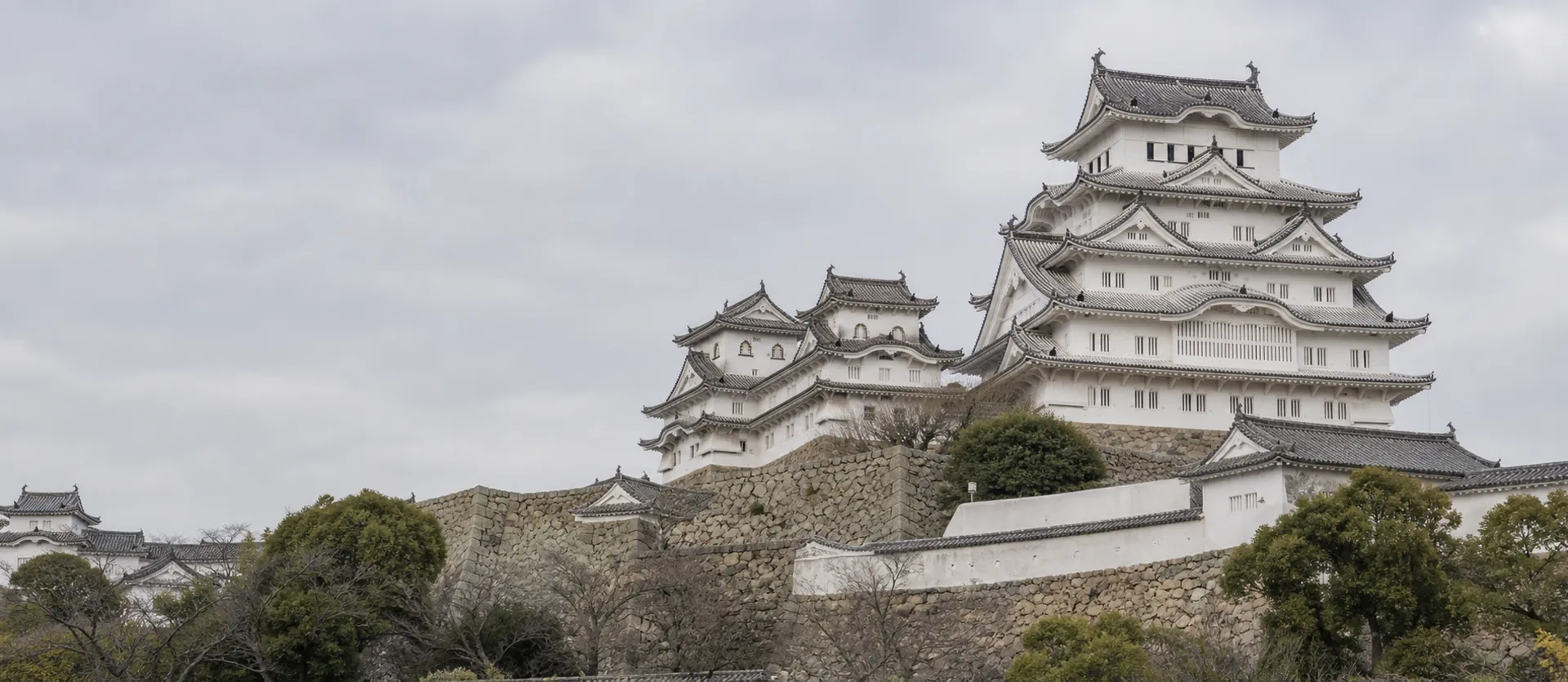
Kamakura is visible at Kotokuin, Kenchoji, and Engakuji. Muromachi appears at Kinkakuji, Ginkakuji, and Ryoanji. Azuchi-Momoyama survives through Himeji Castle, Azuchi Castle ruins, Osaka Castle’s later reconstruction, and tea rooms.
Modern Japan can be read in Ginza, Yokohama’s port buildings, Meiji Mura in Aichi, Tokyo Station Marunouchi, Tokyo Tower from 1958, the 1964 Shinkansen, Taro Okamoto’s Tower of the Sun from Expo 1970, Tokyo Skytree from 2012, and the 2019 National Stadium.
Common mistakes
Do not confuse Nara and Heian. Todaiji is Nara; Byodoin Phoenix Hall is Heian. Both are Buddhist, but the capital, politics, and court culture differ.
Do not treat “Showa” as one mood. The 64 years from 1926 to 1989 include war, occupation, high growth, mass housing, consumer electronics, and the bubble economy.
Do not define sakoku as total closure. Edo Japan restricted foreign contact tightly, but it still managed trade and diplomacy through specific ports and domains.
Useful terms
- Taika Reform
- kokufu culture
- warrior government
- sakoku
- civilization and enlightenment