
Japanese Ingredients and Drinks: Reading Flavor by Region
Rice varieties, kombu and katsuobushi dashi, miso types, sake grades, shochu, beer, wine, and common ordering mistakes.
ARTICLE MAP Reading Map
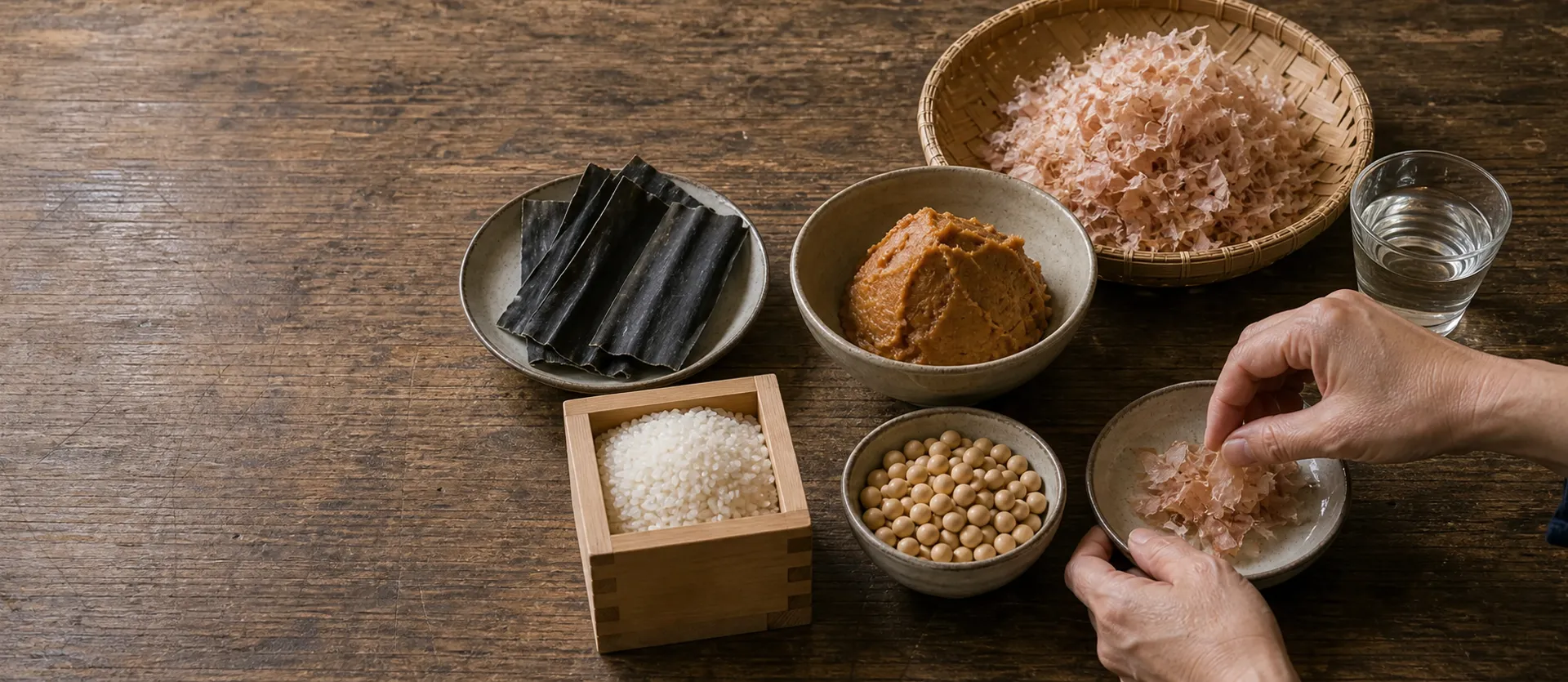
Traditional Japanese flavor often comes from ingredients, fermentation, and water rather than complicated cooking. Rice, dashi, miso, soy sauce, sake, and shochu decide much of the meal’s base note. Reading the menu becomes easier when the region and process are visible.
Rice varieties
Koshihikari is the dominant Japanese rice variety and accounts for roughly one-third of national production. Uonuma Koshihikari from Niigata is a prestige example, often around ¥4,500 to ¥6,500 for 5 kg. It is sweet, sticky, and strong both hot and cold.
Akitakomachi from Akita and Iwate is lighter, less sticky, and often useful where the rice should not overpower fish. Sasanishiki from Miyagi is low-stickiness and clean in flavor, which is why sushi shops value it. Yumepirika from Hokkaido has become popular in the last decade for sweetness and value around ¥3,500 to ¥4,500 per 5 kg.
At supermarkets, 5 kg bags can range from about ¥2,800 to ¥6,500. Check 精米年月日, the milling date. Rice milled within 1 month is better. 無洗米 saves washing time but usually has a slightly weaker texture.
Source: MAFF: Rice information.
Dashi as the base flavor
Kombu dashi uses kelp from Hokkaido areas such as Rishiri, Rausu, and Hidaka. It is soaked and warmed around 60 to 80 C to draw out glutamate, a clean plant-based umami used in temple food and yudofu.
Katsuobushi dashi uses dried bonito flakes. The flakes go into hot water around 80 to 95 C for a short extraction, often about 30 seconds for first dashi, and bring inosinate and aroma. It is common in clear soup and chawanmushi.
Awase dashi combines kombu and katsuobushi. Glutamate and inosinate amplify each other, which is why the combination supports high-end simmered dishes, soups, and steamed egg custard. Instant dashi such as Hondashi is useful at home, but it tastes different from a fresh extraction.
Source: MAFF: Dashi culture.
Miso regions and styles
Rice miso is the mainstream and accounts for about 80 percent of Japanese miso. It uses rice koji, soybeans, and salt. Kyoto white miso is sweet and pale, while Shinshu miso from Nagano is light-colored and balanced, and Sendai-style red miso is saltier and deeper.
Soybean miso is centered in Aichi and Mie. Hatcho miso uses soybean koji and can mature for 2 to 3 years, creating a strong red-miso flavor used in miso-nikomi udon.
Barley miso is common in Kyushu, especially Oita and Kumamoto. It is sweeter and lighter, and fits vegetables and everyday soups. Supermarket packs around 750 g can cost ¥350 to ¥800, while regional handmade miso can be ¥1,500 to ¥3,500 per kg.
Source: Miso Health Promotion Committee: Miso types.
Sake grades
Sake labels often depend on rice polishing ratio. Daiginjo uses rice polished to 50 percent or less, with fruitier aroma and high prices around ¥3,000 to ¥15,000 per 1.8 liter bottle. Ginjo uses 60 percent or less and often costs ¥2,000 to ¥5,000.
Junmai uses only rice, koji, and water without added brewing alcohol, and often tastes fuller; bottles can be around ¥1,800 to ¥4,000. Honjozo uses rice polished to 70 percent or less and a small amount of brewing alcohol, often giving a clean and affordable profile around ¥1,500 to ¥2,500.
At izakaya, one go, 180 ml, is often ¥500 to ¥800, and two go can be ¥900 to ¥1,500. Junmai can work warm at 40 to 50 C, while daiginjo usually works chilled around 5 to 10 C. Niigata, Yamaguchi, Akita, Fukui, and Toyama all have recognizable sake regions and brands.
Source: National Tax Agency: Sake labeling, Japan Sake and Shochu Makers Association.
Shochu, beer, and wine
Shochu is a distilled spirit, often 20 to 25 percent alcohol. Imo shochu from Kagoshima and Miyazaki is aromatic and sweet-potato based. Mugi shochu from Oita and Fukuoka is lighter. Kome shochu from Kumamoto is rice-based, kokuto shochu comes from Amami, and awamori is Okinawa’s rice spirit.
Izakaya shochu is often ¥500 to ¥700 per glass and can be ordered on the rocks, with water, hot water, or soda. Beer standards include Asahi Super Dry, Kirin Ichiban Shibori, Sapporo Black Label, Suntory Premium Malt’s, and Yebisu, with 350 ml convenience-store cans around ¥200 to ¥280.
Japanese wine centers on Yamanashi Koshu, Nagano, and Hokkaido. Koshu is a white grape, and Muscat Bailey A is a Japanese red variety. Supermarket bottles can be ¥1,500 to ¥4,000, while restaurant bottles may be ¥3,000 to ¥10,000.
Useful terms
- 出汁: soup stock
- 精米歩合: rice polishing ratio
- 純米 / 吟醸 / 大吟醸: sake grade terms
- 焼酎: distilled spirit
- 味噌: fermented soybean paste