
Kanazawa crafts: gold leaf, Kaga Yuzen, Kutani ware, and museums
Kanazawa crafts are tied to castle-town history, gold leaf production, Kaga Yuzen dyeing, Kutani ware, Wajima lacquerware, and the National Crafts Museum.
ARTICLE MAP Reading Map
Kanazawa grew as the castle town of the Kaga Domain, and its craft culture still sits inside daily tourism. The city produces about 99% of Japan’s gold leaf and is closely linked with Kaga Yuzen dyeing, Kutani ware, Wajima lacquerware, tea culture, and the National Crafts Museum.
Gold leaf
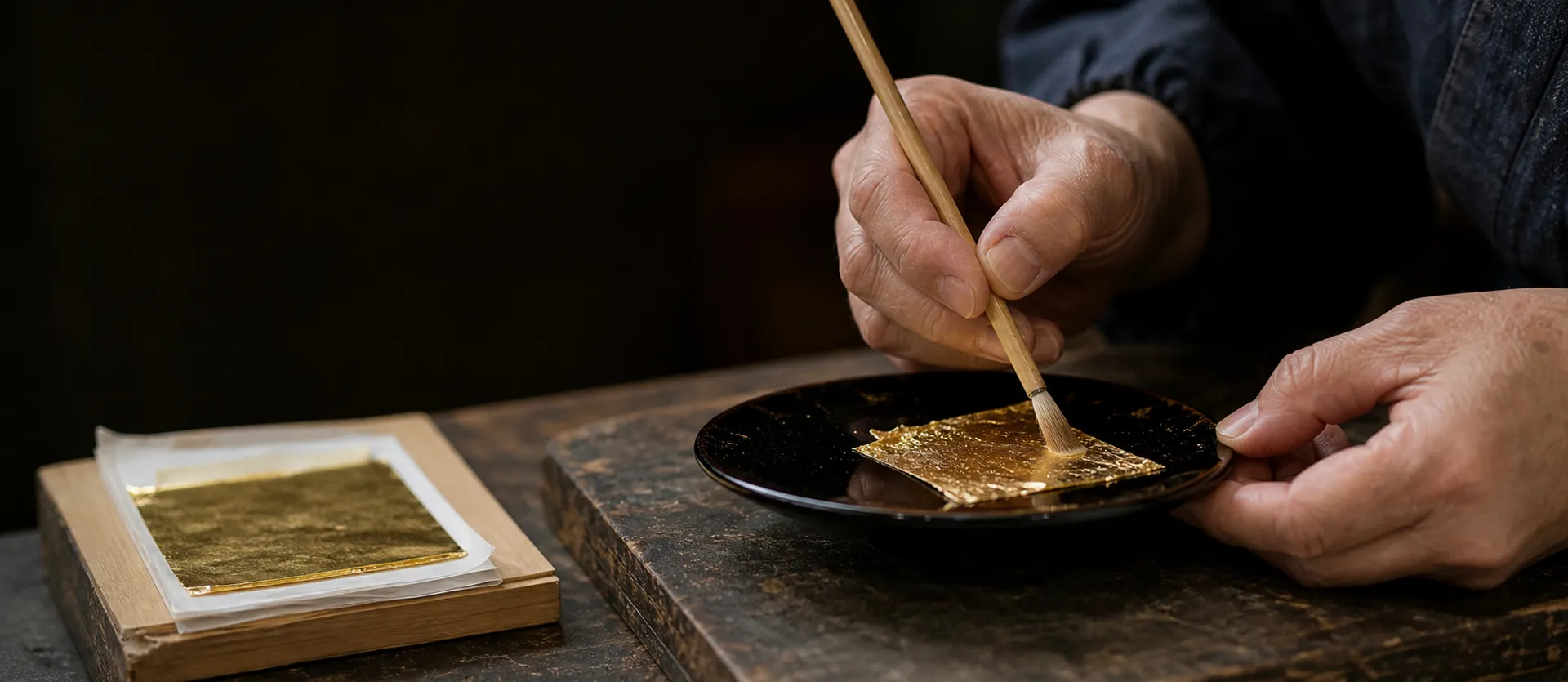
Kanazawa gold leaf is beaten to around 0.0001 mm. It appears on sweets, matcha, sake, Buddhist altars, architectural details, tableware, and small craft items. Around Higashi Chaya and Kanazawa Station, it is one of the easiest crafts to see without an appointment.
Hakuichi and Kanazawa gold-leaf workshops offer hands-on sessions for coasters, small plates, and spoons. Typical prices are ¥1,000-2,500 for 30-60 minutes. Gold-leaf sake costs around ¥1,500-3,000, while a gold-leaf soft serve is about ¥900.
Kaga Yuzen
Kaga Yuzen is a silk-dyeing technique that developed under the Kaga Domain. It uses realistic plant and bird motifs, a calm palette, and a detail called mushikui, which paints insect-bitten marks on leaves.
The Kaga Yuzen Traditional Industry Center offers coloring experiences for roughly ¥3,000-5,000. Full kimono pieces often exceed ¥100,000, so hand towels around ¥1,500-3,000 or small furoshiki cloths around ¥2,000-5,000 are more practical souvenirs.
Kutani ware and Wajima lacquerware
Kutani ware comes mainly from the Nomi and Komatsu areas of southern Ishikawa. It is known for bright overglaze colors such as red, yellow, green, purple, and blue. In Kanazawa, shops around Korinbo and Kanazawa Station sell bowls, plates, and sake cups from about ¥2,000 upward.
Wajima lacquerware comes from Wajima on the Noto Peninsula and can involve more than 100 production steps. The Noto Peninsula earthquake of January 2024 damaged the production area heavily, so buying from confirmed producers has extra significance. A lacquer bowl may cost ¥10,000-50,000.
National Crafts Museum
The National Crafts Museum moved from Tokyo to Kanazawa in 2020. It is Japan’s only national museum dedicated to crafts and sits north of Kanazawa Castle Park and Kenrokuen. Its collection includes about 1,900 works.
Special exhibitions run several times per year, with admission usually around ¥250-1,200 depending on the show. The museum is usually closed on Mondays, so check the calendar before pairing it with Kenrokuen, Ishikawa Prefectural Museum of Art, and the 21st Century Museum.
A half-day craft route
Start from the east gate of Kenrokuen, walk 3 minutes to the National Crafts Museum, then 5 minutes to the Ishikawa Prefectural Museum of Art. From there, move to Higashi Chaya by taxi or on foot, then finish at Omicho Market or Kanazawa Station’s Hyakubangai shopping area.
This 5-6 hour route is better than seeing gold-leaf sweets alone. It lets you compare museum pieces, preserved teahouse architecture, commercial craft shops, and station souvenirs in one sequence.