
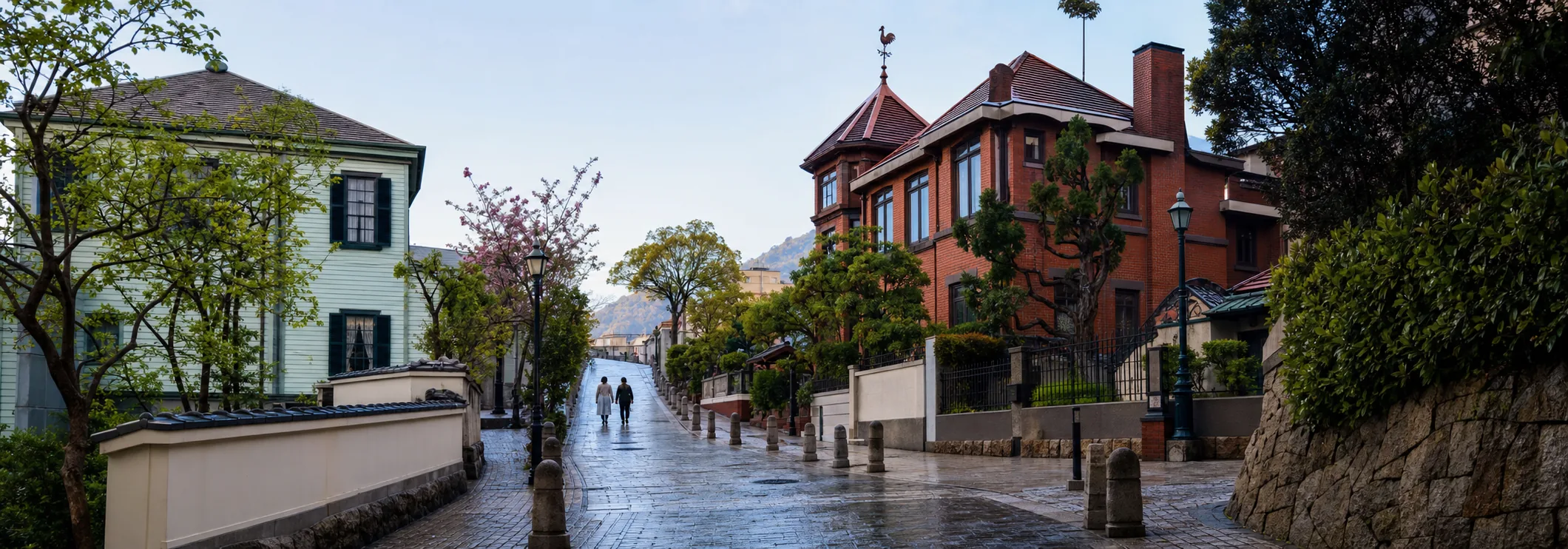
Kitano: slopes, ijinkan houses, and Kobe's port-opening memory
Three routes up from Sannomiya (walk 15 min / City Loop bus ¥260 / taxi ¥1,000). Combo tickets: 2-house ¥650, 5-house ¥1,400, 7-house ¥3,000. Kobe beef lunch from ¥3,500. Rain-day routing and crowd-avoidance timing.
ARTICLE MAP Reading Map
Kitano sits on the hills north of Sannomiya Station. After Kobe opened as a port in 1868, foreign residents who could not secure housing in the seaside foreign settlement moved uphill to the Yamate area, and Western-style houses clustered there over the following decades. The district is now called the Kitano Ijinkan-gai. A morning visit covering three representative houses plus a Kobe beef lunch plus the walk back down to Nankinmachi runs about ¥3,500-6,000 on a weekday. The sections below follow the order: how to get up, which houses to see, where to eat, how to walk back down.
Getting up from Sannomiya (three routes + rain option)
Route A: Walk (most common). Exit JR Sannomiya Station from the east exit, head due north along either Tor Road or Kitano-zaka. Both reach the center of the ijinkan district in about 15 minutes. Kitano-zaka is the main tourist street with clear signage and a clean road surface. Tor Road has more local shops and a livelier everyday feel. The climb is a steady 80 m gain over the full distance. Most people handle it without trouble, but the stone-paved sections get slippery in rain.
Route B: City Loop bus (rain or limited mobility). Board at the Sannomiya-ekimae stop No. 1 (in front of the Kobe Transportation Center Building). Get off at the Kitano Ijinkan stop (stop No. 9 on the loop). Single ride ¥260 (IC card same price), day pass ¥800. Buses run every 15-20 minutes, operating 9:00-17:30. The ride from Sannomiya to Kitano takes about 12 minutes, bypassing the slope entirely.
Route C: Taxi. Sannomiya Station to the top of Kitano-zaka (in front of Weathercock House) costs about ¥1,000-1,300 and takes 5-7 minutes. Split four ways, this is cheaper per person than the bus.
Rain-day routing: Take the City Loop bus directly to the Kitano Ijinkan stop to avoid the wet stone-paved slope. From the bus stop, Weathercock House, Moegi House, and Rhine House are all within 100 m, so you can move between them with minimal outdoor exposure.
Combo tickets and which houses to see
About 16 ijinkan houses are open to visitors. Seeing every paid house costs ¥6,000-7,000 total. Most visitors pick 3-5 houses, and combo tickets bring the per-house cost down significantly.
| Ticket | Price | Includes |
|---|---|---|
| 2-house ticket (Weathercock + Moegi) | ¥650 | The two nationally designated Important Cultural Properties |
| Yamate 4-house ticket | ¥2,100 | Fragrance House (Oranda-kan), Vienna Austria House, Denmark House, Uroko Museum |
| Kitano-dori 5-house ticket | ¥1,400 | England House, Western-style Row House, Ben’s House, Seiyo-kan, Saka-no-ue Ijinkan |
| 7-house special combo ticket | ¥3,000 | The 5-house set above + Uroko House + Uroko Museum |
Recommended first-visit route: Rhine House (free, city-owned, has a cafe and exhibits) then the 2-house ticket (¥650: Weathercock House + Moegi House, the two Important Cultural Properties) then Uroko House (¥1,050, single ticket, the signature fish-scale exterior). Total ¥1,700 for three landmark houses plus one free house, about 2-3 hours to see them all.
Key individual houses:
- Weathercock House (Kazamidori-no-Yakata): Former residence of G. Thomas (German merchant), built 1909. Red brick with a rooster weathervane on the tower. Nationally designated Important Cultural Property. ¥500. Look for the German half-timber structure and tiled heating stoves inside.
- Moegi House (Moegi-no-Yakata): Former residence of Hunter Sharp (American consul general), built 1903. Light green clapboard walls. Nationally designated Important Cultural Property. ¥400. The second-floor veranda has the best view of Kobe Port in the district.
- Uroko House: Built 1885. The exterior is covered with about 3,000 pieces of natural slate arranged in a scale pattern, which gives the house its name. It is the only ijinkan in Kitano that opens every room to visitors. ¥1,050.
Houses you can skip: Some privately operated ijinkan have weak exhibitions that feel like wax figures and antique flea markets. “Rose House” and “Oranda-zaka Studio” charge ¥800-1,000 but take only about 15 minutes to walk through. Check Google Maps ratings before buying a ticket; aim for 4.0 or higher.
Kobe beef lunch: three price tiers
The main food draw around Kitano is Kobe beef (Kobe Biifu) and port-town yoshoku (Western-style Japanese cooking). Lunch prices fall into three tiers.
Budget (¥2,500-4,000): “Steak Land Kobe-kan” (Chuo-ku Kita-Nagasa-dori 1-9-17, 5-minute walk from JR Sannomiya west exit) serves a Kobe beef steak lunch for ¥3,580 (150 g) at a teppanyaki counter. Walk-in only, no reservations. Arrive by 11:30 before opening and expect a 20-40 minute queue. “Mouriya Sannomiya Main Store” (Chuo-ku Shimoyamate-dori 2-1-17, 6-minute walk from JR Sannomiya north exit) has A4 Kobe beef lunch at ¥4,180 (120 g) and A5 at ¥5,500. Reservations accepted on TableCheck; weekday lunches are usually available two weeks ahead.
Mid-range (¥6,000-12,000): “Kobe Plaisir Main Store” (Chuo-ku Shimoyamate-dori 1-1-2) is a Kobe beef specialty restaurant with lunch from ¥6,820 and dinner from ¥15,000. Phone reservation required (078-321-1131), book 2-4 weeks ahead. “Steak Aoyama Kitano” (top of Kitano-zaka) is the only reservation-only charcoal-grilled Kobe beef restaurant in Kitano proper, with lunch at ¥8,800 and dinner at ¥18,000. Book through Ikyu.com or OMAKASE.
Budget option below ¥2,500: Yoshoku set meals along Kitano-zaka run ¥1,500-2,500 (omurice, hamburg steak, meat-and-rice plates). “Bifuteki no Kawamura Sannomiya” has a hamburg steak lunch for ¥1,800 made with Kobe beef trimmings, which is the most reliable way to taste Kobe beef elements under ¥2,000.
Crowd avoidance and timing
Peak congestion: Saturday and Sunday 11:00-15:00 is the worst window. Weathercock House and Moegi House can have 30-60 minute queues. The City Loop bus also runs 5-10 minutes slower per loop.
Three ways to avoid crowds: (1) Go early: enter Weathercock House when it opens at 9:30, finish both 2-house-ticket buildings by 10:30 when foot traffic is still light. (2) Go on a weekday: Tuesday, Wednesday, and Thursday mornings are near-empty, and Kobe beef restaurants often have walk-in seats without a queue. (3) Go on a rainy day: visitor numbers drop roughly 40% compared to clear weather, and as long as you do not mind wet shoes, it is the best time to visit.
Total time for a Kitano visit: Three houses plus a Kobe beef lunch takes 4-5 hours, which is a natural half-day from Sannomiya and back. Spending an entire day in Kitano alone is too much. The standard combination is Kitano in the morning, then the former foreign settlement area and Nankinmachi in the afternoon.
Walking back down and connecting to other areas
From Uroko House or Weathercock House, walk south down Kitano-zaka for about 15 minutes to reach JR Sannomiya Station. From there, a 5-minute walk through the underground passage brings you to the former foreign settlement (Kyu-Kyoryuchi, a boulevard with brand shops and historic Western buildings) and Nankinmachi (Chinatown, where bubble tea runs ¥200 and Roshoki pork buns are ¥110 each). From Nankinmachi, another 10 minutes on foot reaches Meriken Park for the harbor night view, a common evening follow-up.
Convenience stores and supplies: There are no convenience stores on upper Kitano-zaka. The nearest 7-Eleven is on the mid-section of Tor Road (about halfway down from the ijinkan area). Right outside JR Sannomiya north exit you will find a FamilyMart on Nakayamate-dori and a Lawson near Sannomiya Shrine. Drugstores (Matsumoto Kiyoshi, Cocokara Fine) are concentrated in the Sannomiya Center-gai shopping arcade, not up on Kitano-zaka.
ATMs: There are no ATMs on upper Kitano-zaka. The nearest international-card ATM is the Seven Bank ATM at JR Sannomiya north exit (overseas cards accepted 24 hours).
Common mistakes
Buying tickets for all 16 houses. Beyond Weathercock House, Moegi House, Uroko House, and Rhine House, most are privately run with weaker exhibits. Check individual ratings before committing to the ¥3,000 7-house combo ticket.
Relying only on Google Maps for Kobe beef restaurants. The top-rated restaurants within a 5-minute walk mostly operate walk-in only and have 30-60 minute queues. Booking 1-2 weeks ahead through TableCheck or Ikyu.com saves the entire wait.
Wearing leather dress shoes on Kitano-zaka in winter. The stone-paved road plus 80 m of slope makes ordinary leather soles slip. Wear sneakers or low-heeled boots.
Riding the City Loop bus in the wrong direction. The bus runs in one direction only (loop order, stops 1 through 16). From Sannomiya, the Kitano Ijinkan stop is in the forward direction. For the return trip, board the same bus at the same stop and ride the rest of the loop back to Sannomiya. There is no reverse direction.
Trying to photograph ijinkan at sunset in autumn foliage season. Kitano faces south toward Kobe Port, so neither early morning nor late afternoon produces golden-hour light on the house facades. The best light for exterior photography is mid-morning, roughly 10:00-12:00, when side light hits the Western-style walls.
Japanese keywords
- Kitano Ijinkan (きたのいじんかん) / Yamate (やまのて)
- Kazamidori-no-Yakata (かざみどりのやかた) — Weathercock House
- Uroko-no-Ie (うろこのいえ) — the fish-scale-wall house
- Kobe Kaiko (こうべかいこう) — Kobe port opening, 1868
- City Loop Bus (シティループ バス)
- Kitano-zaka (きたのざか)