
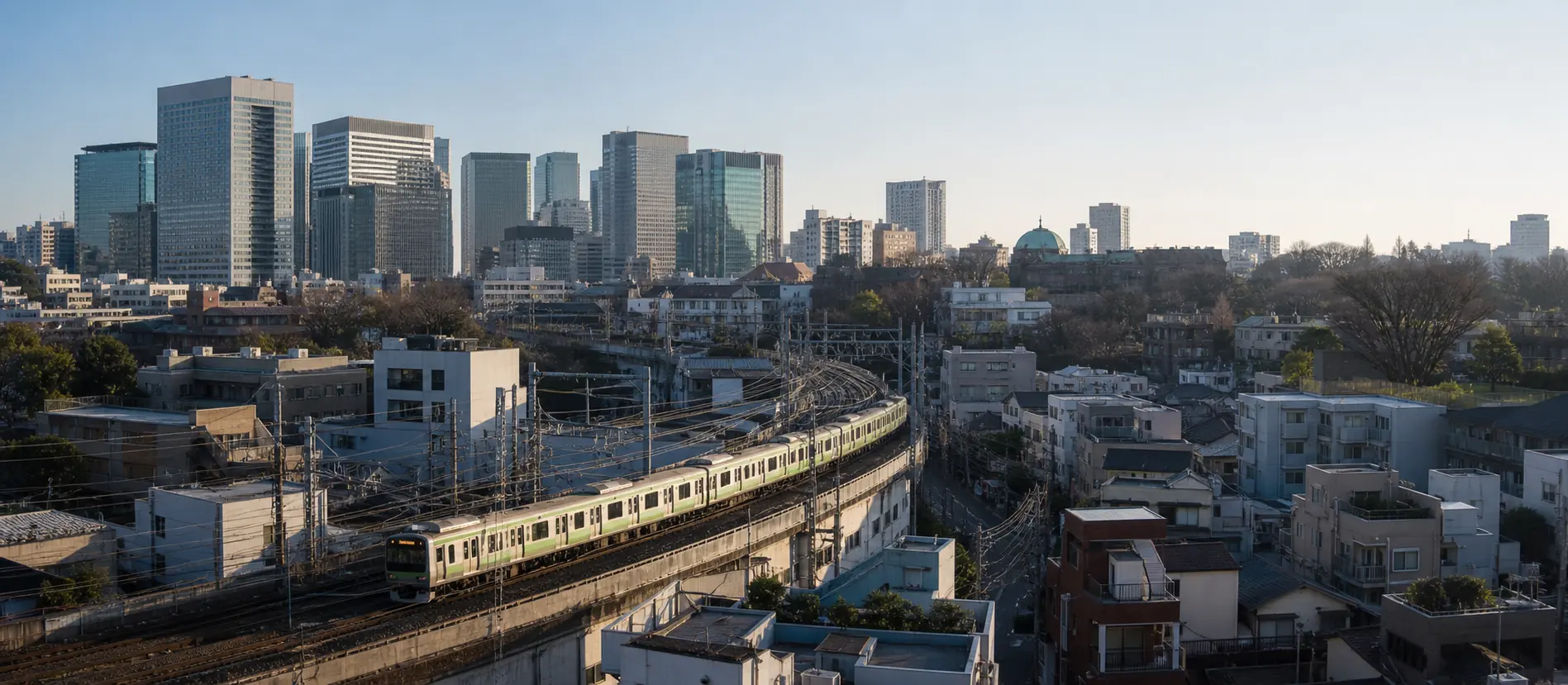
Inside the Yamanote Line: Marunouchi / Hongo / Ueno / Akasaka: Where to Live
The Yamanote loop covers 11 km × 7 km, but rent and life inside it splits 4 ways: Marunouchi/Otemachi (finance/govt) ¥200,000+, Hongo/Yotsuya (universities/hospitals) ¥130,000-180,000, Ueno/Asakusabashi (shitamachi) ¥110,000-150,000, Akasaka/Roppongi (embassies/IT) ¥180,000-280,000.
ARTICLE MAP Reading Map
The ellipse the Yamanote Line draws is about 11 km × 7 km, but the inside is not a uniform “central Tokyo.” North is Hongo (universities and hospitals), east is Ueno-Asakusa (old town), south is Shinagawa (station hub), west is Shinjuku-Shibuya (commercial), and the core splits into Marunouchi-Otemachi (finance/government) and Roppongi-Akasaka (foreign companies/nightlife). Living in each feels more different than living in the suburbs outside Yamanote. This article breaks down “where to live” by commute, monthly rent, supermarket types, nighttime noise, and how much you can stay dry in rain.
1. Marunouchi / Otemachi / Nihonbashi: finance and government
Marunouchi (丸の内), Otemachi (大手町), and Nihonbashi (日本橋) hold Tokyo’s most expensive office towers, owned by Mitsubishi Estate and Mitsui Fudosan. Daytime population is roughly 280,000; after 7 PM the streets are emptied except for security and cleaning crews. Residential supply is thin and clusters at the north edge of Otemachi into Kanda (神田), Awajicho (淡路町), Iwamotocho (岩本町), where a 1LDK runs ¥200,000-300,000, with key money 1 month, deposit 1-2 months, and guarantor company fee starting at 50% of one month’s rent.
Commute is best in class: Tokyo Metro Marunouchi, Chiyoda, Hanzomon, and Tozai lines all meet at Otemachi (5 lines, 1-station transfer), plus JR Tokyo Station is 5 minutes’ walk; Shinjuku, Shinagawa, Ikebukuro, and Ueno are all within 15 minutes. Underground passages connect Mitsui Tower, Shin-Marunouchi, and KITTE; on rainy days you can go from station to office without opening an umbrella.
Living costs are high. Surrounding supermarkets are mainly Seijo Ishii (high unit price, lots of imports); cheap Maibasket only has a few branches around east Kanda. Childcare facilities are sparse. Few clinics open Saturdays, and the 7:30-9:00 weekday commute pushes elevator capacity to the limit.
Sources: Mitsubishi Estate: Marunouchi Area Management, Chiyoda Ward: Marunouchi-Otemachi District Planning.
2. Hongo / Ochanomizu / Kanda / Iidabashi: universities and hospitals
The northern part of Yamanote inside, from Hongo (本郷) through Ochanomizu (御茶ノ水), Kanda, to Iidabashi (飯田橋), is dense with the University of Tokyo, Juntendo Hospital, Tokyo Medical and Dental University, Meiji University, Chuo University, and Sophia University. A 1K-1LDK runs ¥130,000-180,000, 30-40% cheaper than Marunouchi. Graduate students, doctors, hospital staff, and academic visitors prioritize this line.
Dense hospitals doesn’t mean easy outpatient access. Todai Hospital, Juntendo, and Tokyo Medical and Dental are all “specially-functioning hospitals” (特定機能病院): general outpatient almost always requires a shokai-jo (紹介状, referral letter, ¥3,300-5,500 from a local clinic); walking in without one adds selection-treatment fee (選定療養費) of ¥7,000-11,000 (since October 2022). For routine fevers, skin, and dental issues, use a neighborhood “〇〇 Clinic.” Whether there’s a family doctor open on Saturdays within 800 m matters more than being 1 station from a teaching hospital.
Transit is dense but rain coverage is weak: JR Chuo Line (Ochanomizu, Kanda, Iidabashi), Metro Marunouchi, Chiyoda, Namboku, Tozai, Yurakucho, and Toei Mita all cross here, but inter-station passageways are mostly above ground. Walking from Kanda to Ochanomizu takes 8 minutes with an umbrella.
Sources: MHLW: Selection-treatment fee (referral-less visits), Bunkyo Ward: Hongo-Yushima District Planning.
3. Ueno / Okachimachi / Asakusabashi: old town density
The northeast arc of Yamanote, Ueno (上野), Okachimachi (御徒町), Akihabara, and Asakusabashi (浅草橋), is a surviving Edo-era “shitamachi (下町).” 1K is ¥100,000-140,000, 1LDK is ¥150,000-190,000, 20-30% cheaper than the western half. The advantage is low living costs: Ueno Ameyoko, Okachimachi Yoshiike, and Asakusabashi wholesale streets sell fish, meat, vegetables, and stationery at wholesale prices. OK Store, Gyomu Super, and Niku no Hanamasa all have branches; a single person’s monthly groceries land at ¥25,000-35,000 (the same in Roppongi costs ¥45,000+).
The cost is tourist crowds. Weekends jam Ueno Park, Ameyoko, and Asakusa-dera; the south side of the park (Iriya, Inaricho, Tawaramachi) stays quieter. Akihabara is an IT/otaku culture zone, and street noise runs late. Before renting, confirm the window direction: an apartment facing Chuo-dori will be woken on weekend daytimes by promotional speakers.
Commute: JR Yamanote, Keihin-Tohoku, Ueno-Tokyo Line, Metro Ginza, Hibiya, Toei Oedo, Tsukuba Express all concentrate around Ueno Station. Living near Asakusabashi means transferring at Akihabara to reach Shinjuku, about 30 minutes.
Sources: Taito Ward: Tourism Statistics, JR East: Ueno Station Info.
4. Akasaka / Roppongi / Azabu-Juban / Aoyama: embassies, IT, nightlife
The southern part of Yamanote inside, Akasaka (赤坂), Roppongi (六本木), Azabu-Juban (麻布十番), and Aoyama (青山), packs foreign finance, consulting, IT, media, 120+ embassies, and international schools. A 1LDK is ¥180,000-280,000, a family-size 3LDK ¥350,000-700,000. If a foreign IT housing allowance is ¥150,000/month, a single in a Roppongi 1LDK still self-funds ¥30,000-130,000 monthly.
Subway access is dense: Metro Hibiya (Roppongi), Chiyoda (Akasaka), Ginza (Aoyama-Itchome, Gaienmae), Namboku (Roppongi-Itchome), Hanzomon (Aoyama-Itchome), and Toei Oedo (Roppongi, Azabu-Juban, Aoyama-Itchome). Roppongi to Shinjuku is 11 min, Shibuya 8 min, Shinagawa 15 min, but Tokyo Station requires a transfer (about 20 min).
Nighttime noise is high: Roppongi Crossing, Azabu-Juban’s “Gamaguchi Yokocho” stretch, and around Akasaka Sacas still see drinkers and taxis at 3 AM. Visit Friday 1 AM before signing; a 1LDK facing the main road may keep you up all night. The quieter pockets are around Aoyama 3-chome and Hiroo (a Minato-ku western edge inside Yamanote).
Supermarkets are National Azabu, Kinokuniya (Aoyama), PEACOCK, etc.; imports are abundant but prices are 2-3× Maibasket. For daily restock, take a shared bike (Docomo Bike Share ¥165/30 min) to Seijo Ishii in Hiroo or Odakyu OX at Gaienmae.
Sources: Minato Ward: Redevelopment Planning, MOFA: Embassies in Tokyo.
5. Yotsuya / Ichigaya / Kojimachi: the middle tier
Yotsuya (四谷), Ichigaya (市ヶ谷), Kojimachi (麹町) sit in the “middle belt” of Yamanote inside, midway between Shinjuku and Tokyo Station. A 1LDK is ¥160,000-220,000, 1K ¥110,000-140,000. For IT, consulting, and media workers who don’t want over 20-minute commutes but won’t pay Marunouchi rents, this is the sweet spot.
Lines: JR Chuo-Sobu local (Ichigaya, Yotsuya, Shinanomachi, Sendagaya) plus Metro Marunouchi (Yotsuya-Sanchome, Shinjuku-Gyoenmae), Namboku (Ichigaya, Yotsuya), Yurakucho (Ichigaya, Kojimachi), and Toei Shinjuku (Ichigaya, Akebonobashi). Shinjuku in 5 min, Tokyo Station in 7 min, Shibuya in 12 min.
Two life highlights: Shinjuku Gyoen (¥500 entry) is in walking distance, perfect for cherry blossom and fall foliage without the Ueno crowds; and Sophia University, Defense Ministry, Yasukuni Shrine, and Sotobori Park give the area more greenery and walking paths than Marunouchi has. For supermarkets, OK Store Yotsuya-Sanchome (rare cheap grocery inside Yamanote) and Life Yotsuya keep a single’s monthly food bill at ¥35,000-45,000.
Sources: Shinjuku Ward: Yotsuya District Planning, Shinjuku Gyoen.
6. Common mistakes
Treating “inside Yamanote” as one expensive price band. Rent inside Yamanote varies 2-3×: a Marunouchi 1LDK at ¥280,000 versus the same 1LDK in Asakusabashi at ¥150,000. Always price by specific block.
Picking proximity to the office without checking nighttime noise. Roppongi Crossing, Shinjuku Kabukicho, and around Ueno Ameyoko are all loud at 3 AM. Walk the actual block on a weekday at 1 AM, especially checking window direction (main road vs back alley).
Assuming you can always use the university hospital. Showing up without a referral letter costs ¥7,000-11,000 in selection-treatment fee (since Oct 2022). For routine illness, find a family clinic within 800 m. Check Google Maps for a clinic open Saturdays before choosing the apartment.
Equating “supermarket convenience” with “cheap supermarket convenience.” Seijo Ishii, Kinokuniya, and National Azabu are 2-3× pricier than OK Store, Maibasket, and Gyomu Super. Inside Yamanote, cheap supermarkets are essentially absent outside Ueno, Kanda, Yotsuya, and Hongo. Budget ¥45,000-60,000/month for groceries to be safe.
Treating a ¥150,000 housing allowance for Roppongi/Akasaka as enough. With foreign IT/consulting allowance ¥150,000/month against a Roppongi 1LDK ¥220,000-280,000, you still cover ¥70,000-130,000. Run the net before being seduced by “lives next to the office.”
Japanese key terms
- 山手線内側 (yamanote-sen uchigawa, inside the Yamanote loop)
- 紹介状 (shokai-jo, outpatient referral letter)
- 選定療養費 (sentei-ryoyo-hi, walk-in fee at large hospitals)
- 下町 (shitamachi, old town)
- 家賃補助 (yachin-hojo, employer housing allowance)