
Japanese traditional architecture: wood, roofs, machiya, gardens, and castles
Understand Horyu-ji, joinery, tiled and thatched roofs, temples, shrines, machiya, dry gardens, strolling gardens, and the 12 original castle keeps.
ARTICLE MAP Reading Map
Japanese traditional architecture is built around timber, natural materials, and seasonal response. Horyu-ji’s Kondo, traditionally dated to 607, is among the oldest surviving wooden buildings in the world. The structural logic is straightforward: columns and beams hold the frame, joinery locks everything together without nails, and the weight of the roof stabilizes the whole structure. This article covers wood technology and roofs, temple and shrine layouts, machiya townhouses, gardens, castles, and the cultural property protection system.
Wood technology and roofs
Traditional buildings use softwoods: hinoki cypress, sugi cedar, and matsu pine. These species resist moisture and work well under hand tools. The columns at Horyu-ji are hinoki from trees over 1,000 years old at the time of felling, and they remain sound after 1,400 years.
Shiguchi (仕口) and tsugite (継手) are the two families of wood joinery — shiguchi for angled connections, tsugite for extending members in line. More than 200 distinct joint types are documented. Common ones include koshikake-ari-tsugi (a dovetail splice for straight extensions), okkake-daisen-tsugi (a high-strength tension splice), and watari-ago (a cross-lap for perpendicular timbers). None of these use metal nails or adhesives. During earthquakes, the joints flex slightly and absorb shock — a “flexible structure” principle that informed the seismic damping design of Tokyo Skytree.
A traditional building goes up in five stages: (1) timber selection — going into the mountains to choose trees by age, grain, and compass orientation (the north-south face of the trunk matters for placement in the frame); (2) milling — sawing logs into boards and squared members; (3) joint cutting — carving the shiguchi and tsugite and writing bantsuke (assembly marks) on each piece; (4) tatemae — the raising ceremony, where columns go up and beams go on in one or two days, traditionally a community event; (5) interior finishing — walls, flooring, and roofing details.
Roofs divide into four types by material:
| Type | Material | Common use | Lifespan |
|---|---|---|---|
| Kawarabuki (tile) | Fired clay tiles | Castles, large temple and shrine buildings, houses | 50–100 years |
| Kayabuki (thatch) | Miscanthus grass, reeds | Farmhouses, old residences, some shrine main halls | 20–30 years |
| Doubanbuki (copper) | Copper sheet | Important temple and shrine buildings | 100–150 years |
| Hiwadabuki (bark) | Hinoki bark strips | Shrine main halls, imperial buildings | 30–40 years |
Thatching is in serious decline, with only a few hundred professional thatching craftsmen remaining in Japan. Shirakawa-go (Gifu) and Gokayama (Toyama) are the famous gassho-zukuri (prayer-hands style) thatched villages, both UNESCO World Heritage sites. Re-thatching a single house costs tens of millions of yen (roughly ¥10,000,000 per roof face) and must be done every 20–30 years. The work takes a team of specialists several months.
Tile roofing developed along its own path in Japan. The heavy tile mass lowers the building’s center of gravity, improving earthquake resistance. Onigawara — demon-face tiles at the ridge ends — serve as both rain-deflectors and apotropaic ornament. Ibushi-kawara (smoked tiles) have a distinctive gray-black color and are a hallmark of Kyoto streetscapes.
Sources: Agency for Cultural Affairs: Architectural Cultural Properties, National Institutes for Cultural Heritage, Japan Thatching Culture Association.
Temples and shrines
Temples (Buddhist) and shrines (Shinto) follow different layout principles.
A temple compound typically includes: san-mon or sam-mon (a large, often decorated entrance gate), kondo or hondo (the main hall housing the principal Buddha image), a five-story or three-story pagoda (originally a reliquary for Buddha’s ashes — the central shin-bashira pillar absorbs seismic energy, a principle Tokyo Skytree’s designers studied), kairo (covered corridors enclosing the precinct), and tacchu (independent sub-temples, each with their own abbot and garden).
Key temples and what they show:
- Horyu-ji (Ikaruga, Nara, 607) — the oldest surviving five-story pagoda and kondo. Asuka-period architecture at its purest.
- Todai-ji (Nara, 752) — the Great Buddha Hall (Daibutsuden) is among the world’s largest wooden structures. The Nandaimon gate holds Unkei and Kaikei’s guardian statues.
- Kiyomizu-dera (Kyoto, 778) — famous for its butai-zukuri (stage construction), a wooden platform projecting over a hillside without a single nail in the support structure.
- Ginkaku-ji (Kyoto, 1482) — a key example of shoin-zukuri, the study-room style that became the basis for traditional Japanese domestic architecture.
A shrine compound typically includes: torii (the gate marking the boundary between secular and sacred space), chozusha (the water basin for hand-washing before worship), haiden (the worship hall where visitors pray), and honden (the inner sanctuary where the deity resides — visitors do not enter).
Four main honden styles and where to see them:
- Shinmei-zukuri — Ise Jingu. The oldest style: straight lines, raised floor, unpainted wood, thatched roof. Rebuilt every 20 years in the shikinen-sengu cycle.
- Taisha-zukuri — Izumo Taisha. Also ancient, with a distinctive gable roof and elevated floor reached by a steep staircase.
- Kasuga-zukuri — Kasuga Taisha, Nara. Smaller scale, painted vermilion, with a gracefully curved roof.
- Gongen-zukuri — Nikko Toshogu. Lavishly decorated with color and carving, connecting the haiden and honden with a roofed corridor (ishi-no-ma).
Sources: Agency for Cultural Affairs, Architectural Institute of Japan.
Machiya townhouses
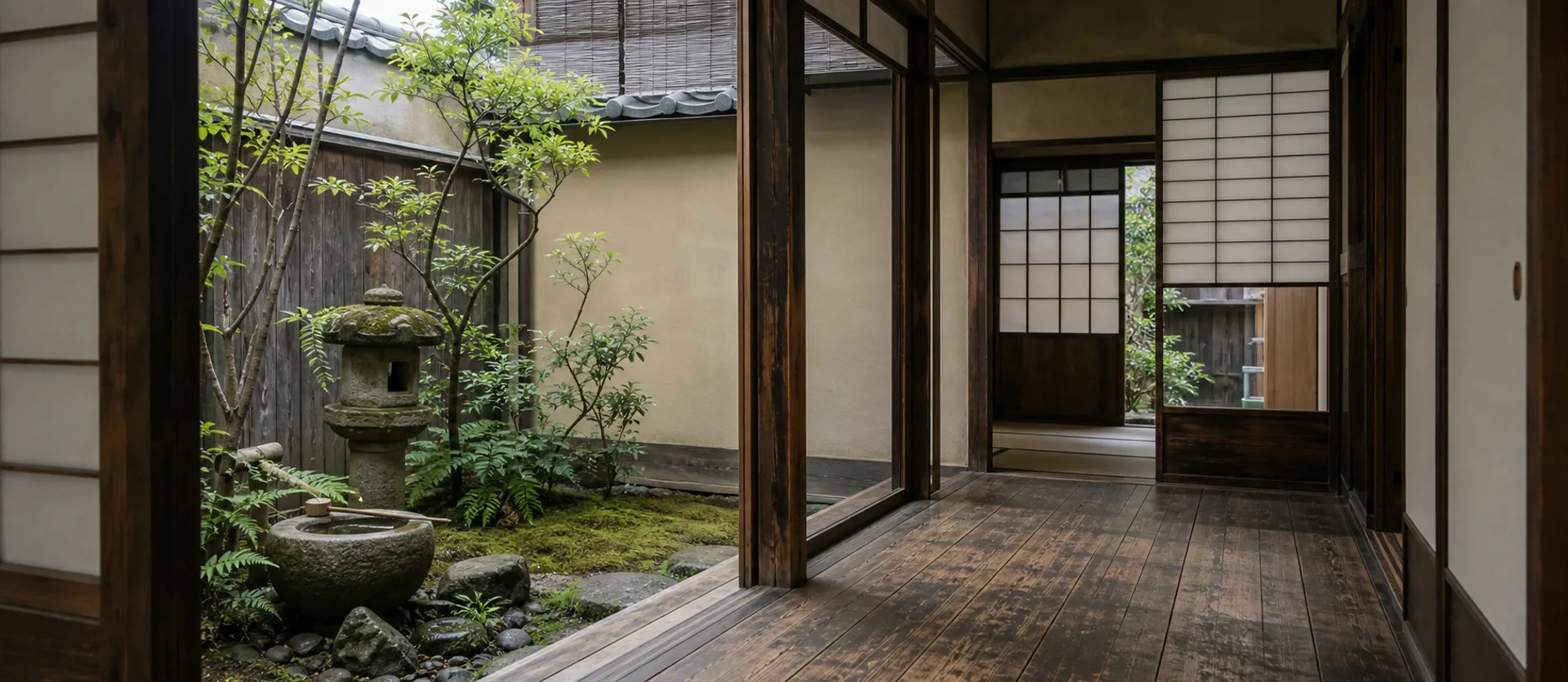
Machiya are the merchant townhouses of historic Japanese cities, with Kyoto and Kanazawa as the best-known concentrations. The nickname “unagi no nedoko” (eel bed) describes the shape: a narrow street frontage of about 5–6 m and a depth of 20–40 m. The narrow front minimized the old frontage tax; the deep plan allowed space for both business and residence.
Five features to look for:
- Koshi (lattice) — the wooden lattice screens across the front. The lattice pattern varies by trade: a rice shop, a kimono shop, and a sake shop each had a different design, readable at a glance by locals.
- Noren (curtain) — the fabric curtain at the entrance, printed with the shop’s house name (yago). Still used by many traditional businesses.
- Tsuboniwa (courtyard garden) — a small garden in the middle of the building, open to the sky, providing light and air circulation to the deep interior.
- Tori-doma (earthen passageway) — a packed-earth corridor running from the front entrance straight through to the back, used as the commercial workspace and connecting all rooms.
- Second-floor windows — low, street-facing windows with drying racks, reflecting the low-ceilinged second floor typical of older machiya (built low so residents would not look down on passing samurai).
Kyoto still has roughly 40,000 traditional machiya, but about 800 disappear each year due to aging owners, inheritance tax burdens, and redevelopment pressure. Since 2017, a preservation ordinance requires owners to file a notification before demolishing a designated machiya.
For visitors, machiya-stay lodgings have become widely available in Kyoto. Renting an entire machiya runs about ¥30,000–80,000 per night, bookable through Airbnb and specialized platforms. The areas around Nishiki Market, Gion, and Nishijin have the highest concentration of converted machiya inns.
Sources: Kyoto City: Kyo-Machiya Preservation, Kyo-Machiya Information Center.
Gardens
Japanese gardens fall into two broad categories.
Karesansui (dry landscape) gardens use white gravel, stones, and moss to represent water and mountains without any actual water. They belong to Zen temple culture and are designed for seated contemplation, not strolling.
Three to visit:
- Ryoan-ji (Kyoto, associated with 1499) — 15 stones arranged so that from any seated viewpoint on the veranda, at least one stone is hidden. The garden is roughly 25 m by 10 m, enclosed by an oil-clay wall whose color has changed over centuries. Admission: adults ¥600, high school students ¥500, children ¥300.
- Daitoku-ji Daisen-in (Kyoto) — considered one of the finest karesansui compositions, using upright stones and raked gravel to suggest a mountain river flowing into an open sea.
- Nanzen-ji (Kyoto) — the hojo garden uses a wide gravel plane with minimal stone placement, emphasizing empty space.
Chisen-kaiyu (pond-strolling) gardens center on a large pond and are walked in a circuit, with the scenery changing at each turn. These were built by feudal lords (daimyo) as pleasure gardens attached to their residences.
Japan’s three most famous gardens are all of this type:
- Kenrokuen (Kanazawa) — known for yukitsuri, the conical rope supports protecting trees from heavy snow. Admission: adults ¥320, children ¥100.
- Korakuen (Okayama) — a spacious lawn-and-pond garden completed in 1700.
- Kairakuen (Mito) — famous for its 3,000 plum trees, best in late February to March.
Katsura Imperial Villa (Kyoto) is widely considered the supreme example of the strolling garden. It is managed by the Imperial Household Agency and requires advance reservation (free, available online 3 months ahead, but slots fill quickly).
Sources: Agency for Cultural Affairs: Famous Gardens, Imperial Household Agency: Katsura Villa Tours.
Castles and cultural properties
The castle (shiro) reached its peak during the Sengoku and Edo periods. The defining feature is the tenshu (天守閣), a multi-story tower of 5 to 7 levels that served as the symbolic center of the fortification.
Japan has 12 original castle keeps — tenshu that have survived continuously since the Edo period or earlier, without being destroyed and rebuilt:
| Castle | Location | Notable features |
|---|---|---|
| Himeji-jo | Hyogo | UNESCO World Heritage, called “White Heron Castle,” largest surviving tenshu |
| Matsumoto-jo | Nagano | Called “Crow Castle” for its black walls, flat-land castle |
| Hikone-jo | Shiga | Seat of the Ii clan, National Treasure |
| Inuyama-jo | Aichi | Oldest surviving tenshu |
| Matsue-jo | Shimane | National Treasure, designated 2015 |
| Kochi-jo | Kochi | Best-preserved complete honmaru (inner bailey) compound from the Edo period |
| Hirosaki-jo | Aomori | Famous cherry blossom site, moat reflects 2,600 trees |
| Marugame-jo | Kagawa | Tallest stone walls of any Japanese castle |
| Bitchu-Matsuyama-jo | Okayama | Highest-altitude castle keep in Japan (430 m) |
| Uwajima-jo | Ehime | Coastal castle (umijiro) |
| Matsuyama-jo | Ehime | Late Edo construction, reached by ropeway |
| Maruoka-jo | Fukui | Oldest castle keep in the Hokuriku region |
Many famous castles — Osaka, Nagoya, Kumamoto, Okayama, Fukuyama — were destroyed in wars or by the Meiji government’s abolition orders and rebuilt in reinforced concrete during the 1960s–1980s. The distinction between “original” (genson) and “reconstructed” (saiken) matters when visiting. Reconstructed keeps often house museums; original keeps show actual Edo-period woodwork, steep stairs, and narrow defensive corridors.
Admission is typically ¥500–1,000 for adults, ¥200–500 for children. Himeji-jo charges ¥1,000 for adults, or ¥1,050 for a combined ticket including the Nishi-no-maru garden.
Cultural property protection system. Japan classifies its built heritage in tiers:
| Designation | Level | Approximate count |
|---|---|---|
| National Treasure (kokuho) | National | ~230 |
| Important Cultural Property (juyo bunkazai) | National | ~5,400 (buildings) |
| Registered Tangible Cultural Property | National | ~12,000 |
| Prefectural/municipal designated cultural property | Local | Tens of thousands |
| UNESCO World Heritage | International | 26 (21 cultural, 5 natural) |
Japan’s UNESCO World Cultural Heritage sites (as of 2024) include: Horyu-ji, Himeji-jo, Historic Monuments of Ancient Kyoto, Shirakawa-go and Gokayama, Hiroshima Peace Memorial, Itsukushima Shrine, Historic Monuments of Ancient Nara, Shrines and Temples of Nikko, Gusuku Sites of the Ryukyu Kingdom, Sacred Sites and Pilgrimage Routes of the Kii Mountain Range, Iwami Ginzan Silver Mine, Hiraizumi, Mount Fuji, Tomioka Silk Mill, Sites of Japan’s Meiji Industrial Revolution, Le Corbusier’s National Museum of Western Art, Sacred Island of Okinoshima, Hidden Christian Sites in Nagasaki, Mozu-Furuichi Kofun Group, Jomon Prehistoric Sites in Northern Japan, and Sado Island Gold Mines (2024).
Repair subsidies for National Treasures and Important Cultural Properties cover 50–85% of costs, supervised by the Agency for Cultural Affairs. Repairs must use traditional methods and materials — reinforcing with steel or replacing with modern composites is not permitted.
Sources: Agency for Cultural Affairs: Castles, Japan Castle Foundation, Agency for Cultural Affairs: Cultural Properties Protection Act, UNESCO World Heritage Centre: Japan.
Common mistakes
Assuming every castle is original. Osaka-jo, Nagoya-jo, and Kumamoto-jo are among the most visited, but all three were rebuilt in reinforced concrete. Only the 12 original keeps listed above survive from the Edo period.
Climbing onto thatched roofs. Thatched structures look rustic and inviting, but the roof surface is fragile. Stepping through thatch means repair bills over ¥1,000,000. Respect “no entry” signs.
Mixing up temple and shrine etiquette. At a temple you place palms together silently. At a shrine the standard is two bows, two claps, one bow (ni-rei ni-hakushu ichi-rei). See the shrines and temples article for details.
Dropping in at Katsura Imperial Villa. Katsura, Shugakuin, and the Kyoto Imperial Palace are managed by the Imperial Household Agency. All require advance reservation — free, available online 3 months ahead, but popular slots fill within days.
Dismissing karesansui as “a garden without water.” The point of a dry garden is to represent water through its absence. The gravel patterns and stone placement are the subject; the garden is meant for focused, seated looking, not a quick walk-through.
Photographing machiya interiors without asking. Many machiya are still occupied residences. Shooting through the entrance into someone’s home is intrusive. For exteriors, check whether the building shows signs of habitation and behave accordingly.
References
- Agency for Cultural Affairs: Architectural Cultural Properties
- National Institutes for Cultural Heritage
- Architectural Institute of Japan
- Japan Thatching Culture Association
- Kyoto City: Kyo-Machiya Preservation
- Kyo-Machiya Information Center
- Japan Castle Foundation
- Imperial Household Agency: Katsura and Kyoto Palace Tours
- UNESCO World Heritage Centre: Japan