
Yakitori Specialty Shops: Tiers, 14 Cuts, Ordering, Salt vs Sauce
Four price tiers from chain to ¥15,000 course, the 14 standard cuts, ordering rhythm in groups of 3–5, *shio* vs *tare*, reservation channels, and pitfalls.
ARTICLE MAP Reading Map
“Yakitori” is not a single dish but a system of shop type, chicken cut, and grilling method. A single chicken yields more than 30 cuts; menus typically carry 14. Prices range from ¥1,500 chains to ¥15,000 omakase counters, and the differences track back to sourcing (shiire), charcoal, skewer work (kushiuchi), and heat control. Order along these axes and you stay out of trouble.
Tiers and the Pricing Logic
Four tiers by reservation difficulty and per-person spend. The entry layer is the big chain—Torikizoku (flat ¥390 per item since May 2025), Yakitori Center, Iseya—with skewers around ¥200–400, per-head spend ¥2,000–3,500, and walk-ins usually fine. The second is the salaryman-friendly individual shop (Toritake, Torisakae, and similar). Per-head ¥3,500–6,000, with 20–40 minute waits on weekday evenings.
The third tier is the course shop—Torishige, Bird Land, and Torishiki in Tokyo—where everything runs through omakase (chef’s choice) at ¥10,000–25,000 per head, reserved three to six months ahead. The top tier is the 8–10-seat counter inside that course-shop category, sourcing jidori (heritage breeds such as Nagoya Cochin or Hinai Jidori) and grilling over bin-chōtan (Kishū white charcoal, high temperature and long duration). Per head ¥15,000–25,000.
The pricing rests on three levers: sourcing (jidori vs broiler), charcoal (binchōtan vs ordinary), and skewer work (hand-cut and threaded along the muscle fiber vs factory pre-skewered). When all three are at the top end, the shop sits in the ¥15,000+ range.
The 14 Standard Cuts
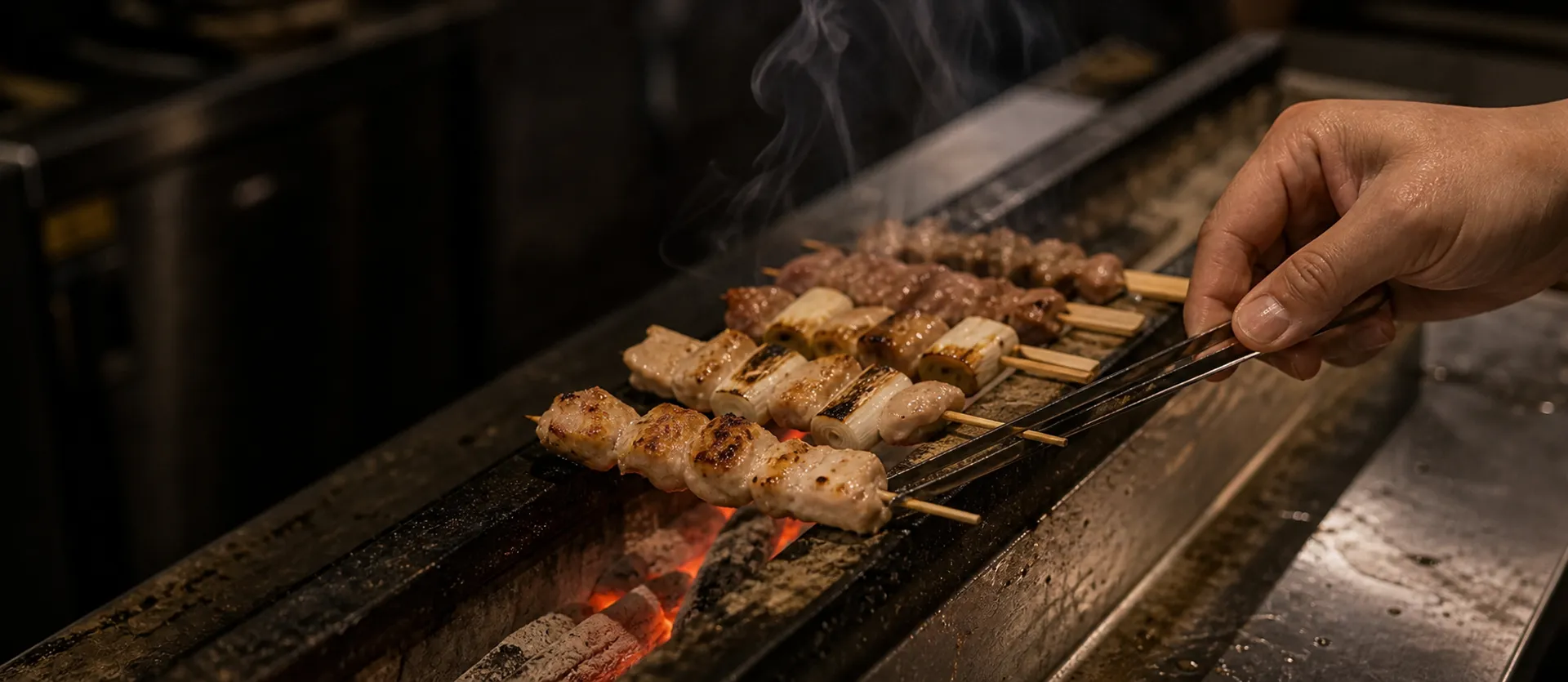
Once you can read the tier, the next step is reading the menu. The 14 cuts taken from a single bird form the backbone of every yakitori menu: momo (thigh), mune (breast), sasami (tenderloin), kawa (skin), sunagimo (gizzard), rebā (liver), hatsu (heart), nankotsu (knee cartilage), bonjiri (tail), seseri (neck meat), tebasaki (wingtip), tebamoto (drumette), tsukune (meatball), negima (thigh with leek).
Beyond these, course shops offer rarer cuts: harami (diaphragm), the whole heart split and grilled, shirako (testicles), yukiwa (trachea), and at shops with a public-health permit, reba-sashi (raw liver). Most of these yield only one or two skewers per bird; check the kyōshō-buii (today’s rare cuts) board on arrival.
Ordering in Groups of 3–5
With cuts learned, the next gate is how to order. The rule is not to dump every cut on the chef at once; order in groups of 3–5, letting the kitchen pace heat. The basic sequence runs from light → rich → tare (sauce) → offal → tsukune to close.
A concrete example. First round: momo, mune, sasami with salt, to read the shop’s baseline heat and salting. Second round: rebā, tsukune, bonjiri with tare, to read the shop’s sauce. Offal (rebā, hatsu, sunagimo) depends on same-day sourcing freshness; order them early, end of round two or start of round three. Close with tsukune and negima, often paired with rice or onigiri chazuke (rice ball in chicken broth) as the shime (closer).
Salt vs Sauce
Order sequence settled, the next decision is shio (salt) or tare (sauce) per skewer. Shio is for reading the ingredient itself—momo, mune, sasami, kawa, hatsu default to salt. Tare reveals the shop’s house style—tsukune, rebā, bonjiri default to sauce. For anything you’re unsure of, “omakase de” (your call) is a fine reply, and the chef picks based on the day’s meat.
Some shops set a salt-only or sauce-only policy, posted at the entrance. Sanshō (Japanese sansho pepper) is the classic companion for rebā, bonjiri, and tsukune, usually within reach on the counter. Japanese tōgarashi (chili) is mild compared to Sichuan-style heat; if you expect má là, it will read as faint, but its aroma is part of the yakitori palette and a small dusting brings flavor forward.
Reservation, Cancellation, Payment
Tier picked, time to reserve. Big chains generally do not take reservations; call the door or queue up. Salaryman-tier individual shops take bookings through Tabelog or shop LINE accounts about a week ahead. Course shops require three to six months, mostly through Tabelog Premium, OMAKASE, official LINE direct booking, or shōkai-sei (referral-only, needing an introduction from an existing customer) at the upper end.
Cancellation fees vary by shop, but a common ladder is free up to two weeks out, 50% at one week, 100% on the day; check before locking in. Budget math: per-head = average per-skewer price × 8–12 skewers + 2–3 drinks + otōshi (table snack, ¥300–600) + service and tax. ¥4,500–6,000 is a typical salaryman-tier evening.
Sources: Ministry of Health, Labour and Welfare: Food Hygiene, OMAKASE Reservation Platform.
Pitfalls
A few specific traps. “焼き鳥” and “やきとり” look the same but the notation matters: 焼き鳥 strictly means chicken, while やきとり in many shops includes butabara (pork belly), beef skewers, and vegetable skewers. The Hokkaidō Muroran and Fukushima Namie styles of “yakitori” are actually pork-led. Order an assortment and don’t be surprised if half the skewers aren’t chicken.
Tori-sashi (raw chicken) carries a real Campylobacter risk; MHLW has repeated the warning since 2018. Shops that serve it slaughter the bird the day before; ordinary shops cannot offer it, and at shops that can, starting with a small portion is the safer move.
Check the bill. Off-course, skewer counts and drink counts add separately, otōshi may be charged per head, and the reservation’s saitei shōhi hoshō (minimum charge guarantee) may be hidden in small print. Course shops at ¥10,000+ usually include tax and service; salaryman-tier shops under ¥5,000 often display “tax/service excluded” at the entrance.
Glossary
- shiire: day-to-day sourcing of ingredients
- kushiuchi: skewering technique, fiber alignment changes the eating
- jidori: heritage chicken breeds, deeper flavor and higher price than broilers
- binchōtan: Kishū white charcoal, high heat for long duration
- otōshi: table snack delivered at seating, usually charged