
Gift and souvenir etiquette: ochugen, oseibo, temiyage, and noshi
Japanese gift-giving depends on occasion, price, wrapping, regional souvenirs, noshi paper, mizuhiki knots, and return gifts.
ARTICLE MAP Reading Map
Japanese gift-giving is a relationship system with fixed seasonal moments across the 12-month year. Ochugen and oseibo are seasonal gifts, while weddings, births, moving, retirement, illness visits, daily souvenirs, and house visits each have different price ranges and wrapping rules.
Ochugen and oseibo
Ochugen is a summer gift, usually in early July to July 15 in eastern Japan and July 15 to August 15 in parts of Kansai. Oseibo is a year-end thank-you gift, usually from early December to around December 20.
Ochugen often costs ¥3,000-5,000, while oseibo may be ¥5,000-10,000. Sending only oseibo is acceptable, but sending only ochugen and not oseibo may look odd. For someone in mourning, shift the timing and use kanchu mimai instead.
Omiyage
Omiyage is the souvenir brought back from travel or business trips. For workplaces, individually wrapped sweets are safest. For 10-30 people, a ¥1,500-3,500 box with 15-30 pieces works well.
Regional classics around ¥1,000-3,000 are easy to understand: Shiroi Koibito or Rokkatei for Hokkaido, Tokyo Banana for Tokyo, yatsuhashi for Kyoto, 551 Horai for Osaka, Torimon for Fukuoka, and momiji manju for Hiroshima.
Temiyage
Temiyage is a small gift brought when visiting someone’s home. A normal range is ¥1,500-3,500. Department-store sweets, baked goods, fruit, alcohol, and seasonal sweets are common.
Avoid fresh sweets that must be eaten within the same day, strong allergens such as nuts or dairy if you have not checked, items with price tags left on, and fragile ceramics or glass. Within the first 10 minutes of a visit, take it out of the paper bag and give it with both hands.
Noshi and mizuhiki
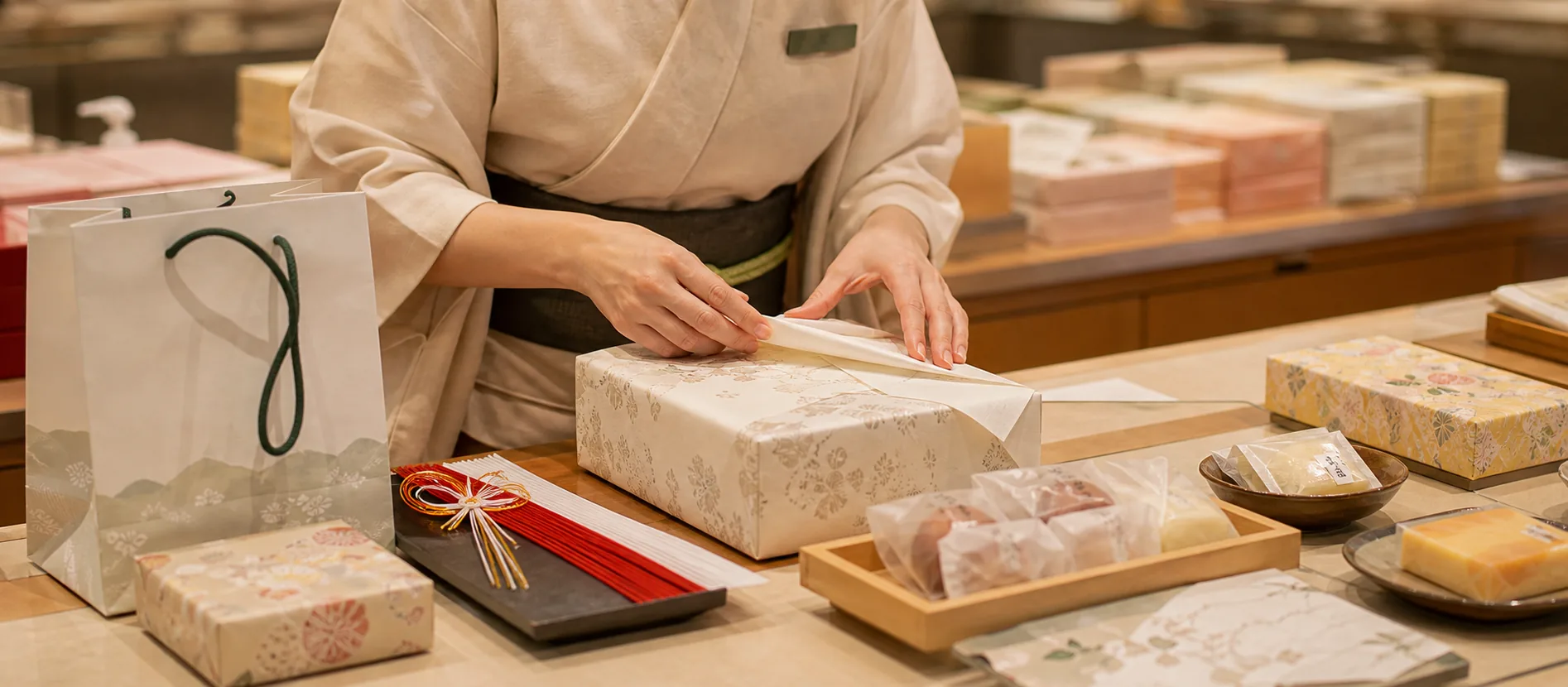
Noshi paper is a formal wrapping sheet printed with mizuhiki cords and a small noshi mark. Red-white bow knots are used for happy occasions that may repeat, such as births, school entrance, ochugen, and oseibo, and shops can usually prepare it in under 10 minutes.
Red-white knot ties are used for once-only events such as weddings or recovery gifts. Black-white knot ties are for funerals, while yellow-white is used for some Buddhist memorials in Kansai, including 49-day memorial contexts. The label changes by occasion: ochugen, oseibo, oiwoai, uchiiwai, omimai, or okoden.
Return gifts
For births, weddings, and recovery gifts, recipients often return uchiiwai worth about 30-50% of the original gift. It does not need to match exactly, but ignoring return-gift customs can affect future relationships.
Department stores and specialty shops can add wrapping and noshi paper if you say it is a gift. Tell staff the occasion, label, and sender name; many shops do this for free, though busy December counters may require 10-20 minutes.