
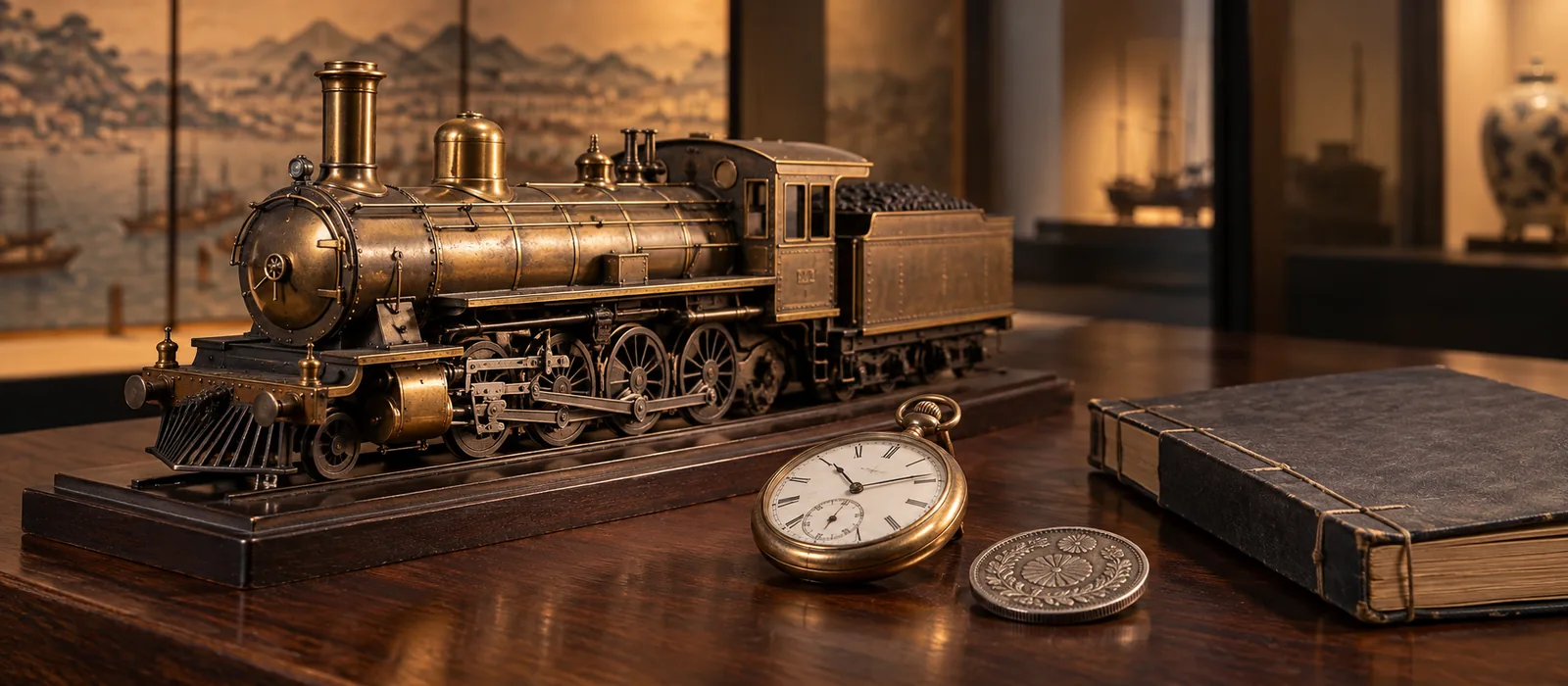
The Meiji Restoration: From the Black Ships to a Constitution, and Where Japan's Yen, Prefectures, and Railways Came From
Commodore Perry reached Uraga in 1853. In 1867 Tokugawa Yoshinobu announced the return of power at Nijo Castle, the era became Meiji in 1868, domains became prefectures and the yen was born in 1871, the Shimbashi-Yokohama railway opened in 1872, and a constitution followed in 1889. This is the Meiji Restoration in order, tied to places you can still visit: Nijo Castle, Goryokaku, the old Shimbashi Station, Tomioka Silk Mill, and Meiji Mura.
ARTICLE MAPReading Map
SERIESJapanese HistoryFrom the eras overview to single events, each tied to places you can still visit.8 parts
Start here
Classical and medieval
Sengoku and Edo
Modern era
- 06Meiji Restoration
- 071923 earthquake
War and postwar
The Meiji Restoration (Meiji Ishin) usually means the handover of power from the Tokugawa shogunate to the emperor in 1867 and 1868, the new government that followed, and the roughly 20 years of rebuilding institutions after that. A lot of what you meet every day in Japan was settled in those 20 years: money counted in yen, the country divided into prefectures, era names that change with each emperor, trains from Tokyo to Yokohama, and the Western calendar. Below, the story is told in order and matched to places you can still visit.
Japan used a lunisolar calendar until the end of Meiji 5 (1872), so some events have two dates. They are written below as old-calendar date (Western date).
From the Black Ships to the return of power (1853 to 1867)
The story starts in 1853, when Commodore Matthew Perry of the US East India Squadron sailed four warships into the waters off Uraga, in today’s Yokosuka, Kanagawa, and demanded that Japan open its ports. People called the dark steamships kurofune, the Black Ships. The next year the Convention of Kanagawa opened Shimoda and Hakodate, and the 1858 Treaty of Amity and Commerce, followed by similar treaties with the Netherlands, Russia, Britain, and France, opened Yokohama, Nagasaki, Hakodate, and other ports to trade.
Opening the ports pushed up prices and anger at the shogunate. “Revere the emperor, expel the barbarians” (sonno joi) became the anti-shogunate slogan, and forces centered on the Choshu and Satsuma domains drew together. In 1867 the fifteenth shogun, Tokugawa Yoshinobu, gathered domain officials in the Great Hall of the Ninomaru Palace at Nijo Castle in Kyoto and announced he would return power to the imperial court. This is the Taisei Hokan, on Keio 3, 10th month, 14th day (November 9, 1867). In the 12th month the court issued the Restoration of Imperial Rule, formally ending the shogunate.
Nijo Castle is now a World Heritage site run by the city of Kyoto, and life-size figures in the Great Hall recreate the announcement. Admission is JPY 800, plus JPY 500 for the Ninomaru Palace, JPY 1,300 in total, with entry from 8:45 to 16:00. The palace is closed on Tuesdays in January, July, August, and December.
Sources: Nijo Castle: admission fees, National Diet Library: modern Japan in documents.
The Boshin War and the birth of Tokyo (1868 to 1869)
Handing back power did not make the old regime’s supporters stand down, and a year and a half of civil war followed. On Keio 4, 1st month, 3rd day (January 27, 1868), government and former shogunate forces clashed at Toba and Fushimi, south of Kyoto, starting the Boshin War.
In the 3rd month the new government issued the Charter Oath (Gokajo no Goseimon) in the Meiji Emperor’s name, promising among other things that “all matters shall be decided by public discussion”. On the 11th day of the 4th month (May 3), the shogunate’s Katsu Kaishu and the government’s Saigo Takamori agreed terms, and Edo Castle was handed over without a fight, known as the bloodless surrender of Edo Castle. In the 7th month Edo was renamed Tokyo, and on the 8th day of the 9th month (October 23) the era became Meiji, under a new rule of one era name per emperor (issei ichigen) that today’s Reiwa era still follows.
The fighting did not end at Edo. Aizu and other northern domains held out, and the last stronghold was Goryokaku in Hakodate, Hokkaido. Enomoto Takeaki of the former shogunate navy surrendered there on Meiji 2, 5th month, 18th day (June 27, 1869), ending the Boshin War. Goryokaku is a Western-style star fort, now a park, and the magistrate’s office inside, the Hakodate Bugyosho, was rebuilt in its original form and reopened in 2010.
Sources: Hakodate Bugyosho, National Diet Library: modern Japan in documents.
Abolishing the domains and rebuilding the state (1869 to 1877)
With the war over, the government faced more than 260 domains that each collected their own taxes and kept their own armies. In 1869 the lords were made to return their land and people to the court (hanseki hokan). On Meiji 4, 7th month, 14th day (August 29, 1871), the domains were abolished and replaced by prefectures (haihan chiken), first 3 urban prefectures and 302 prefectures, merged into 3 and 72 by the end of that year, and later adjusted into today’s 47.
Reforms followed one after another. In 1871 the Iwakura Mission set out on a tour of the United States and Europe that lasted nearly two years and shaped the reforms that came after. The 1872 Education Order began a national system of primary schools. In 1873 conscription replaced the samurai army, and the land tax reform the same year turned rice dues into a cash tax based on land value. The 1876 sword ban ended the carrying of swords in public. Samurai lost their stipends and privileges, and their anger broke out in the 1877 Satsuma Rebellion, which ended with Saigo Takamori’s defeat and death in Kagoshima. It was Japan’s last large-scale civil war.
Source: National Diet Library: modern Japan in documents.
Meiji in daily life: the yen, the post, railways, and the calendar
Beyond government, several things still used every day were settled in these same years.
The New Currency Act of 1871 replaced the ryo with the yen, with 1 yen equal to 100 sen and 1 sen equal to 10 rin. That is where the yen begins. The same year, a government postal service led by Maejima Hisoka began carrying letters between Tokyo, Kyoto, and Osaka, and his portrait is still on the 1-yen stamp today.
On Meiji 5, 9th month, 12th day (October 14, 1872), the railway between Shimbashi and Yokohama opened, with steam locomotives imported from Britain, and October 14 later became Railway Day. The Old Shimbashi Station, rebuilt on its original site, is a 5-minute walk from the Ginza exit of JR Shimbashi Station. Through a window on the ground floor you can see the foundation stones of the original building. Entry is free, from 10:00 to 17:00, closed on Mondays.
The same year the government adopted the Western calendar. The day after Meiji 5, 12th month, 2nd day became Meiji 6, January 1, so that December had only two days.
In industry, the state-run Tomioka Silk Mill in Gunma began operating in 1872, bringing in French silk-reeling machines and expertise and training workers from across the country. It was listed as a World Heritage site in 2014 together with related sericulture sites. Adult admission is JPY 1,000, from 9:00 to 17:00, with last entry at 16:30.
Sources: Bank of Japan: history (New Currency Act), Old Shimbashi Station railway history exhibition room, Tomioka Silk Mill: visitor information.
Constitution, parliament, and expansion (1889 to 1912)
The sign that the new state had taken shape was the constitution. The Constitution of the Empire of Japan was promulgated on February 11, 1889, modeled partly on the Prussian constitution and giving the emperor sweeping powers including supreme command of the military. The first Imperial Diet met in 1890, but only men paying a set amount of direct national tax could vote.
In the same period Japan began to expand abroad. After the First Sino-Japanese War of 1894 to 1895, the Treaty of Shimonoseki gave Japan Taiwan and the Penghu Islands. After the Russo-Japanese War of 1904 to 1905 it gained rights including the South Manchuria Railway, and in 1910 it annexed Korea. Seen from China and the Korean Peninsula, late Meiji marks the start of a modern history of invasion, and how to judge this era is still debated within Japan. The Meiji Emperor died in 1912 and the era became Taisho.
To see Meiji-era buildings in one place, Meiji Mura in Inuyama, Aichi, opened in 1965 and preserves Meiji buildings moved there from around the country, including the main entrance of the old Imperial Hotel and Kyoto streetcars. Adult admission is JPY 2,500.
Sources: National Diet Library: modern Japan in documents, Aichi Now: Meiji Mura.
Common misunderstandings
Last, a few points that are often confused.
The first is treating the Meiji Restoration as an event of 1868 alone. From the Black Ships in 1853 to the constitution in 1889 is 36 years, and the return of power and the new era name are turning points within it.
The second is reading “bloodless surrender” as meaning no blood was shed. Edo Castle itself was handed over without a fight, but the Battle of Ueno and the Aizu War were fought the same year, and the Boshin War went on until Hakodate in 1869.
The third is the idea that Sakamoto Ryoma drafted the blueprint for the Restoration. The well-known Eight-Point Plan (Senchu Hassaku) survives in no original copy, and recent research suggests it may have been compiled later. His role as a go-between before the return of power is recorded, but how large it was is debated.
The fourth is mixing old-calendar and Western dates. The return of power is often given as October 14, which is the old-calendar date; in the Western calendar it was November 9. Railway Day, October 14, is by contrast the converted Western date.
Useful terms
- Meiji Ishin: Meiji Restoration
- Taisei Hokan: return of power to the emperor
- Boshin Senso: Boshin War
- Haihan chiken: abolition of domains and creation of prefectures
- Edo muketsu kaijo: bloodless surrender of Edo Castle