
Nakanoshima: Osaka's waterfront culture district and modern architecture
Nakanoshima is the long island between the Dojima and Tosabori rivers. Walk Osaka City Central Public Hall, museums, the rose garden, and the Keihan Nakanoshima Line in half a day.
ARTICLE MAP Reading Map
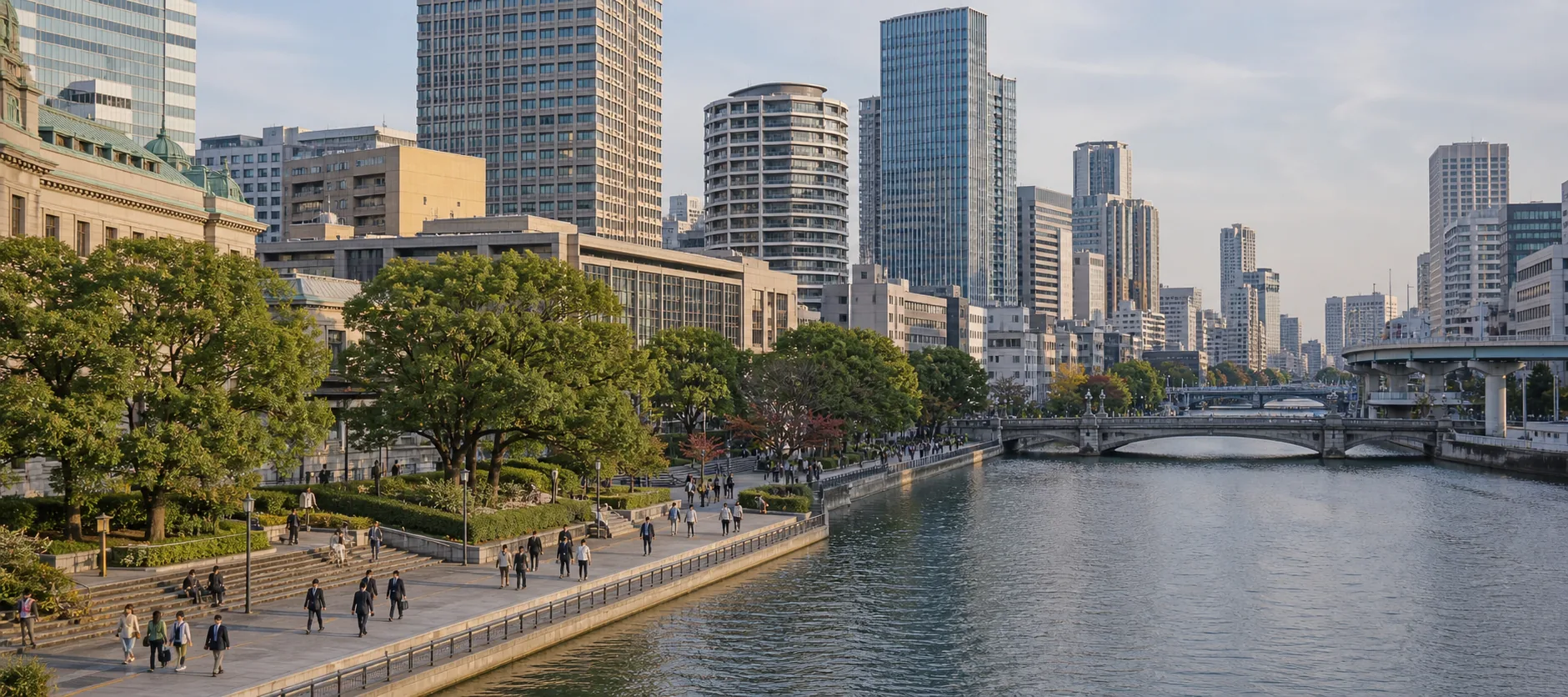
Nakanoshima is a narrow island about 3 kilometers long in central Osaka, between the Dojima and Tosabori rivers. It feels much quieter than Namba or Dotonbori, but it holds Osaka’s civic buildings, museums, riverside park space, and newer office towers in one walkable strip.
Modern architecture
The eastern side has Osaka’s clearest group of modern public buildings. From Yodoyabashi Station, you can see the former Bank of Japan Osaka Branch, Osaka Prefectural Nakanoshima Library, and Osaka City Central Public Hall within a short walk.
| Building | Completed | What to see |
|---|---|---|
| Osaka City Central Public Hall | 1918 | Red brick, neoclassical style, Important Cultural Property |
| Osaka Prefectural Nakanoshima Library | 1904 | Stone neoclassical facade, Important Cultural Property |
| Former Bank of Japan Osaka Branch | 1903 | Exterior linked with Kingo Tatsuno’s design language |
The public hall is worth even a 10-minute exterior stop. Interior access depends on events and open days, but the main hall is the key space when it is viewable. The basement restaurant is a practical lunch option around ¥1,500 to ¥3,000.
Museums
Nakanoshima Museum of Art, Osaka opened in 2022 in a black box-like building. Its collection focuses on modern art and design, including Saeki Yuzo and Modigliani. Special exhibitions often cost about ¥1,200 to ¥2,000, while the collection exhibition is around ¥400.
The National Museum of Art, Osaka sits nearby and is almost entirely underground, with only a metal tube-like entrance structure above ground. It focuses on postwar and contemporary art. The collection exhibition is about ¥430, and special exhibitions often range from ¥800 to ¥1,800. Seeing both museums usually takes 2.5 to 3 hours.
Park and rose garden
Nakanoshima Park covers about 10.6 hectares at the eastern end of the island. Its rose garden has about 310 varieties and 3,700 rose bushes, with peak seasons around mid-May to June and mid-October to November. Entry is free.
The riverside paths along Dojima River and Tosabori River can be connected into a roughly 2-kilometer loop around the eastern island. Kitahama, Naniwabashi, and Yodoyabashi are close, so the area also works for a 30-minute walk between cafes, offices, and station exits.
Western redevelopment
The western side has Festival Tower and Festival Tower West, with offices, hotels, shops, and performance halls. Conrad Osaka is part of this high-rise cluster.
The Nakanoshima 4-chome area farther west continues to develop. Walking from the historic buildings in the east to the museums and towers in the west shows how administration, culture, and business are layered on the same island.
Half-day route
Start at Yodoyabashi Station, cross the bridge to Nakanoshima, and see the former Bank of Japan Osaka Branch from outside. Continue to Osaka City Central Public Hall, then spend about 30 minutes in Nakanoshima Park and the rose garden.
Walk west to Nakanoshima Museum of Art for 1 to 1.5 hours, then add about 1 hour at the National Museum of Art. The full walk is about 3 kilometers and takes 3 to 4 hours. Ticket cost depends on exhibitions, but ¥800 to ¥2,400 is a practical range. Watanabebashi Station on the Keihan Nakanoshima Line or Higobashi Station on the Yotsubashi Line is convenient for leaving.
Useful Terms
- Nakanoshima
- Dojima River
- Tosabori River
- Osaka City Central Public Hall
- Keihan Nakanoshima Line