
Getting Help in a Disaster in Japan: 110 and 119, the 171 Message Line, Multilingual Hotlines, Shelters, and Recovery Grants
After a major disaster, calls are hard to get through. Call 119 or 110 when lives are at risk; many fire departments add a three-way interpreter on 119. Tell family you are safe with the 171 disaster message line, 30 seconds per message. Use the free 00000JAPAN Wi-Fi if mobile data is down, and the Japan Visitor Hotline for help in other languages. Foreign residents can use shelters, and households whose homes are destroyed can apply for up to JPY 3 million in recovery support.
ARTICLE MAPReading Map
SERIESDisasters and TyphoonsAlerts, when to evacuate, preparing your home for typhoons, insurance, and calling for help.5 parts
The first few hours after a major earthquake or strong typhoon are when panic sets in most easily: mobile networks jam, calls fail, and Japanese-language broadcasts are hard to follow. Japan has a fixed set of channels for exactly this: emergency numbers, a voice message service for checking on family, free Wi-Fi, multilingual hotlines, and cash support paid according to how badly your home was damaged. They are listed below in the order you are likely to need them.
Which number to call first
If someone is trapped or injured, or there is a fire, call 119 for the fire service and ambulance. For crime, traffic accidents, or anything that needs the police on site, call 110. For accidents at sea or on the coast, call 118 for the Japan Coast Guard. All three work nationwide, are free, and can be dialed from a public phone without coins. How to give your location and symptoms on 119 is covered in emergency care and 119.
You can call 119 without speaking Japanese. The Fire and Disaster Management Agency has pushed fire departments to adopt three-way phone interpreting, with the caller, the dispatcher, and an interpreting center on the line together, covering major languages 24 hours a day. As of June 2019, 437 of Japan’s 726 fire departments (about 60%) had it. Once connected, say your language in English or Chinese, and a department that has the service will bring in an interpreter.
Right after a major disaster, the network is congested and even 110 and 119 may not connect at once. Avoid calls that are not urgent, and check on family through the message services in the next section, so the lines stay free for people whose lives depend on them.
Source: FDMA: handling 119 calls from foreign residents and people with disabilities (2019 white paper).
Telling family you are safe, and getting online without a signal
Leave the lines that do connect for 110 and 119, and use 171, the disaster message dial (saigaiyo dengon daiyaru), to tell family you are safe. NTT opens this voice mailbox during major disasters. Messages are stored under a phone number, so the person recording and the person listening do not need to be on the phone at the same time.
To record, dial 171, press 1, enter your home phone number (with the area code for a landline), speak for up to 30 seconds after the tone, and press 9 to finish. To listen, dial 171, press 2, and enter the same number. Agree in advance which number your family will use as the mailbox, or you will not find each other’s messages after a disaster. You can practice too: trial days are the 1st and 15th of every month, January 1 to 3, Disaster Prevention Week (August 30 to September 5), and Disaster Prevention and Volunteer Week (January 15 to 21), with up to 20 messages of 30 seconds each per number. There is also a web version, web171, and each mobile carrier runs its own disaster message board, found in the disaster menu of the carrier’s app or website.
If mobile data is down but there is Wi-Fi nearby, look for a network called 00000JAPAN. Carriers open it jointly and for free during large disasters, with no password. Whether and when it opens is decided by the participating operators for each disaster, so there is no guaranteed timing; since a May 2023 guideline revision it can also open during major network outages at a carrier’s request. It is not encrypted, so use it only to check information and contact family, and never log in to online banking or enter passwords or card numbers.
Sources: NTT West: 171 trial use, MIC: unified disaster SSID 00000JAPAN.
Finding out what to do, in your language
Once you have reached family, the next step is working out what to do now. If you cannot follow the Japanese news, a few multilingual channels are always there.
The Japan Visitor Hotline at 050-3816-2787 is run by JNTO, the Japan National Tourism Organization, 24 hours a day, every day of the year, in English, Chinese, and Korean, and stays open during disasters. It is aimed at visitors, but residents who call also get answers on evacuation and transport.
The Immigration Services Agency’s Foreign Residents Support Portal collects government information on daily life in 15 languages, including disaster preparedness and what to do in a disaster. After major disasters, the affected prefectures and large cities often open a disaster multilingual support center (saigai tagengo shien center) with the local international association, translating shelter and support information into several languages. Announcements appear on the local government and international association websites.
If your residence card is lost or destroyed in a disaster, apply for a replacement at the regional immigration bureau within 14 days of finding out it is lost. After large disasters the agency often announces special arrangements, so check its disaster notices first.
Sources: Immigration Services Agency: Foreign Residents Support Portal, JNTO: Safety tips, CLAIR: multilingual living information.
At an evacuation shelter
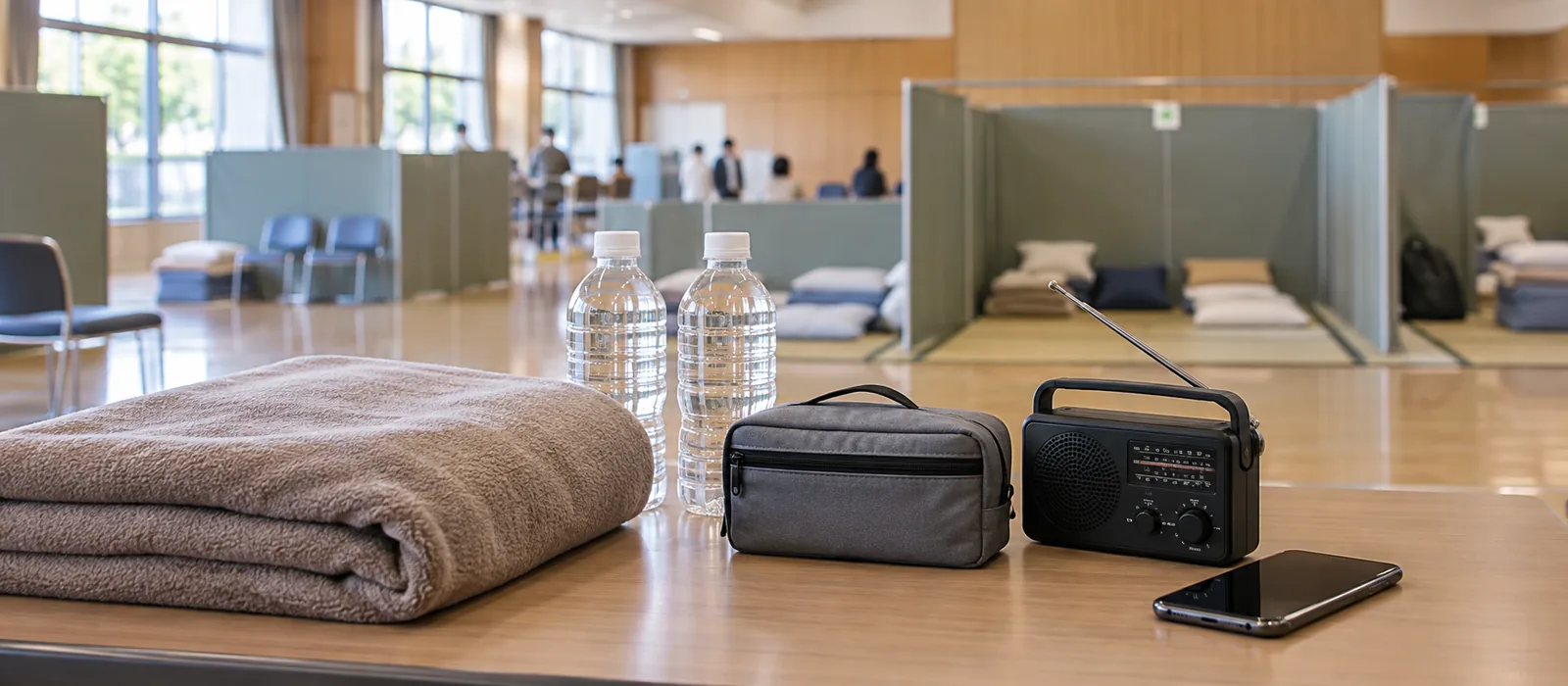
If your home is unlivable or you are told to evacuate, you go to a shelter. Designated shelters (shitei hinanjo) are usually in school gyms and community centers, and they are free. Foreign residents can use them too; Cabinet Office materials describe cases where municipalities passed the list of foreign evacuees registered at shelters to the disaster multilingual support center so they could get interpreting and other help.
When you arrive, register your name, address, and number of people at the reception desk. The list is used to share out supplies by headcount, and family and officials use it to find people. Shelters hand out water, food, and blankets, but supplies often run short for the first day or two, so bring your own emergency bag. What to pack is in disaster preparedness.
If your home is undamaged and you stay there, many municipalities still let you collect food, water, and information at a nearby shelter. In 2024 the Cabinet Office issued guidance on supporting people sheltering at home or in their cars, asking municipalities to include them when distributing supplies and information.
Sources: Cabinet Office: shelter living conditions, Cabinet Office: guide to supporting people sheltering at home or in cars (2024), Cabinet Office: example of information support for foreign evacuees at shelters.
Support you can apply for afterwards
Once things settle, you can apply for support. Everything starts with the disaster certificate (risai shomeisho) issued by your city or town, which classifies damage to your home as total loss, large-scale half destruction, half destruction, and so on. Cash support and tax or premium reductions all depend on that classification. The application needs photos of the damage, and how to take them is in typhoons at home.
The largest payment is the Support for Livelihood Recovery of Disaster Victims (hisaisha seikatsu saiken shienkin), paid only for disasters large enough for the Act on Support for Livelihood Recovery to apply. The basic payment depends on the damage: JPY 1 million for total loss and similar, JPY 500,000 for large-scale half destruction. An additional payment then depends on how you rebuild: JPY 2 million to build or buy, JPY 1 million to repair, and JPY 500,000 to rent, for a maximum of JPY 3 million in total. Single-person households receive three quarters of each amount. Renting households are eligible, and so are foreign residents. Apply at your city or town office within 13 months of the disaster for the basic payment and within 37 months for the additional payment.
Many municipalities add their own support on top, and resident tax, National Health Insurance premiums, and National Pension contributions may be reduced or deferred. Each is applied for at the relevant counter of your city or town. To see which programs apply to a given disaster, the quickest route is the “for disaster victims” (hisai sareta kata e) page on your local government website.
Source: Cabinet Office: livelihood recovery support system.
Common mistakes
Last, a few problems that come up often.
The first is not agreeing which number your family will use on 171. After a disaster everyone records under a different number and nobody hears anyone else. Try it together once on a trial day, the 1st or 15th of the month.
The second is logging in to online banking or shopping with a card while connected to 00000JAPAN. The network is not encrypted, and other people on the same access point may be able to intercept your traffic.
The third is assuming foreigners cannot use shelters or receive support. Foreign residents can use shelters, and the recovery payments cover foreign residents too. If language is a barrier, turn to the disaster multilingual support center.
The fourth is putting off the disaster certificate. Cash support, tax and premium reductions, and applications for temporary housing all require it, and the recovery payments have 13-month and 37-month deadlines, so the sooner you apply the less you miss.
Useful terms
- Saigaiyo dengon daiyaru (171): disaster message dial
- 00000JAPAN: free disaster Wi-Fi
- Shitei hinanjo: designated evacuation shelter
- Risai shomeisho: disaster certificate
- Hisaisha seikatsu saiken shienkin: livelihood recovery support payment