
Typhoons at Home in Japan: Balcony, Windows, Power Cuts, When to Evacuate, and Damage Photos
Two to three days out, read the storm-zone forecast and Kikikuru. The day before, clear the balcony, unblock drains, lock the shutters, fill the bathtub, and charge everything. Decide by Level 4 whether to leave or move upstairs, and photograph damage before you clean up, because the disaster certificate and insurance claims depend on those photos.
ARTICLE MAPReading Map
SERIESDisasters and TyphoonsAlerts, when to evacuate, preparing your home for typhoons, insurance, and calling for help.5 parts
Japan’s typhoon season runs from July to October. Approaches and landfalls peak around September, and strong typhoons still move north in October. Unlike earthquakes, typhoons show up in track forecasts three to five days ahead, so there is time to prepare. Most of the damage comes from balcony items nobody brought in, blocked drains, and leaving too late. Below, the steps are ordered by how close the typhoon is, for people riding it out at home.
Two to three days out: read the forecast and your own risk
The Japan Meteorological Agency (JMA) typhoon map has two circles that matter. The storm zone (bofuiki) covers average winds of 25 m/s or more, and the strong-wind zone 15 m/s or more. The storm warning area on the forecast map shows where the storm zone may pass. If your address falls inside it, start preparing. JMA ranks intensity by maximum wind: 33 m/s and up is “strong”, 44 m/s “very strong”, and 54 m/s “violent”.
For a sense of scale, at average winds of 20 to 30 m/s you cannot stand without holding on, and flying debris can injure people. Gusts are often about 1.5 times the average wind and sometimes more than three times. When the forecast says an average of 25 m/s, assume a flowerpot on your balcony can land several floors down.
Next, check the risk at your address. Flood, landslide, and storm-surge zones are on the hazard map, explained in disaster preparedness. As the typhoon approaches, open JMA’s Kikikuru risk map. It updates every 10 minutes and shows the current flood and landslide risk where you are, in an ordinary browser.
Sources: JMA: typhoon size and intensity, JMA: wind strength terms, JMA: Kikikuru.
The day before, in daylight: balcony, windows, and drains
Once the forecast firms up, finish outdoor work before the wind and rain build. The Fukuoka Regional Headquarters of JMA says plainly that you should never climb up high or inspect outside once the storm has strengthened. Aim to be done by dusk on the day before the typhoon arrives.
Bring in everything on the balcony that can blow away: the laundry pole (monohoshi-zao), hangers, flowerpots, sandals, brooms, and empty boxes. Tie down what will not come inside, and tape the lid and drain hose of a balcony washing machine. In apartment buildings, the thin partition between balconies (hedate-ita) is an escape route in fires and earthquakes, so do not stack things in front of it.
Clear the balcony drain and any floor drains. When leaves and rubbish block them, water pools on the balcony and comes in under the window frame. On the ground floor or in a half-basement, also check that the gutter by your entrance is flowing.
Close and lock the storm shutters (amado) or roller shutters. In rooms without them, draw the curtains or blinds, which stop some of the glass if a window breaks. Shatter-resistant film over the whole pane works better than tape. Tape only reduces how far shards scatter and does not stop the glass breaking; if you use it, cross it over the entire pane. In a rental, ask the management company before applying film, because some contracts require you to remove it at move-out.
Source: Fukuoka Regional Headquarters, JMA: preparing for typhoons.
Preparing for power and water cuts
With the outside secured, prepare for a power cut. Typhoon outages usually come from fallen trees and debris cutting lines, and repairs start only after the wind drops. In Typhoon Faxai in 2019, up to about 930,000 households in TEPCO’s area lost power, and parts of Chiba took about two weeks to be fully restored.
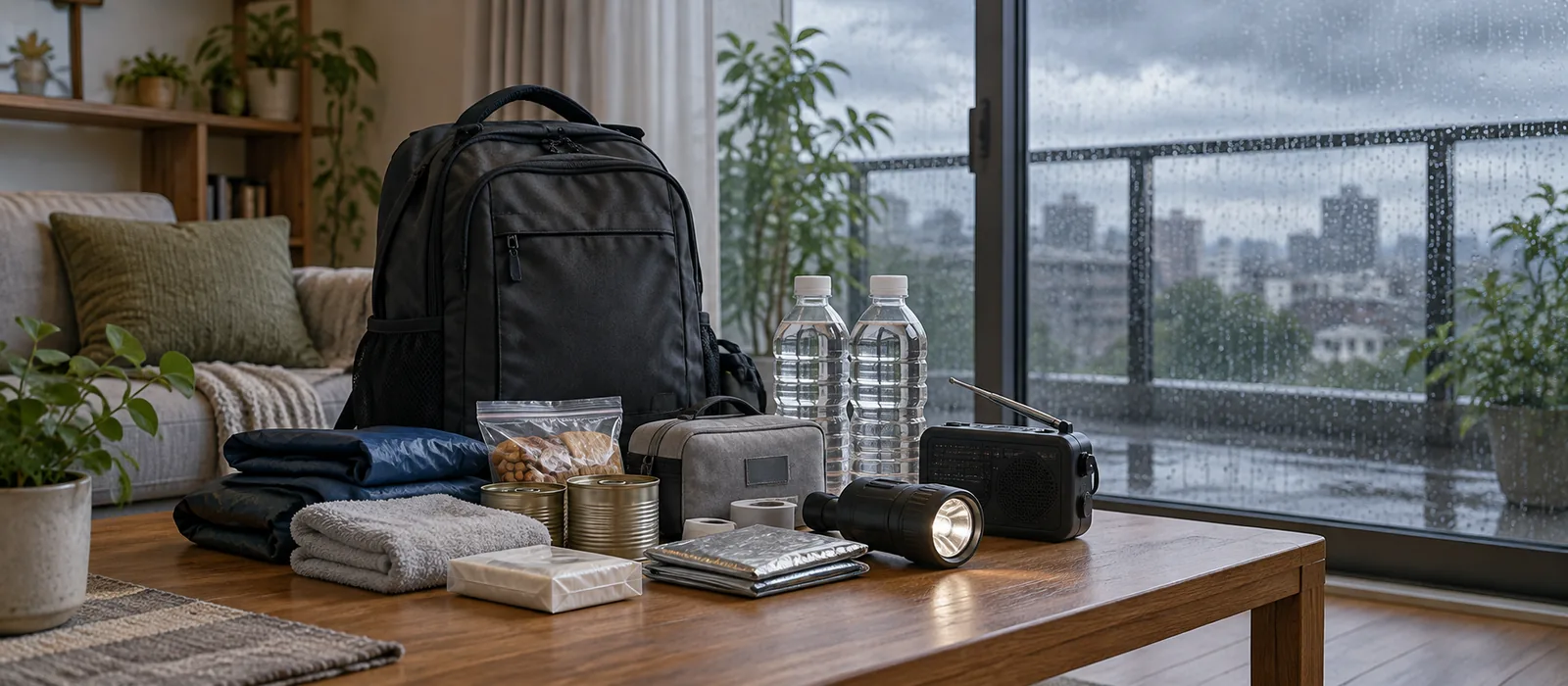
Fill the bathtub the night before. If the water stops, that is your water for flushing the toilet and washing hands. Keep drinking water separately, about 3 liters per person per day. Fully charge your phone, power banks, and laptop, and keep a flashlight or headlamp and a battery radio within reach. Store checkout registers and ATMs can go down in a blackout, so keep cash in JPY 1,000 notes and coins. Pack the freezer with ice packs or frozen water bottles and open the fridge as little as possible once the power is out.
When the lights go out, first check whether it is just your unit or the whole area. If your own breaker has tripped, flip it back on. If the whole area is dark, check the outage map of the regional grid company; in TEPCO’s area that is TEPCO Power Grid outage information. Even if you buy electricity from a newer retailer such as Rakuten Denki, outages and damaged lines or poles are handled by the regional grid company. Stay away from fallen or hanging lines, or lines touching trees or signs, and report them to the grid company.
Sources: Fukuoka Regional Headquarters, JMA: preparing for typhoons, TEPCO Power Grid outage information.
Leave, or stay at home
With supplies ready, the hardest call is whether to leave. Since the 2026 rainy season, warning names carry the alert-level number. When Level 4, an evacuation order, is issued, everyone in a danger zone should leave. Older people and families with babies or small children should move at Level 3, evacuation of older people and others. The new warning names are listed in typhoons and heavy rain.
Evacuating does not have to mean a school gym. The Cabinet Office guidelines count staying with relatives or friends, or at a hotel, as evacuation, as long as those places are outside the danger zone. On the other hand, staying upstairs at home (okunai anzen kakuho, securing safety indoors) can be an option when all three of these are true: your home is outside the zone where the hazard map shows houses may be swept away by river floods; your living space is higher than the expected flood depth; and you have enough water, food, and toilet supplies to last until the water recedes. If any one of them is not true, leave before Level 4.
Once the storm is strong and the streets are flooding, moving can be more dangerous than staying. Even water below the knee can knock you off your feet if it is flowing, so move to the second floor or higher at home or in a solid building nearby. Before leaving home, switch off the main breaker and unplug appliances, to prevent fires when power comes back. If someone is trapped or hurt, call 119. The Japan Visitor Hotline at 050-3816-2787 runs 24 hours a day, every day of the year, in English, Chinese, and Korean, including during disasters.
Sources: Cabinet Office: evacuation information guidelines, JMA: changes to warnings from 2026, MIC: preventing fires after disasters.
After the typhoon: photograph first, then clean up
When the wind dies down, take photos before you start cleaning up. The disaster certificate (risai shomeisho) issued by your city or town is the basis for tax and fee reductions and many kinds of support, and fire insurance claims also need photos of the damage. Once things are cleaned up, you cannot take those photos again.
Municipal guidance is broadly the same everywhere. Photograph the outside of the building from four sides if you can. Inside, take a wide shot of each damaged room and close-ups of the damage. If water came in, hold a tape measure against the wall to show the flood line, in both a wide and a close shot. Cover walls, floors, windows, doors, kitchen, washbasin, toilet, and bathroom, and photograph mud that washed in before you remove it.
Do not use electrical appliances that were under water, even if they still turn on. They may be leaking current inside, so ask the maker or the shop first. When power returns, check wiring and outlets for damage and move anything flammable away, then turn appliances on one at a time.
If the typhoon damages windows, shutters, the balcony, or the water heater in a rental, photograph it and report it to the management company or landlord. How repairs and costs are usually handled is in renting an apartment. Your own furniture and appliances are your property, so they are covered only by contents insurance (kazai hoken) that you took out. Wind cover in fire insurance usually includes windows and roofs damaged by a typhoon, but whether flood cover is included and when it pays depends on the policy. Many policies pay for flooding only above floor level or more than 45 cm above the ground, so contact your insurer soon after the typhoon. Which policies to buy, where, and how claims work are covered in typhoon and earthquake insurance.
Sources: NITE: handling flooded electrical products, General Insurance Association of Japan.
Common mistakes
Last, a few problems that come up every year.
The first is clearing the balcony after the wind picks up. The night before a typhoon, winds can already exceed 15 m/s. Leaning out to reach the laundry pole risks a fall or dropping things onto people and cars below.
The second is assuming a high floor is safe. Flooding will not reach you, but a blackout stops the lifts and the water pumps. In buildings that pump water upstairs, a power cut also means no water, so filling the bathtub matters more the higher you live.
The third is leaving too late. Going out in the middle of the night at the storm’s peak, you cannot see flooded roads or downed lines, and the trip is more dangerous than staying. Deciding when Level 3 comes out in daylight is far safer than being woken by Level 4 at midnight.
The fourth is cleaning up before taking photos. Once soaked carpets and furniture are thrown out, neither the municipal damage survey nor the insurer’s assessment has evidence, and there is no way to go back and take the photos.
Useful terms
- Bofuiki: storm zone
- Amado: storm shutters
- Okunai anzen kakuho: securing safety indoors
- Risai shomeisho: disaster certificate
- Kazai hoken: contents insurance