
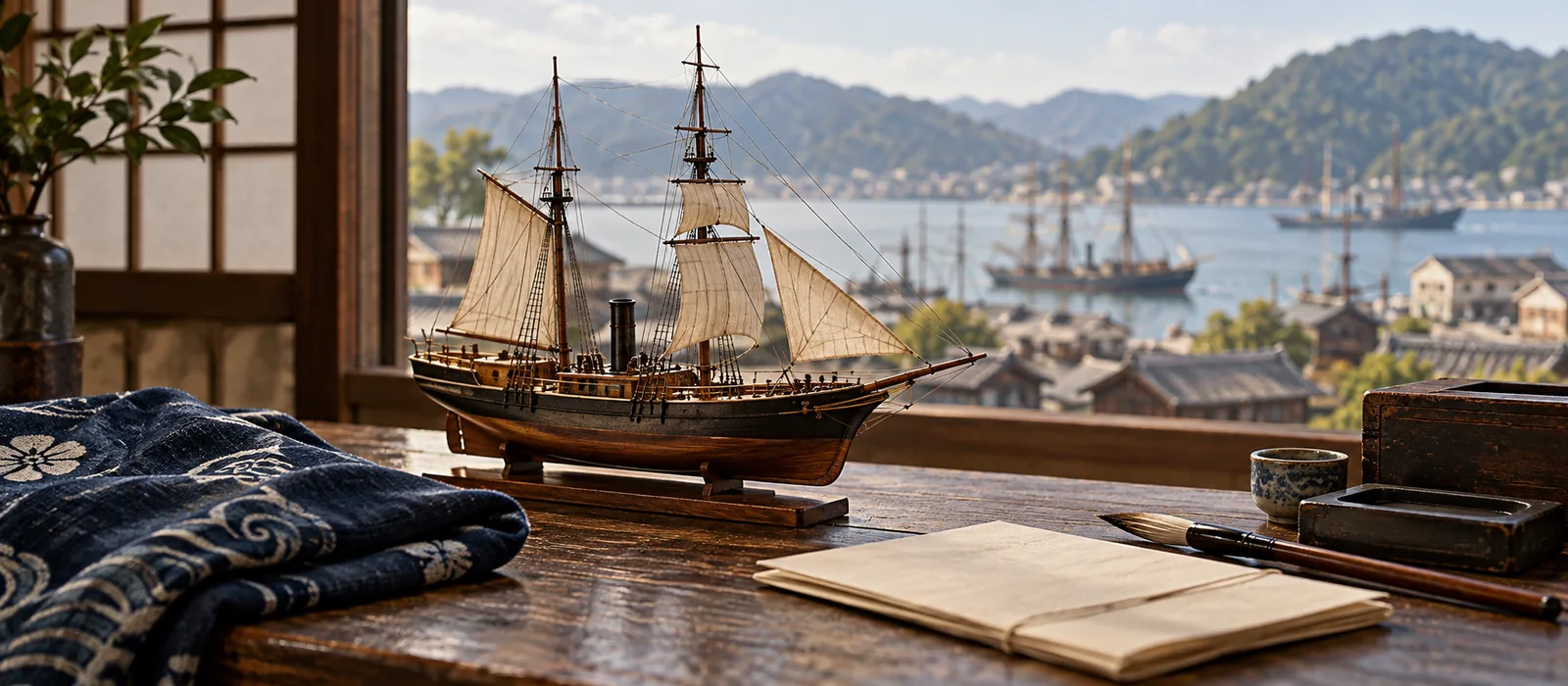
Sakamoto Ryoma: The Runaway Samurai Who Wrote of Giving Japan a Good Wash, and the Hero a Novel Made Bigger
Born the second son of a low-ranking Tosa samurai family, he deserted his domain at 26 (28 by the traditional count), became Katsu Kaishu's disciple, set up the Kameyama Shachu trading company in Nagasaki, helped bring Satsuma and Choshu into alliance, and was assassinated in Kyoto on his birthday by the old calendar, aged 33 by the traditional count. His letters to his sister Otome are now Important Cultural Properties. A late-Meiji magazine reader poll of heroes from around the world reportedly put him only 58th; he became a household hero after Shiba Ryotaro's 1962 novel. This covers his life, which stories hold up, and what to see in Kochi, Nagasaki, and Kyoto.
ARTICLE MAPReading Map
SERIESJapanese LivesFrom the faces on banknotes to figures tied to China: their stories, and where to find them today.2 parts
On the 29th day of the 6th month of 1863 by the old calendar, a 27-year-old masterless samurai from Tosa wrote to his sister far away in Kochi. One moment he was fuming that the shogunate was repairing foreign warships that had fired on Japan; the next he was talking her out of her latest threat to become a nun. In between he wrote a line that would be quoted endlessly: he meant to give Japan “one more good wash” (Nihon wo ima ichido sentaku itashi moshi soro).
The writer was Sakamoto Ryoma. The original letter is now designated an Important Cultural Property, and the many letters he wrote to his sister Otome survive as one of the most reliable primary records of who he was. Almost everyone in Japan knows his name; his statue stands in shopping streets and business leaders love to quote him. But there is a real gap between what he actually did and the stories told about him later. The sections below follow his short 33 years in stages, separating what is backed by his own letters from what is only legend.
Source: Cultural Heritage Online: Sakamoto Ryoma letter to Otome, Bunkyu 3, 6th month, 29th day.
A second-class samurai family in Tosa (1836 to 1853)
Ryoma was born on January 3, 1836 (Tenpo 6, 11th month, 15th day by the old calendar) in Kamimachi, in the castle town of Kochi in Tosa domain. Keep that old-calendar date in mind; it comes back later. The Sakamoto family were goshi, low-ranking samurai, descended from the Saitaniya, a rich merchant house in sake brewing and pawnbroking that had bought its way into samurai status, and they were comfortably off.
Tosa’s samurai were split into upper samurai (joshi) and goshi, and goshi were placed a step lower in dress and etiquette at every turn, with rules said to reach as far as what footwear they could use in the rain and who gave way to whom in the street. That inequality is one reason Tosa produced so many activists against the shogunate, Ryoma among them.
He was the youngest child. His sister Otome, three years older, tall and trained in swordsmanship, looked after him from childhood. Later, as he roamed the country, she was the person he wrote to most, and he told her everything: politics, complaints, and jokes.
Swordsmanship in Edo, and the Black Ships (1853 to 1862)
In 1853, at 17, Ryoma went to Edo to train at the Hokushin Itto-ryu school of Chiba Sadakichi. That same year Commodore Perry’s squadron arrived off Uraga, and Ryoma was sent by his domain to coastal guard duty around Shinagawa, where he is generally said to have seen Western steam warships.
Back in Tosa he joined Takechi Hanpeita’s Tosa Loyalist Party, which called for revering the emperor and expelling foreigners. In 1862, at 26 (28 by the traditional count), he left the domain without permission, an act called dappan. It was a serious crime that meant throwing away his status and becoming a ronin. His second sister, Ei, is said to have suffered for it, though biographies differ on this.
The “came to kill Katsu Kaishu” story (1862 to 1864)
Soon after deserting, Ryoma became the disciple of Katsu Kaishu, a senior official of the shogunate’s navy. In the best-known version, Ryoma went to assassinate Katsu, an advocate of opening the country, only to be won over by Katsu’s account of the wider world and become his disciple on the spot.
The story comes from Katsu’s own recollections late in life. Some researchers point out that the two had mutual acquaintances and probably met in a more ordinary way, and think Katsu exaggerated. What is certain is a letter to Otome dated the 20th day of the 3rd month of 1863 by the old calendar, in which Ryoma proudly tells her he has become a disciple of Katsu, “the foremost man in Japan”, and is busy helping build a navy. That letter is also an Important Cultural Property.
The “good wash” letter was written in 1863, while Ryoma was working for Katsu’s navy plans. The next year, 1864, Katsu formally opened the Kobe Naval Training Center, and Ryoma studied seamanship there. The center closed within a year after political upheaval inside the shogunate.
Source: Cultural Heritage Online: Sakamoto Ryoma letter to Otome, Bunkyu 3, 3rd month, 20th day.
Kameyama Shachu in Nagasaki (1865 to 1867)
After the training center closed, Ryoma took a group of comrades to Nagasaki. In 1865, with backing from the Satsuma domain, they set up Kameyama Shachu, which carried cargo for various domains by ship and traded in weapons, and is often called one of Japan’s first trading companies. In 1867 it was reorganized under Tosa domain as the Kaientai.
The Kaientai had a dispute that looks a lot like a modern commercial case. In 1867 the Iroha Maru, a ship they had chartered, sank after colliding with the Meiko Maru, a large ship belonging to Kishu domain, one of the three senior Tokugawa branch houses. Ryoma argued his side using Western international law (Bankoku Koho), had a song mocking Kishu spread around Nagasaki, and in the end won substantial compensation.
The area around the Kameyama Shachu site is now the Kameyama Shachu Memorial Museum, run by the city of Nagasaki.
Source: Nagasaki City: admission fee reductions at the Kameyama Shachu Memorial Museum.
The Satcho Alliance, and a night at the Teradaya (1866)
Ryoma’s most important role in history was bringing the Satsuma and Choshu domains together. A few years earlier they had fought each other in Kyoto, and they were bitter enemies. Ryoma and his fellow Tosa man Nakaoka Shintaro worked between them, and Ryoma used Kameyama Shachu to help Choshu buy weapons in Satsuma’s name. On March 7, 1866 (Keio 2, 1st month, 21st day by the old calendar), the Satsuma-Choshu Alliance was agreed in Kyoto.
The talks produced only a verbal agreement. The cautious Choshu leader Kido Takayoshi afterwards wrote the terms out in a letter to Ryoma and asked him to confirm them, and Ryoma wrote a guarantee in red ink on the back and signed it. Both that red endorsement and the thank-you letter Kido sent next survive, and the thank-you letter is an Important Cultural Property; together they are direct evidence of Ryoma’s part.
There is also a newer view of how much he mattered. In a 2018 book, Machida Akihiro of Kanda University of International Studies argued that the two domains had settled the framework themselves late in the talks, and that Ryoma was not the go-between at the signing that tradition makes him. It is one scholar’s view and the traditional assessment still has many supporters, but it shows that “no Ryoma, no alliance” is not settled fact.
Source: Cultural Heritage Online: letter from Kido Takayoshi to Ryoma, Keio 2, 2nd month, 22nd day.
Two days after the alliance, on the night of March 9, 1866, Ryoma was surrounded by officers of the Fushimi magistrate at the Teradaya inn in Fushimi, Kyoto. Oryo (Narasaki Ryo), who was bathing downstairs, noticed the commotion and ran upstairs to warn him without stopping to dress properly. Ryoma fired back with a pistol and escaped with wounds to both hands. The two were already married (usually dated to 1864), and after the attack they traveled to Kirishima in Satsuma so he could recover and take the waters, a trip often called Japan’s first honeymoon, though that label was attached later.
The Eight-Point Plan and the return of power (1867)
In 1867 Tosa domain advised the shogun Tokugawa Yoshinobu to return power to the imperial court, and in the 10th month Yoshinobu announced he would. The background is in the Meiji Restoration.
The most popular story is that, on a ship from Nagasaki to Kyoto, Ryoma wrote the Eight-Point Plan (Senchu Hassaku), proposing a parliament, a code of laws, and more, and that Tosa adopted it as the blueprint for the return of power. Recent research notes that no original of the plan survives and that it may have been compiled later. Ryoma’s efforts toward the return of power are on record, but how large his role was is debated among historians.
His 33rd birthday (December 10, 1867)
Just a month after the return of power, December 10, 1867, was the 15th day of the 11th month by the old calendar, Ryoma’s birthday by that calendar; he was 33 by the traditional count. That night he was talking with Nakaoka Shintaro upstairs at Omiya, a soy sauce merchant’s house on Kawaramachi in Kyoto, when several assassins burst in. Ryoma was fatally wounded and died that night; Nakaoka died two days later.
Who did it is still argued over. The strongest view points to the shogunate’s Kyoto Mimawarigumi patrol, one of whose members, Imai Nobuo, confessed to taking part when questioned in the early Meiji years. Other theories blame Satsuma behind the scenes or rivalries within Tosa, and none is settled. Ryoma and Nakaoka are buried side by side at Ryozen in Higashiyama, Kyoto.
Sources: Kyoto City Tourism Association: Walking Kyoto with Sakamoto Ryoma, Sanjo to Shijo, same series, Higashiyama.
How the hero was made
For a long time after his death, Ryoma was not the national hero he is today.
In 1883 a Kochi newspaper serialized Kanketsu Senri no Koma, a novel about Ryoma by his fellow Tosa man Sakazaki Shiran, and he began to be told as a legend. Yet in a reader poll of heroes from around the world run by the magazine Boken Sekai in the late Meiji years (dated to 1908 or 1909), he is reported to have placed only 58th. The writer who truly lifted him up was Shiba Ryotaro, whose novel Ryoma ga Yuku, serialized in the Sankei Shimbun from 1962, made him a young man speaking Tosa dialect, careless of convention and far ahead of his time. Later films and TV dramas followed that image, and NHK’s 2010 historical drama Ryomaden set off another wave of popularity.
There has been pushback too. In 2017 a study group of high school and university teachers proposed cutting the terms in high school history textbooks and entrance exams to about half, and “Sakamoto Ryoma” was among the candidates for removal, arguing his real historical role was smaller than his popular image. The proposal caused an uproar and did not actually remove him from textbooks, but it made a point: much of the Ryoma people picture today is the Ryoma of the novel.
Places to visit today
Ryoma’s traces gather in three cities: Kochi, where he was born; Nagasaki, where he did business; and Kyoto, where he died.
Kochi: Katsurahama and his birthplace
On a rise above the Pacific at Katsurahama, southeast of central Kochi, a statue of Ryoma gazes out to sea. The figure is 5.3 m tall, about 13.5 m with its pedestal, and it was built in 1928 with donations raised by young people of Kochi Prefecture. The nearby Sakamoto Ryoma Memorial Museum is open every day from 9:00 to 17:00 (last entry 16:30); adult admission is JPY 900 during special exhibitions and JPY 500 when only the permanent exhibition is on. Take a bus for Katsurahama from Kochi Station to Ryoma Kinenkan-mae, then walk 2 minutes. Near his birthplace in Kamimachi, in the city center, is the Birthplace of Ryoma Memorial Museum.
Nagasaki: Kameyama Shachu
Nagasaki’s Kameyama Shachu Memorial Museum stands near the site of Kameyama Shachu and is run by the city.
Kyoto: Omiya, Ryozen, and the Teradaya
On Kawaramachi Street stands a stone marking the place where Sakamoto Ryoma and Nakaoka Shintaro were attacked, erected in 1927 by the Kyoto City Education Association. Omiya is said to have actually stood one plot to the south; the owner of the original site would not agree, so the marker went next door. The Kyoto Ryozen Gokoku Shrine in Higashiyama holds the graves of Ryoma and Nakaoka, and the Ryozen Museum of History opposite displays late-Edo material. The Teradaya in Fushimi still operates as an inn open to visitors, but a Kyoto city survey concluded that the original building burned in the Battle of Toba-Fushimi in 1868 and the current one is a later rebuild; some argue parts survived.
Sources: Sakamoto Ryoma Memorial Museum: FAQ, Sakamoto Ryoma Memorial Museum: access, Kochi City Tourism Association: visitor brochure (March 2026, PDF), Nagasaki City: admission fee reductions at the Kameyama Shachu Memorial Museum, Kyoto City Tourism Association: Walking Kyoto with Sakamoto Ryoma, Fushimi.
Common misunderstandings
Last, a few points people often get wrong.
The first is taking scenes from Shiba Ryotaro’s novel as history. Ryoma ga Yuku is fiction, and many of its scenes and lines are invented; for the real man, his letters and other primary sources are the better guide.
The second is thinking Ryoma single-handedly brought about the return of power and the Meiji Restoration. He was an important go-between, but behind the Satsuma-Choshu Alliance lay each domain’s own calculations, and the return of power came out of a contest of interests involving Tosa, Yoshinobu, and many others.
The third is assuming the Teradaya building is the original. A Kyoto city survey concluded it burned in 1868; what stands now is mostly a rebuild.
The fourth is assuming Ryoma was famous nationwide in his lifetime. He was known mainly among activists and domain officials; he drew attention several times after the Meiji era, but became a household name only in the second half of the 20th century.
Useful terms
- Sakamoto Ryoma: the subject of this article
- Dappan: deserting one’s domain
- Kameyama Shachu: his Nagasaki trading company
- Satcho domei: the Satsuma-Choshu Alliance
- Omiya jiken: the Omiya assassination incident
References
- Cultural Heritage Online: Sakamoto Ryoma letter to Otome, Bunkyu 3, 6th month, 29th day
- Cultural Heritage Online: Sakamoto Ryoma letter to Otome, Bunkyu 3, 3rd month, 20th day
- Nagasaki City: admission fee reductions at the Kameyama Shachu Memorial Museum
- Kyoto City Tourism Association: Walking Kyoto with Sakamoto Ryoma
- Sakamoto Ryoma Memorial Museum: FAQ
- Cultural Heritage Online: letter from Kido Takayoshi to Ryoma, Keio 2, 2nd month, 22nd day