
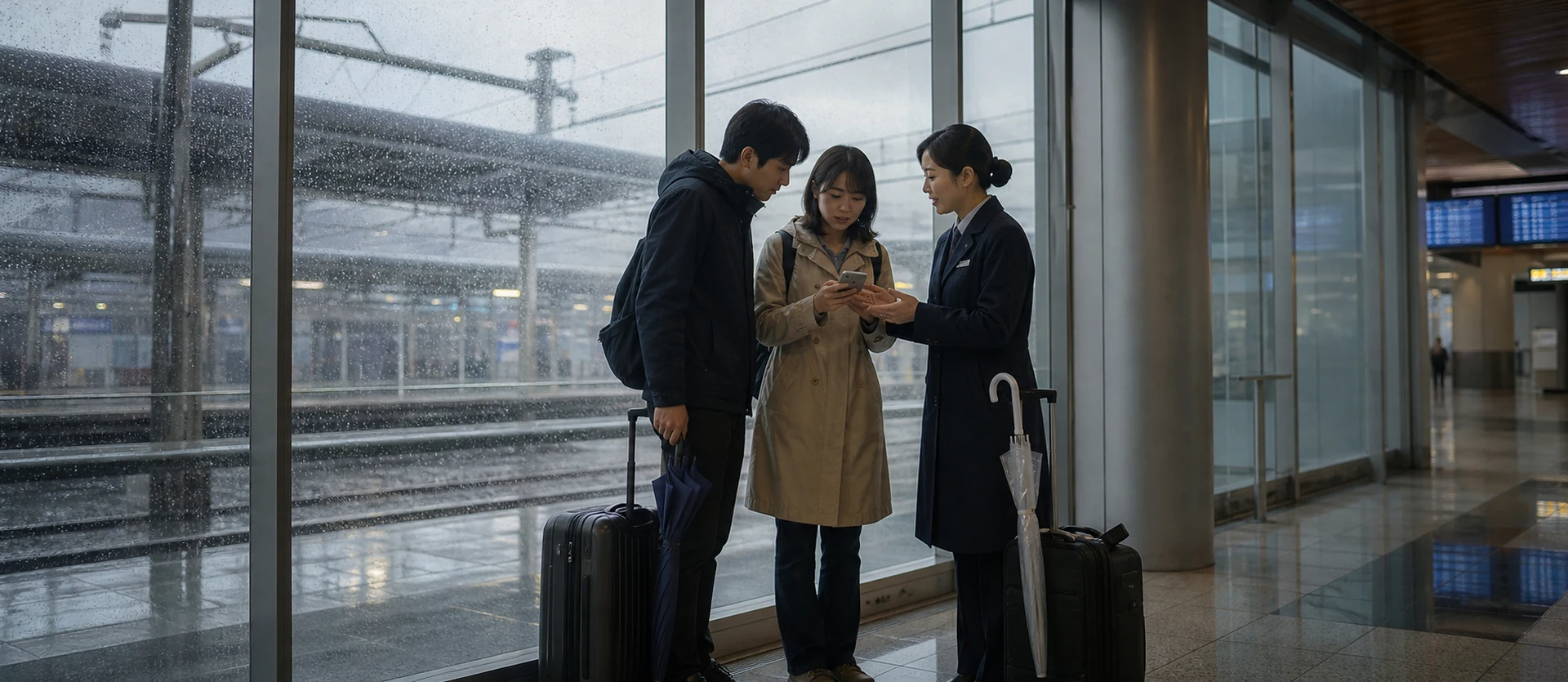
Typhoons and Heavy Rain: Planned Suspensions and Free Rebooking
The 2026 warning rename, the wind speeds that stop trains, when suspensions are announced, how airlines let you move a flight early, and what to do on a washed-out day.
ARTICLE MAP Reading Map
SERIESJapan Summer TravelHeat, sun, heatstroke, medical care, transport, and routes rebuilt around temperature.13 parts
The Japan Weather Association forecast in May 2026 that the year would produce about 28 typhoons with roughly 14 approaching Japan, above an average year, with August approach counts normal to high and the possibility of well-developed storms in autumn. For a trip between July and September, a typhoon is not a question of whether to plan for one but where it ranks. The useful part is that Japan handles this through a highly formalized process: suspensions are announced in advance and nearly every ticket can be moved or refunded without a fee. Knowing the process costs you half a day. Not knowing it costs the itinerary plus change fees.
Warning names changed this year, so read the level number
Start with something new. From the 2026 flood season, the Japan Meteorological Agency aligned disaster weather information with the five-step alert level scale and put the level number into the warning name itself. The old heavy rain warning is now Level 3 Heavy Rain Warning. The landslide warning became Level 4 Landslide Danger Warning. River flooding gained a new Level 5 Inundation Emergency Warning, and the old flood warning and flood advisory were abolished. Information on linear rainbands is now issued as a Weather Disaster Bulletin.
For a traveler this removes the need to memorize which warning maps to which danger. Read the number: 3 means older residents begin evacuating, 4 means everyone leaves a dangerous area, 5 means the disaster is already happening. Emergency alert texts push to any phone on a Japanese network without installing anything. Shelters and the alert levels in full are in disaster preparedness.
Source: JMA: changes to disaster weather information from 2026.
Planned suspensions and how tickets are handled
Warnings are the weather side. Planned suspensions are the transport side, and the two do not move together, so watch them separately.
Rail suspension thresholds are set on wind. Conventional JR lines cut speed at gusts of 20 m/s and stop at 25 m/s, and Shinkansen lines also begin restricting from 20 m/s. Most private railways restrict at 25 m/s and stop at 30 m/s. Those speeds arrive while the storm center is still far away, which is why trains often stop half a day to a day before what the news calls landfall.
Announcements come in two fixed steps. Two days before the forecast arrival, operators publish the possibility of a planned suspension. One day before, they publish the specific lines and time bands. Act on the first announcement. By the second, replacement hotels and tickets are gone.
Ticket handling is generous. Once a suspension is announced or expected, affected tickets are refunded or have their validity changed with no fee, handled at any JR station counter or through the site you booked with. This covers Shinkansen and limited express tickets including reserved seats.
Source: JR Hokkaido: how planned suspensions work.
Airlines let you move before anything is canceled
Airline rules favor travelers more than most people realize. ANA and JAL open fee-free changes and refunds for affected airports as soon as operations are expected to be disrupted, without waiting for an actual cancellation. If the forecast shows a typhoon the day after tomorrow, you can move today’s booking to the day before the storm or to after it, at no cost. The change window typically runs 30 days from the original travel date, and when an outbound leg is canceled the return usually moves with it.
Both airlines publish the affected flights by airport and date on their operations pages. Low-cost carriers set their own rules and some refund only in vouchers, so check at booking.
Sources: ANA: changes and refunds for bad weather, JAL: cancellations and delays.
The day you are stuck somewhere
With tickets moved, the remaining question is how to spend the day, and the answer is mostly indoors. Japanese cities largely shut down during a typhoon, and forcing movement is both risky and unpleasant.
Extend at your current hotel rather than finding a new one; front desks can usually add a night. Department stores and shopping centers often close or shorten hours, and convenience stores stay open but run out of stock, so buy water, food, and a power bank the night before. Underground malls and station-connected complexes are the exception that keeps trading, and places on the scale of the Umeda underground in Osaka or the Meieki underground in Nagoya usually operate normally.
If you must move, avoid buses and bicycles and use the subway. The danger in high wind is flying debris rather than rain, and signs and bicycles lift every year. Stay away from rivers and coastlines, where people are injured watching waves annually.
Three things to have on your phone
Before a trip in typhoon season, set up three things.
Safety tips is a free multilingual app supervised by the Japan Tourism Agency, pushing earthquake early warnings, weather warnings, and evacuation advisories for your location. Kikikuru is the JMA hazard map, updated every ten minutes, showing flooding and landslide risk where you are, and it runs in a browser. Third, bookmark the operations page for whichever carrier you booked, because during a storm those pages update faster than news sites.
One more number: the Japan Visitor Hotline on 050-3816-2787, 24 hours a day, 365 days a year, in English, Chinese, and Korean, including during disasters.
Common mistakes
Watching only the track map is the first. Suspensions follow wind and rainfall rather than the position of the eye, and trains stop while the storm is still hundreds of kilometres away.
Waiting for certainty before changing tickets is the second. Fee-free changes open at the announcement stage, and moving early buys choice. Moving late still works, but by then there are no seats.
Treating an August typhoon separately from Obon is the third. Shinkansen capacity from 7 to 16 August is already tight, and when service resumes after a suspension the backlog fills every following train. That period is covered in the Obon crunch.
Forgetting insurance is the fourth. Trip delay, extra accommodation, and baggage delay are covered by many travel policies, but you need hotel receipts and the airline’s cancellation certificate. The seasonal plan sits in summer travel in Japan.
Useful terms
- Keikaku unkyu: planned suspension announced ahead of a storm
- Unten miawase: service temporarily halted
- Mutesuryo: without handling fee
- Kisho bosai sokuho: weather disaster bulletin, new in 2026
- Kikikuru: the JMA real-time hazard map