
Ryukyu and Okinawan Culture: 450 Years of the Ryukyu Kingdom, Shuri Castle, Kumiodori, Sanshin, and Bingata
Sho Hashi unified the Ryukyus in 1429, and the kingdom grew rich on entrepot trade centered on Shuri Castle. Satsuma invaded in 1609, and in 1879 the kingdom was annexed as Okinawa Prefecture. Shuri Castle's main hall, burned in 2019, opens to the public from November 23, 2026, when adult admission rises to JPY 1,000 and the hall requires booking. Kumiodori was added to UNESCO's intangible heritage list in 2010, and the sanshin, bingata dyeing, awamori, and eisa dancing are still part of everyday Okinawa.
ARTICLE MAPReading Map
SERIESTraditional Japanese CultureBelief, performing arts, crafts, and the Ainu and Ryukyuan cultures, each with where to see them today.11 parts
Belief and festivals
Performing arts and sumo
Crafts and architecture
Diverse Japan
- 10Ainu culture
- 11Ryukyu and Okinawa
Until 1879, what is now Okinawa Prefecture was an independent country, the Ryukyu Kingdom. Through its ties with China, Japan, and Southeast Asia it developed a language, religion, performing arts, and food different from mainland Japan’s, and traces of the kingdom are everywhere in Okinawa’s buildings, music, festivals, and cooking. The sections below follow the kingdom’s history in order, then the culture you can still see.
Unifying three kingdoms, and trading between them all
In the 14th century, Okinawa Island was split among three powers, Hokuzan, Chuzan, and Nanzan. Each built stone strongholds called gusuku and sent tribute to Ming China. In 1429 Sho Hashi of Chuzan unified the three and founded the Ryukyu Kingdom, with Shuri Castle as its palace.
The kingdom prospered on tribute and entrepot trade, carrying Chinese silk and porcelain to Japan, Korea, and Southeast Asia, and Southeast Asian spices and Japanese swords and lacquer to China. The vermilion color and dragon pillars of Shuri Castle’s main hall reflect the influence of Chinese palaces.
In 2000, nine sites including Shuri Castle, Nakijin Castle, and the Sefa-utaki sacred site were listed as the World Heritage site “Gusuku Sites and Related Properties of the Kingdom of Ryukyu”.
The Satsuma invasion and annexation
In 1609 the Shimazu clan of the Satsuma domain sent troops and took Shuri. From then on Ryukyu kept up its formal tribute to China while being controlled in practice by Satsuma, belonging in effect to both.
The Meiji government made the kingdom a domain in 1872, and in 1879 sent soldiers and police to order the king to hand over Shuri Castle, creating Okinawa Prefecture, an event known as the Ryukyu Shobun, the disposition of Ryukyu. The last king, Sho Tai, was moved to Tokyo, and the kingdom that had lasted about 450 years came to an end. Assimilation policies followed, and local languages were banned in schools. The 1945 Battle of Okinawa was one of the largest ground battles fought on Japanese territory and drew in civilians on a scale unmatched elsewhere in Japan; Iwo Jima, part of Tokyo, had seen major ground fighting earlier that year. Okinawa remained under US rule until 1972; that period is covered in war and postwar Japan.
Shuri Castle: the main hall reopens in November 2026
Shuri Castle, symbol of the kingdom, has been destroyed many times by war and fire. The current buildings were restored in 1992, and a fire on October 31, 2019, again destroyed the main hall and other key buildings. With the main hall’s national reconstruction complete, it opens to the public from noon on November 23, 2026, while the North Hall, South Hall, and other buildings lost in 2019 are restored in later phases; the park is closed all day on November 22 and on the morning of the 23rd for the ceremony.
Admission changes the same day, rising from JPY 400 to JPY 1,000 for adults. Entry to the main hall requires an online booking for a 30-minute slot; any remaining same-day slots are sold at the Kankaimon gate ticket office and online until 15 minutes before the slot. Other paid areas need no booking. Tickets for November 23 to December 31 went on sale in two batches on September 1 and October 1, and from January 2027 each month’s tickets go on sale at 13:00 on the 1st of the month two months earlier. It is about a 15-minute walk from Shuri Station on the Yui Rail monorail.
Sources: Shuri Castle Park, Travel Watch: Shuri Castle main hall opening and new fees.
Kumiodori and the sanshin: arts of the royal court
The most representative court art of the kingdom is kumiodori, a dance drama combining spoken lines, music, and dance. In 1719 Tamagusuku Chokun, an official in charge of entertaining the Chinese envoys who came to invest each new king, created the first works for their banquets. Kumiodori was inscribed on UNESCO’s Representative List of the Intangible Cultural Heritage in 2010, and the National Theatre Okinawa in Urasoe is its dedicated venue, with regular performances.
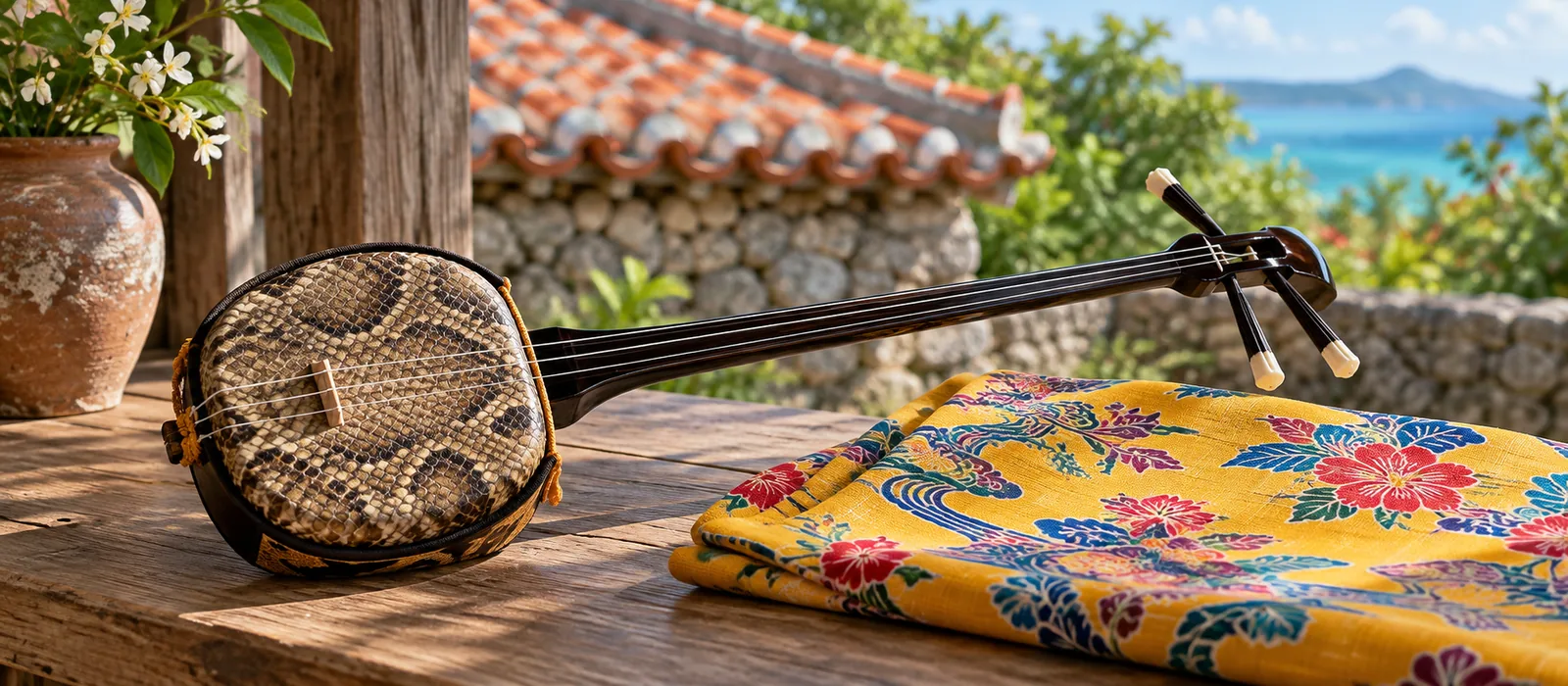
The sanshin that accompanies it came from the Chinese sanxian and is covered with snakeskin; it later traveled to Osaka and became the mainland shamisen. Okinawan folk and pop music still revolve around the sanshin, and folk-music bars around Kokusai Street in Naha have live playing every night.
Source: Agency for Cultural Affairs: intangible cultural heritage.
Ryukyu in daily life: bingata, awamori, eisa, and shimakutuba
The kingdom’s culture lives on in everyday life. Bingata is brightly colored cloth dyed with stencils and many pigments, originally worn by royalty and the warrior class; workshops around Naha and Shuri welcome visitors and offer hands-on sessions. Awamori is a distilled liquor made from Thai rice with black koji mold, a method said to have arrived from Southeast Asia in the kingdom’s time.
Around the Bon festival each year, by the old calendar, local youth groups parade through their neighborhoods beating drums and playing sanshin in eisa dances that welcome and send off ancestral spirits; you can see them across Okinawa from late August into September. Okinawa’s languages are known together as shimakutuba and differ sharply from mainland dialects. UNESCO lists Okinawan and the other Ryukyuan languages as endangered, and an Okinawa Prefecture ordinance in 2006 made September 18 Shimakutuba Day to encourage passing them on.
Source: Okinawa Prefecture: shimakutuba promotion plan.
Common misunderstandings
Last, a few points that are often confused.
The first is thinking Okinawa was always part of Japan. The Ryukyu Kingdom was an independent state with its own king and diplomacy for about 450 years, and it became Okinawa Prefecture only in 1879.
The second is taking Shuri Castle for an ancient building. Today’s buildings are the result of two restorations, in 1992 and after the 2019 fire; the originals burned in the Battle of Okinawa in 1945. Parts of the stone walls and underground remains preserve the original layout.
The third is treating the sanshin and the shamisen as the same thing. The sanshin came to Ryukyu from the Chinese sanxian and uses snakeskin; the shamisen is the mainland adaptation of the sanshin, using cat or dog skin, with a different sound and playing style.
The fourth is thinking Okinawan is just a Japanese accent. The Ryukyuan languages are a separate branch of the same family as Japanese, and mainland Japanese speakers can barely follow them without study.
Useful terms
- Ryukyu okoku: the Ryukyu Kingdom
- Gusuku: Ryukyuan castles and strongholds
- Ryukyu shobun: the annexation of Ryukyu
- Kumiodori: Ryukyuan court dance drama
- Shimakutuba: Okinawa’s local languages