
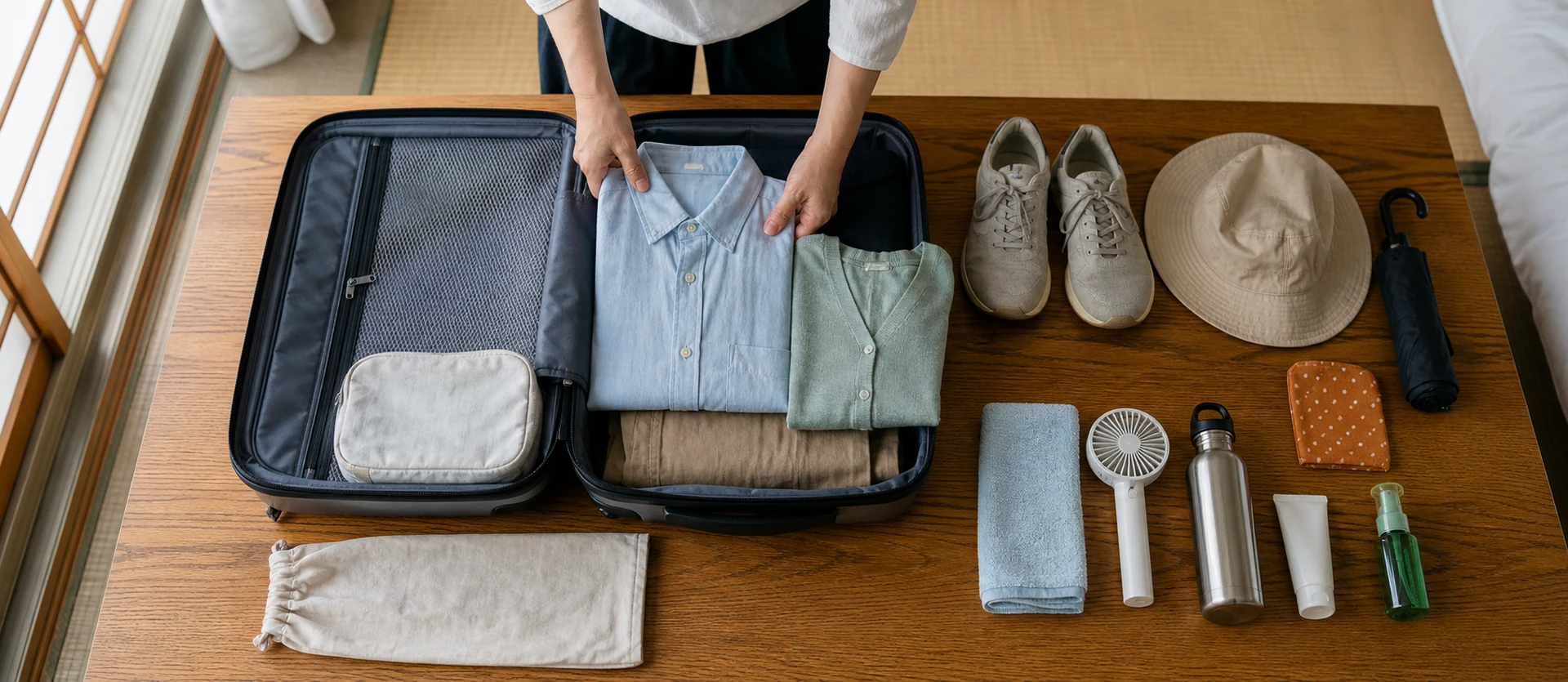
What to Wear and Carry in a Japanese Summer
Tokyo averages 31.3C and 74 percent humidity in August. Fabric labels, the jacket you will need indoors, shoes for 20,000 steps, sweat products, repellent rules, and luggage storage.
ARTICLE MAP Reading Map
SERIESJapan Summer TravelHeat, sun, heatstroke, medical care, transport, and routes rebuilt around temperature.13 parts
What makes a Japanese summer hard is humidity rather than the temperature reading. Tokyo’s normals for August are a daily high of 31.3C, a daily low of 23.5C, and mean relative humidity of 74 percent, measured over 1991-2020; July runs 29.9C and 76 percent. At 31C in a dry climate sweat evaporates as it forms. At this humidity it stays on the skin, and both comfort and heat loss change completely. 2026 has run hotter than the normals, with Gujo in Gifu reaching 40.0C on 21 July. Pack for that.
Two fabric labels, plus a jacket
Japanese summer clothing carries two different functional labels. Kyukan sokkan means it absorbs sweat and dries fast, solving the clammy problem. Sesshoku reikan means it feels cool on contact through fast heat conduction, which is pleasant for a moment and matters less over a day. In this humidity, prioritize the first. Uniqlo’s AIRism range and the equivalents at the workwear chain Workman are available nationwide at ¥1,000 to ¥2,000 a piece.
Color and coverage are part of sun protection. A thin long-sleeved layer with a UV-cut label is less effort than reapplying lotion. Dark colors block ultraviolet better but absorb heat, light colors do the reverse, so a pale UV-cut long sleeve plus sunscreen is the balanced answer. Product choice is in drugstore sun protection.
Bring a light jacket. Trains, underground malls, department stores, and restaurants run their air conditioning hard, and stepping in from a 35C street often means a drop of 10C or more. A cardigan or sun shirt that folds into a bag is the single most used garment on a Japanese summer trip.
Shoes decide whether tomorrow happens
After clothing, footwear has the largest effect. A day of sightseeing in Tokyo or Kyoto reaches 15,000 to 20,000 steps easily, and station transfers add more: at Shinjuku or Umeda, a single transfer over 500 m is unremarkable.
Take breathable trainers, and not new ones. Sandals and flip-flops look right for the season, but the tops of your feet burn, which is the spot nearly everyone forgets to cover, and straps rub over long distances. Some temple and shrine buildings require removing shoes, where easy-off footwear saves time, but wear socks; bare feet on tatami read badly in many settings.
Pack two extra pairs of socks. In this humidity, wet socks left on lead to blisters the next day. Drugstores and convenience stores sell replacements.
Managing sweat is a daily task here
Japan is attentive to body odor, which is why the product category is so deep.
Body sheets are the everyday tool. Gatsby and Biore versions are in every convenience store and drugstore at ¥300 to ¥500 for 20 to 30 sheets, and the menthol versions cool noticeably. Antiperspirants come as sprays, roll-ons, and sticks, applied before leaving. Between them they cover most situations.
Plan on changing clothes more often, realistically two tops a day. If a hotel room will not dry laundry, a coin laundry costs ¥500 to ¥800 for a wash and dry cycle taking 60 to 90 minutes, and many run 24 hours in residential areas and beside some convenience stores. Business hotels often have machines on site.
Insects, rain, and a few small things
Two more variables come with being outdoors in summer.
Repellents in Japan are sold by active ingredient, and the concentration is what to read. DEET at 30 percent cannot be used on anyone under 12. At 12 percent or below it cannot be used under 6 months, is limited to once a day under 2 years, and one to three times a day from 2 to 12. Icaridin at 15 percent has no age or frequency limit, irritates skin less, and does not attack plastics or synthetic fabrics, which makes it the simplest choice with children. Concentration sets duration rather than strength: about 6 hours for DEET 30 percent, 5 hours at 15 percent, 3 hours at 10 percent. For bites, Muhi-type topical treatments are on every drugstore shelf.
For rain, July and August bring both late rainy-season downpours and afternoon thunderstorms, plus typhoons. Convenience stores sell clear plastic umbrellas at around ¥700, but they block no ultraviolet; a folding umbrella rated for sun and rain with UV-cut does both jobs. Storm handling is in typhoons and heavy rain.
Add a power bank. A handheld fan, navigation, translation, and photos roughly double phone consumption, and rental services such as ChargeSPOT at stations and convenience stores are often empty at peak times. Cooling gear is covered in heatstroke prevention.
What to do with luggage during the day
Dragging a suitcase through a 35C street is the most exhausting thing you can do, and Japan’s storage infrastructure is good enough to avoid it.
Coin lockers at major stations are extensive, at roughly ¥400 to ¥500 for small, ¥600 to ¥700 for medium, and ¥800 to ¥1,000 for large per day, with most accepting IC cards. The weakness is that central stations fill up during Obon and at weekends. The alternative is a service like ecbo cloak, which turns cafes and shops into storage points booked through an app at ¥500 to ¥800 per item per day, with far better certainty than hunting for a free locker.
For intercity moves, hands-free travel goes further: send the bag by takuhaibin courier from one hotel directly to the next, at ¥2,000 to ¥3,000 per item, usually arriving the following day, arranged at the front desk. Keep what you need that day in a day bag.
Common mistakes
Packing to the temperature number is the first. 31C at 74 percent humidity and 31C at 40 percent are different weather, and the figure alone will mislead you.
Ignoring the indoor-outdoor gap is the second, and it is the main reason people catch colds in a Japanese summer.
Dress codes are the third. Sightseeing places have essentially no restrictions on shorts and sandals, but upmarket restaurants, some bars, and certain tea rooms and special temple viewings do. If any of that is on the itinerary, bring long trousers and one pair of proper shoes.
Buying everything before you leave is the fourth. Apart from well-fitted shoes and your regular medication, most of this is cheaper and better matched in a Japanese drugstore or convenience store, and leaving suitcase space is the more useful move. The seasonal plan is in summer travel in Japan.
Useful terms
- Kyukan sokkan: absorbs sweat and dries quickly
- Sesshoku reikan: cool to the touch on contact
- Asefuki sheet: body wipe for sweat
- Mushiyoke: insect repellent, read the DEET or icaridin percentage
- Tebura kanko: hands-free travel, forwarding luggage to the next hotel