
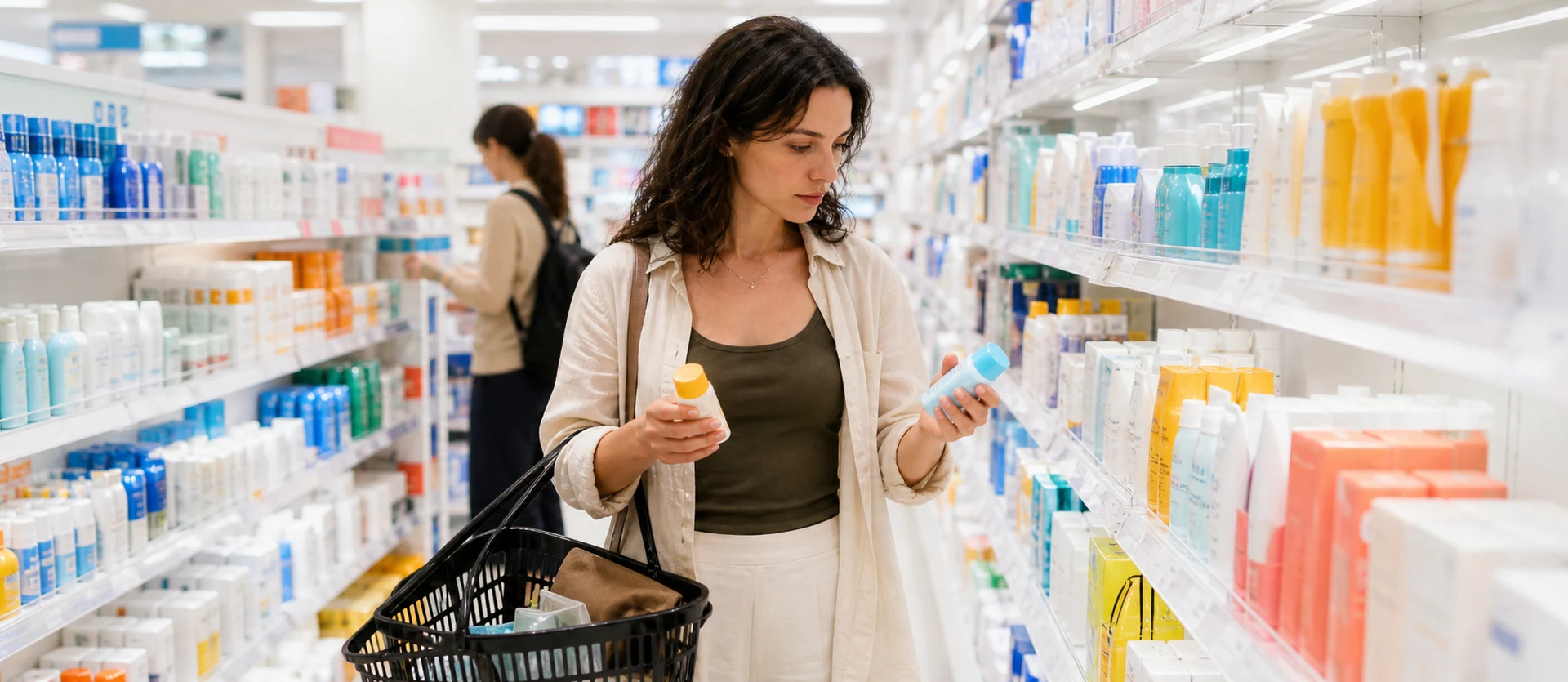
Buying Sun Protection at a Japanese Drugstore
SPF and PA caps, chemical versus mineral filters, which format to buy, how much to apply, and the duty-free rule that stops you using it here.
ARTICLE MAP Reading Map
SERIESJapan Summer TravelHeat, sun, heatstroke, medical care, transport, and routes rebuilt around temperature.13 parts
July and August carry the strongest ultraviolet radiation of the Japanese year. Outside Sapporo, the main observation points run a UV index above 8 for several hours around noon, which the World Health Organization scale calls very high. Three hours outdoors without protection will redden skin. Drugstores stock a deep range at low prices, so the problem is choosing rather than finding.
SPF and PA cover different damage
Both numbers appear together but measure different things. SPF applies to UVB, which causes burning and redness. PA applies to UVA, which causes tanning and photoaging and passes through glass and thin cloud, so it reaches you in a train seat or on an overcast day.
Japanese labeling stops at SPF 50+ and PA++++. Choose by the day rather than by the maximum: SPF50+ with PA++++ for a full day outside, at the beach, or in the mountains; around SPF30 with PA+++ for indoor days with short transfers. Applying an even layer matters more than the printed number.
Filters decide feel and removal
The second choice is how the product blocks light, and it determines both texture and how you wash it off at night.
Chemical filters convert ultraviolet into heat. They feel light, leave no white cast, and give strong protection, but can irritate sensitive skin. Mineral filters use titanium dioxide and zinc oxide to reflect light. They are gentler but heavier and can leave a white cast. A label reading non-chemical or without UV absorber means a mineral-only formula, which is the starting point for sensitive skin and children.
Removal follows the formula. A product marked as washing off with soap comes away with normal face wash. Anything else, especially waterproof formulas, needs a proper cleanser, and residue causes problems. Fancl Sunguard 50+ pairs mineral filters with water resistance, and Mamabutter UV Barrier Moist Milk targets sensitive skin. Both are on drugstore shelves.
Format follows the situation
| Format | Japanese label | Best for |
|---|---|---|
| Gel | jeru | Large areas, lightest feel, slightly lower protection |
| Milk | miruku | Long wear, the default for a full day outdoors |
| Cream | kurimu | Heaviest, for dry skin and maximum protection |
| Spray | supure | Reapplying on scalp, back, and legs |
| Stick | sutikku | Reapplying on the face without disturbing makeup |
The working combination is a milk or gel before leaving and a spray or stick in the bag for reapplication. Spray alone as a base layer never lands enough product and leaves streaks.
Quantity and reapplication decide the result
Most people fail on volume. Rated SPF and PA figures are measured at 2 mg per square centimetre. Applying half that gives roughly half the protection. For a face, the guide is a coin-sized amount, dotted on forehead, cheeks, nose, and chin before spreading, which lands more evenly than one blob.
Reapply every two to three hours. Waterproof means water and sweat resistant, not permanent, and swimming or wiping your face removes a layer. Ears, the back of the neck, the backs of hands, and the tops of feet are the four spots people miss. A day in sandals with burnt feet ends the walking part of a trip.
Where to buy and what tax-free actually means
Matsumoto Kiyoshi, Welcia, Sundrug, Cocokara Fine, and Don Quijote carry largely the same open-shelf products, with many stores open to 21:00 or 22:00 and price differences in the tens of yen. Biore UV in 60-90 g runs about ¥700 to ¥1,200, with the Aqua Rich line lighter and the Athlizm line built for sweat. Anessa Perfect UV Skincare Milk N 60 mL lists at ¥3,058. Skin Aqua, Allie, and Nivea Sun fill the middle.
The tax-free rule is counterintuitive. Sunscreen is a consumable, so ¥5,000 to ¥500,000 spent in one store on one day qualifies, but duty-free consumables are sealed in a bag that may not be opened inside Japan. Break the seal and customs collects the tax on departure. Buy the bottle for this trip at the normal price and reserve duty-free for what goes home. From 1 November 2026 the system changes to paying tax at the register and claiming a refund at customs on departure; this summer still uses point-of-sale exemption.
Sources: Japan Tourism Agency: tax-free system overview, Japan Tourism Agency: refund method from November 2026.
Common mistakes
Skipping cloudy days and indoor days is the first. UVA passes through cloud and glass, and three hours in a Shinkansen window seat counts.
Treating sunscreen as the only tool is the second. Parasols are used by men and women in Japan, but the clear plastic umbrellas sold in convenience stores block rain and not ultraviolet, so look for a UV-cut label. A hat and a light long-sleeved layer work as well as lotion.
Mishandling sunburn is the third. Sunburn is a burn: cool it with cold water or an ice pack, then rehydrate the skin. Blistering or large hot areas need a dermatologist. Aloe gels and after-sun products in drugstores relieve without treating.
Overdosing children is the fourth. Infants do better with physical cover plus a mineral formula, and products labeled baby or kids use gentler chemistry that also washes off more easily.
For the heat itself rather than the light, see heatstroke prevention, and for the whole season see summer travel in Japan.
Useful terms
- Shigaisen kyushuzai: chemical UV absorber
- Shigaisen sanranzai: mineral UV reflector, titanium and zinc oxide
- Non-chemical: formula without chemical absorbers
- Waterproof: water and sweat resistant, still needs reapplication
- Higasa: parasol, worth choosing with a UV-cut rating