
Osaka in Summer: Three Underground Malls and No Surface Walking
August normals of 33.7C, and 1,041 heatstroke ambulance calls in one July week, the highest of any prefecture. How Whity Umeda, Namba Walk, and Crysta Nagahori connect, plus Kaiyukan and a valley 24 minutes from Umeda.
ARTICLE MAP Reading Map
SERIESJapan Summer TravelHeat, sun, heatstroke, medical care, transport, and routes rebuilt around temperature.13 parts
Start here
Health
Transport
City routes
Osaka’s August normals are a daily high of 33.7C, a daily low of 25.8C, and mean humidity of 66 percent, measured over 1991-2020. In the week of 13-19 July 2026, Osaka Prefecture recorded 1,041 heatstroke ambulance calls, the highest of all 47 prefectures. Temperature is only part of it: the sightseeing spine runs north to south along Midosuji with a high share of surface walking. The counterweight is that Osaka has some of the largest underground malls in Japan, and moving the route below ground changes the day entirely.
Three underground malls, and how they join up
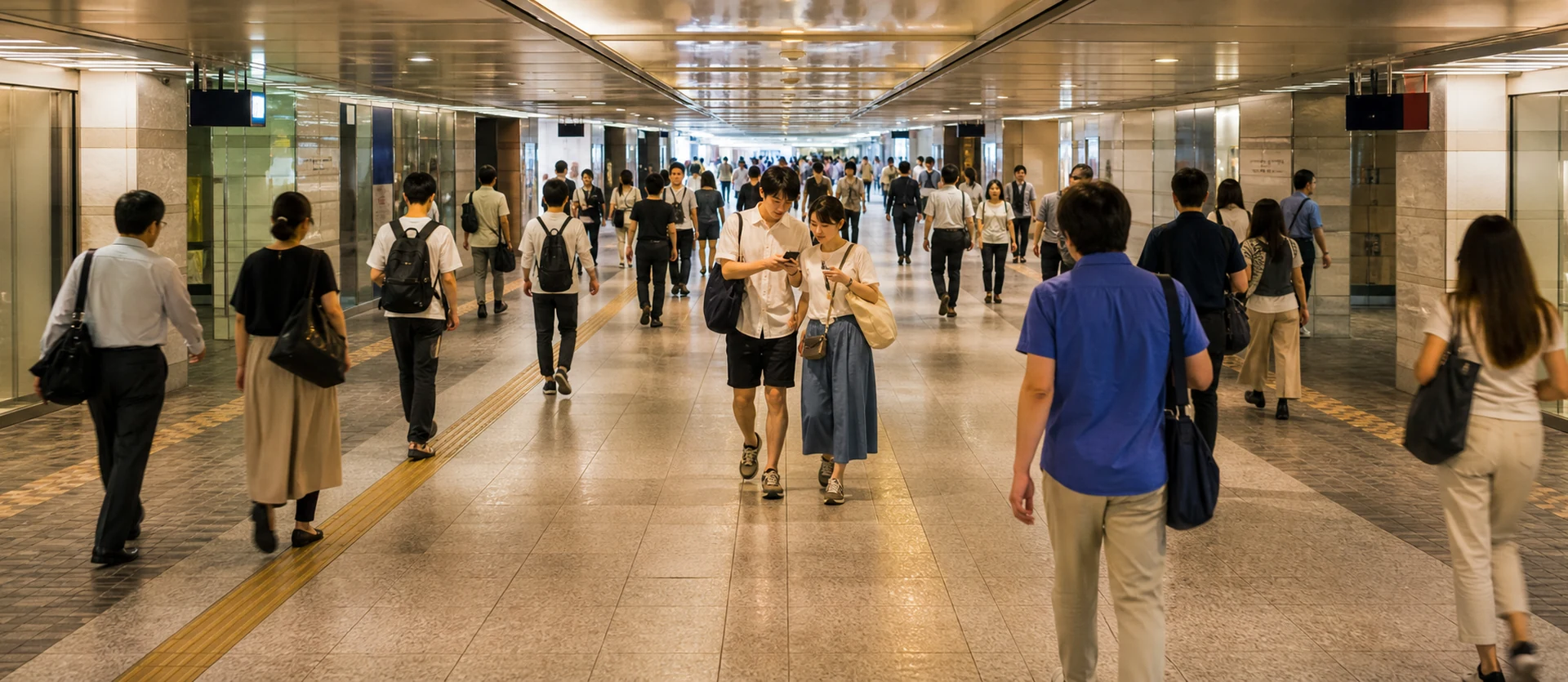
Central Osaka’s underground is not a set of scattered passages but three continuous commercial spaces of several hundred meters each, one per district.
| Underground mall | Location | Length |
|---|---|---|
| Whity Umeda | Umeda, south of JR Osaka Station | about 600 m |
| Namba Walk | Namba, east to west from Nippombashi to Yotsubashi-line Namba | 715 m |
| Crysta Nagahori | Shinsaibashi, under Nagahori-dori from Yotsubashi-suji to Sakai-suji | 860 m, of which 730 m is mall |
Use them as air-conditioned arterial roads. Around Umeda, the department stores, subway, and Hankyu and Hanshin lines all connect through Whity Umeda without surfacing. Between Shinsaibashi and Namba, Crysta Nagahori and Namba Walk relay you from the southern end of the Shinsaibashi-suji shopping street to Namba Station under cover. Shinsaibashi-suji itself has an arcade roof but no air conditioning, and it gets stifling in the afternoon, so dropping into the underground periodically is the practical move.
Station layouts and line roles are in Osaka transit, and the relationship between Umeda’s seven station names is in Umeda.
Indoor anchors: Kaiyukan and Nakanoshima
For longer indoor stays, there are two directions.
Osaka Aquarium Kaiyukan at Tempozan charges adults ¥2,700 to ¥3,500 depending on the period, and generally opens 10:00 to 20:00 with last entry an hour before closing, so confirm your date on the official site. Fully indoors, the Pacific Rim exhibit spirals downward and takes over two hours, which makes it the sturdiest option for the middle of the day. The Tempozan Market Place and Ferris wheel sit next door.
Nakanoshima is the other direction, with two art museums and a cluster of early modern buildings on one sandbank, short walks between them and shelter along the way. The Nakanoshima Museum of Art and the National Museum of Art face each other across a road. The area in detail is in Nakanoshima.
For height, Harukas 300 costs ¥2,000, the Umeda Sky Building floating garden ¥1,500, and Tsutenkaku ¥1,500 under its April 2026 pricing. All three are best at dusk; queue times and prices are in a day across Osaka.
Evenings in Dotonbori and along the water
Osaka only starts properly after sunset, which is also when it becomes comfortable.
Dotonbori lights up from around 17:00, and the neon at Ebisubashi is the signature view. In summer the Tonbori River Walk along the canal runs cooler than the arcade, and you can follow the water from Nippombashi to Minatomachi River Place. Sightseeing boats add evening sailings.
On food, locals use a summer pattern worth copying: skip hot fried food in the day and eat the flour dishes at night. Kushikatsu and takoyaki shops are mostly standing counters or small rooms, and queuing outside them at midday is a poor trade, while the evening is busier but far cooler. The kushikatsu cluster sits at the foot of Tsutenkaku in Shinsekai, in the range of ¥1,500 to ¥2,500 for ten skewers. Categories are in eating in Osaka and the district layout in Namba and Shinsaibashi.
A valley half a day away
When the forecast passes 35C, there is a gorge within commuting distance to the north.
Minoo lies in northern Osaka Prefecture. From Hankyu Osaka-umeda take the Takarazuka line to Ishibashi handai-mae and change to the Minoo line, about 24 minutes to Minoo Station. From there the Takimichi trail runs about 2.7 km, roughly 40 minutes, to Minoo Great Falls on a paved gentle slope that needs no hiking gear. The path follows a stream under tree cover, and the water noticeably lowers how the air feels. On the way back, the fried maple leaf snack sold outside the station is the local specialty.
Further options run toward Mount Rokko and Arima Onsen, about 30 minutes from Osaka to Sannomiya and then up; the Kobe side is in the Kobe waterfront. Toward Kyoto, the streamside dining platforms at Kibune are in Kyoto in summer.
August festivals and fireworks
Osaka’s two big summer events fall in late July and August. Tenjin Matsuri runs on 24 and 25 July, with the boat procession and dedicatory fireworks on the Okawa on the evening of the 25th, one of Japan’s three great festivals. Early August brings the Naniwa Yodogawa Fireworks Festival on the Yodo river flats, after which stations toward Juso and Umeda impose entry restrictions.
Viewing spots, paid seating, and yukata rental are in fireworks festivals, the national calendar is in the annual festival calendar, and Shinkansen rules for the period are in the Obon crunch.
Common mistakes
Misjudging Midosuji on foot is the first. The main north-south axis from Umeda to Namba runs about 11.5 km, which looks walkable on a map and finishes you in summer. Two stops on the Midosuji subway often takes two minutes, and this is not the fare to economize on.
Assuming arcades are cool is the second. Shinsaibashi-suji and Tenjinbashi-suji have roofs but no air conditioning, and they get worse as they fill, so step into an air-conditioned shop at intervals.
Timing Kuromon Market badly is the third. Seafood and fruit stalls peak around midday in narrow, poorly ventilated aisles; between 09:00 and 10:00 it is a different place.
Neglecting fluids and cooling is the fourth, given Osaka’s position at the top of the ambulance figures. The decision line is in heatstroke prevention, the kit list in what to wear and carry, and the seasonal plan in summer travel in Japan.
Useful terms
- Chikagai: underground shopping mall, the summer arterial route
- Takimichi: the streamside trail from Minoo Station to the falls
- Funatogyo: the river boat procession at Tenjin Matsuri
- River Walk: the promenade along the Dotonbori canal
- Nyujo kisei: station entry restriction after a large event