Heatstroke in Japan: Alert Levels, Symptoms, and First Aid
How to read WBGT bands, the three severity grades, the three cooling points, what to drink, and what a drugstore sells for the heat.
ARTICLE MAP Reading Map
SERIESJapan Summer TravelHeat, sun, heatstroke, medical care, transport, and routes rebuilt around temperature.13 parts
Heatstroke is not discomfort from a long day in the sun. It is a continuous failure of temperature regulation, and there is no obvious step between dizziness and loss of consciousness. In the week of 13-19 July 2026, ambulances carried 10,857 people in Japan for heat illness, and people aged 65 and over made up more than half. The most common location was not outdoors but at home. On a trip that translates to a hotel room with the air conditioning switched off overnight.
WBGT decides what the day can hold
WBGT, the heat index, reflects strain better than air temperature because it includes humidity and radiant heat. The Japanese Society of Biometeorology and the Japan Sport Association set five bands, and the Ministry of the Environment publishes measured and forecast values by location.
| WBGT | Band | Daily life | Exercise |
|---|---|---|---|
| 31 and above | Danger | Risk even at rest for older people, avoid going out | Cancel as a rule |
| 28-31 | Severe caution | Avoid direct sun, watch indoor temperature | Stop hard exercise, rest every 10-20 minutes |
| 25-28 | Caution | Rest regularly during moderate activity | Rest every 30 minutes |
| 21-25 | Attention | Low risk except in hard exercise or labor | Drink actively |
| Below 21 | Nearly safe | Low risk in general | Drink as needed |
Japanese cities sit above 28 for most of a July or August afternoon and often pass 31 around midday. Read the table backwards into an itinerary: at 31, keep continuous outdoor walking under 30 minutes with an air-conditioned stop in between; at 28-31, find a convenience store or underground passage every 15 minutes. A route app saying twenty-five minutes on foot costs roughly what an hour costs in a mild season.
Source: Ministry of the Environment: about WBGT.
Three grades and one decision line
The Japanese Association for Acute Medicine has graded heat illness by required treatment since 2000.
Level I is manageable on the spot: dizziness, greying vision on standing, heavy sweating, numb hands or feet, muscle cramps. Level II needs a hospital: headache, vomiting, fatigue, and dropping concentration, where the person says they feel bad but cannot say where. Level III needs inpatient care: altered consciousness, seizures, hot skin, unsteady walking, slow response to their own name.
In practice you check two things. Is anything at all off about their awareness, in which case treat it as Level II or worse and do not wait for improvement. And can they drink water by themselves, because if they cannot, or they choke on it, call 119 and do not try to pour liquid in.
Sources: Ministry of the Environment: what to do about heat illness, Fire and Disaster Management Agency: heatstroke information.
First aid runs in a fixed order
Once you have judged the grade, the order of actions matters as much as the actions.
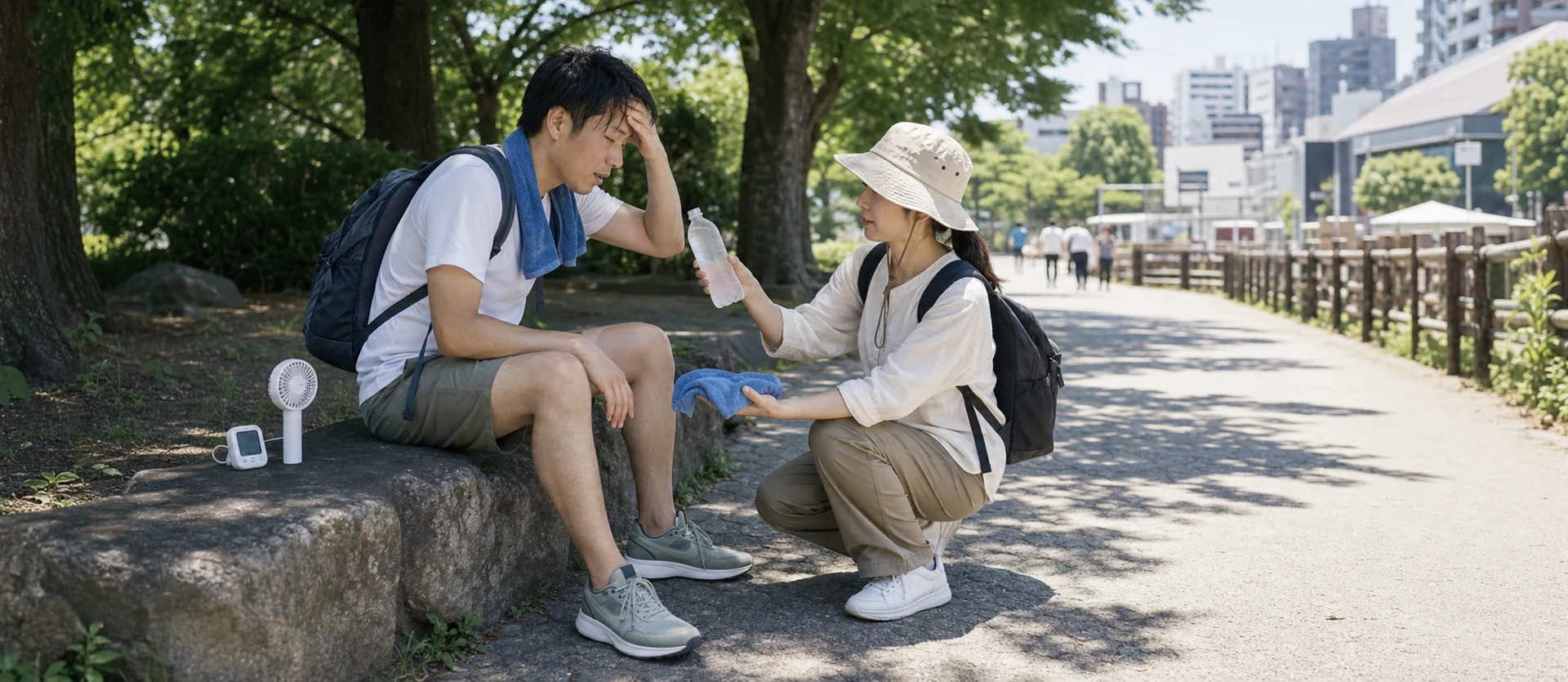
Move to shade or an air-conditioned room first. In Japan the nearest cooling point is usually a convenience store, an underground passage entrance, a station waiting room, or the ground floor of a department store, and you may simply walk in. Loosen clothing next, including collar, belt, and shoes. Then cool: ice packs, chilled drink cans, or convenience-store ice wrapped in a towel, held against the sides of the neck, the armpits, and the front of the groin. Large veins run close to the surface at those three points, which cools blood far faster than a forehead compress. Wetting the skin and fanning adds evaporative cooling.
Fluids and salt come fourth, and only if the person is alert and can drink unaided. Do not leave them alone at any stage, because the slide from Level II to Level III can take fifteen minutes.
Ambulances are called on 119, work nationwide around the clock, and are free. The operator asks for location, symptoms, age, and whether the person is conscious. Saying English please works, and major fire departments have three-way interpretation. Phrasing is in emergencies and 119.
What to drink, how much, how cold
Oral rehydration solution carries more than double the sodium of a sports drink with less sugar, and it matches a body that is already dehydrated. Products sold in Japan are made under the national food-for-the-sick framework, the formula follows the World Health Organization pattern, and OS-1 from Otsuka Pharmaceutical Factory is the common brand, in bottles and jelly pouches, at drugstores and some convenience stores. Pocari Sweat and Aquarius are sports drinks, fine for topping up while walking, too weak in sodium once dehydration is visible.
Water alone dilutes blood sodium further and can make symptoms worse, which is the usual reason someone collapses after drinking plenty. Three meals supply roughly one liter of fluid a day, leaving about 1.2 liters to drink deliberately, more on a hot day of walking. Small amounts often beat one large bottle, and 5-15C absorbs faster than room temperature, which is what a convenience store chiller holds.
Salt tablets with plain water are the simplest combination, a few hundred yen a pack at any drugstore or convenience store. Umeboshi and miso soup also replace sodium.
Sources: Otsuka Pharmaceutical Factory: OS-1, Ministry of the Environment: heat illness prevention site.
What to buy here rather than bring
Cooling gear is cheap and everywhere in Japan, so there is little reason to pack it.
PCM neck rings need no power, refreeze below 28C, do not sweat onto clothing, and cost roughly ¥1,220 to ¥1,890. Electric neck coolers with Peltier plates cool harder but need charging and add weight. A handheld fan alone does little in Japanese humidity and works only combined with a mist spray or damp towel.
Cooling forehead sheets mostly feel pleasant and do little to core temperature; real cooling goes back to the neck, armpits, and groin. Parasols are normal for all genders here, but the clear convenience-store umbrella blocks no ultraviolet, so buy one marked UV-cut. A tenugui cotton cloth soaked in water and hung round the neck is the cheapest option that works.
Matsumoto Kiyoshi, Welcia, and Don Quijote devote a full shelf to this in July and August, usually at the shop entrance. Sun protection itself is in drugstore sun protection.
Common mistakes
Sleeping with the air conditioning off is the first, and the ambulance data shows why: homes lead the location count, with night and early morning cases common. Japanese summer nights stay above 25C until dawn, so 26-28C left running all night beats a timer.
Treating alerts as advisory is the second. When a heat alert is issued, municipalities open cooling shelters at city halls, libraries, and community centers, free to enter, no registration, no questions about nationality.
Alcohol and caffeine are the third. Beer is a diuretic and leaves you drier than before, which makes a draft beer before an afternoon walk a bad trade.
Older travelers and small children are the fourth. A stroller sits close to the ground, where asphalt radiates heat, so the real temperature down there runs several degrees above what an adult feels. Lift children up while waiting at crossings and on platforms.
The seasonal plan around all of this is in summer travel in Japan.
Useful terms
- Atsusa shisu: WBGT, the heat index including humidity
- Keiko hosuieki: oral rehydration solution, higher sodium than sports drinks
- Nettaiya: a night when the low stays at or above 25C
- Cooling shelter: free public refuge opened on alert days
- Enbun tablet: salt tablet