
Kyoto in Summer: Early Mornings, Indoor Afternoons, Riverside Nights
August normals of 33.7C in a basin. Kiyomizudera opens at 06:00 for ¥500, Kamogawa dining platforms run 1 May to 15 October, Kibune riverbed courses from ¥16,500, and the aquarium from ¥2,600.
ARTICLE MAP Reading Map
SERIESJapan Summer TravelHeat, sun, heatstroke, medical care, transport, and routes rebuilt around temperature.13 parts
Start here
Health
Transport
City routes
Kyoto sits in a basin ringed by mountains on three sides, and the heat has nowhere to go. August normals are a daily high of 33.7C, a daily low of 24.7C, and mean humidity of 66 percent, measured over 1991-2020; July runs 32.0C and 69 percent. Add stone paving and uphill streets through Higashiyama and the real load at midday around Kiyomizudera far exceeds the numbers. Summer here works if you cut the day into three: outdoors early, indoors through the middle, outdoors again after sunset.
From 06:00 to 09:00, three places that are free and empty
Kyoto’s core sights are a different experience at dawn, with few people, better light, and temperatures that have not yet climbed.
Kiyomizudera opens at 06:00, closing at 18:30 in July and August, with admission at ¥500 for adults and ¥200 for school children. It fills noticeably from 09:00, and 10:00 to 15:00 is the daily peak, so arriving before 07:00 gives you the veranda and the whole city view almost alone. Fushimi Inari Taisha and its vermilion torii are open at all hours and free, and before 07:00 photographs come without anyone in frame; the route climbs, so the difference between an early ascent and a midday one is considerable. The bamboo path at Arashiyama is essentially empty between 06:00 and 07:00, ten minutes on foot from either JR Saga-Arashiyama or Randen Arashiyama.
Do not stack all three into one morning. Kiyomizudera and Fushimi Inari sit east and south, Arashiyama is west, and crossing between them takes over 40 minutes, which spends the cool hours on a train.
From 10:00 to 16:00, hand the day to indoor venues
Outdoor time ends around 09:30, and the following six hours are the dangerous stretch, so plan them inside.
Kyoto Aquarium in Umekoji Park, beside JR Umekoji-Kyotonishi Station, costs from ¥2,600 for adults, opens 10:00 to 18:00, and is air-conditioned throughout. The Kyoto Railway Museum shares the same park, five minutes away on foot. The Kyoto International Manga Museum beside Karasuma Oike subway station opens 10:00 to 18:00 with last entry at 17:30, and reading manga there for hours is an efficient way to spend the worst part of the afternoon. The Kyoto National Museum in Higashiyama sits across the road from Sanjusangendo, an indoor wooden hall that stays far cooler than an open-air temple.
Without admission fees, Kyoto Station Building and the Porta underground mall, the department stores on Shijo-dori, and Nishiki Market all work for a stretch, though Nishiki is roofed rather than air-conditioned and becomes impassable between 11:00 and 14:00. Crowd-avoidance routes are in avoiding the crowds in Kyoto and transport roles in getting around Kyoto.
From dusk, the Kamogawa dining platforms
Once the sun drops the temperature eases and the river carries a breeze, which gives Kyoto its two best hours of the summer day.
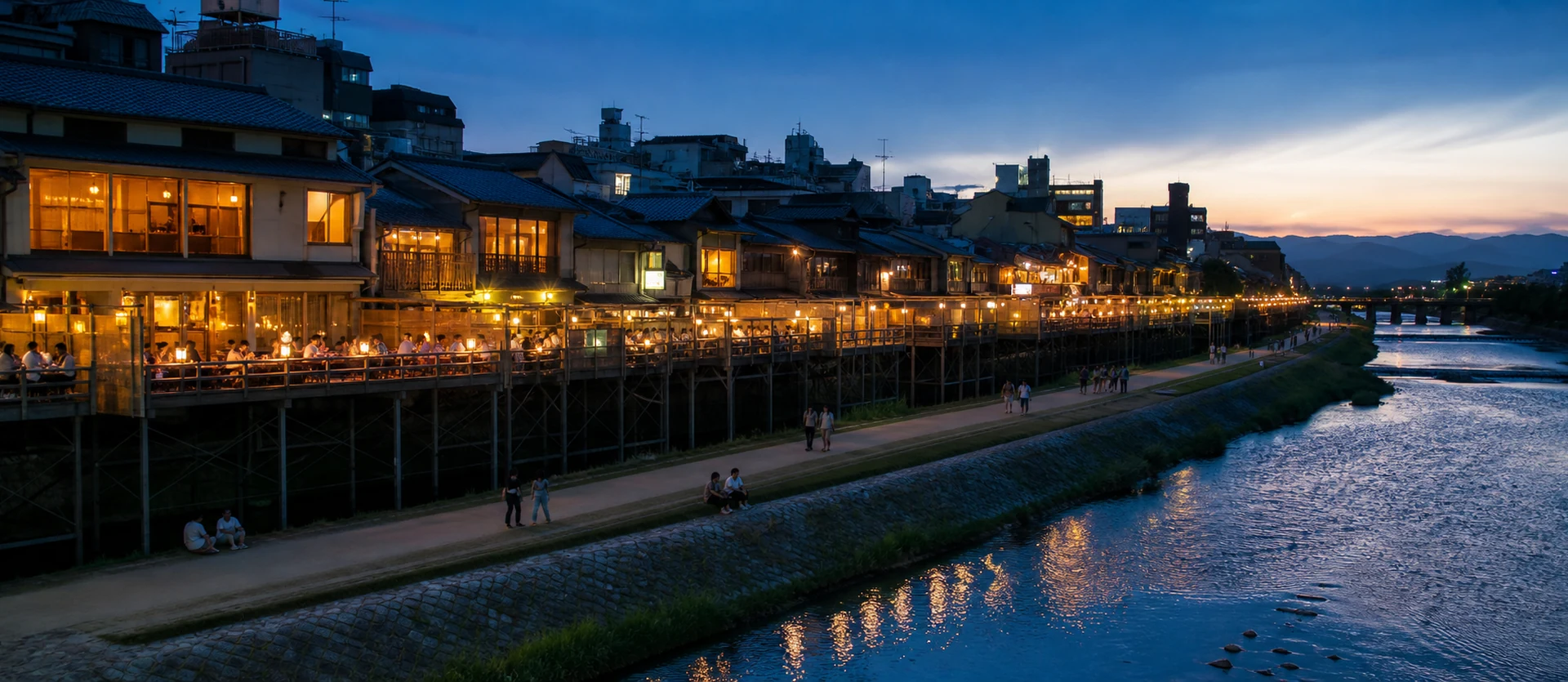
Kamogawa Noryo Yuka is an Edo-period practice in which restaurants along the right bank of the Kamo river, between Nijo and Gojo bridges, extend wooden decks out over the water. In 2026 the season runs 1 May to 15 October. Prices spread widely: around Pontocho, lunch courses start near ¥7,000 and evening kaiseki mostly falls between ¥10,000 and ¥20,000. Popular restaurants need advance booking, and platforms such as Ikyu list them by price band.
You can enjoy the same hour without eating. Walk south along the west bank from Sanjo bridge to Shijo and the riverbed fills with people cooling off, at no cost. The narrow lanes of Pontocho light up from early evening and bear no resemblance to their daytime selves. The area in daily use is in Kawaramachi.
Kibune, for a day out of the basin
If a day forecasts above 35C, the most effective response is to leave the basin.
Kibune lies in a valley in northern Kyoto, where restaurants along the Kibune river build their seating directly over the stream, called kawadoko, running May to September in 2026. The water passes a few dozen centimetres below your feet and the difference from the city is substantial. Pricing is by kaiseki course: Kibune Hiroya sets three tiers at ¥16,500, ¥22,000, and ¥29,800, other restaurants sit in a similar band, and lunch runs cheaper. All of them require reservations.
Getting there means the Eizan Railway from Demachiyanagi to Kibuneguchi, then a Kyoto Bus up the valley, roughly 1 hour 15 minutes to 1 hour 45 minutes from Kyoto Station. Kibune Shrine stands on the same road, its stone steps flanked by red lanterns. Last services from Kibuneguchi run much earlier than in the city, so check the final train before booking a late dinner.
Gion Matsuri and the August dates
Two more fixtures reshape crowds in July and August. Gion Matsuri occupies the whole of July, with the Yamahoko processions on 17 July and 24 July; the yoiyama evenings beforehand close Shijo-dori to traffic, fill it with food stalls, and rank among the most crowded nights of the year. On 16 August, Gozan Okuribi lights five mountain fires from 20:00, visible from many points across the city, with good sightlines along the Kamo river and from tall buildings.
Both push hotel prices up a tier and tighten the Shinkansen. Rules for the Obon period are in the Obon crunch and national dates in the annual festival calendar.
Common mistakes
Underestimating stone paving and gradient is the first. From Kiyomizudera through Kodaiji to Yasaka Shrine is continuous slope and steps, which costs roughly twice what flat ground does, so plan shoes and water accordingly. The list is in what to wear and carry.
Buses are the second. Kyoto’s sightseeing buses run crowded in summer and the stops are in full sun, so fifteen minutes waiting at midday costs more than the ride itself. Prefer the subway and railways during the day.
Rain at the dining platforms is the third. When it rains, restaurants move seating indoors and the price stands, which is the rule rather than a dispute. Most close outright under typhoon warnings, so call ahead.
Heat is the fourth. Kyoto’s humidity runs a few points below Tokyo’s, but the basin has little wind and feels heavier. The decision line and first aid are in heatstroke prevention, and the seasonal plan is in summer travel in Japan.
Useful terms
- Noryo yuka: summer dining decks over the Kamo river
- Kawadoko: the streamside version at Kibune, read differently
- Yoiyama: the evenings before the Gion Matsuri processions
- Gozan Okuribi: the five mountain fires on 16 August
- Haikanryo: admission fee at a temple or shrine