
Furano and Biei: The Lavender Window and Getting to the Blue Pond
Furano averaged 24.6C in July 2025. Farm Tomita is free to enter, lavender peaks late June to early August, the Blue Pond car park doubled to ¥1,000 on 1 July 2026, and the bus from Biei costs ¥550.
ARTICLE MAP Reading Map
SERIESJapan Summer TravelHeat, sun, heatstroke, medical care, transport, and routes rebuilt around temperature.13 parts
The Furano basin in inland Hokkaido averaged 24.6C in July 2025, against Tokyo’s July normal of 25.7C and an actual figure well above it. What matters more is the humidity: Hokkaido air is dry in summer, sweat evaporates, and a full day on foot leaves you in a different state than the same day on Honshu. Tourism here concentrates into July, because the lavender season compresses the whole summer into a few weeks.
The lavender window is narrow
Most visitors come for lavender, and the flowering period is shorter than people expect, so a week’s difference changes the view substantially.
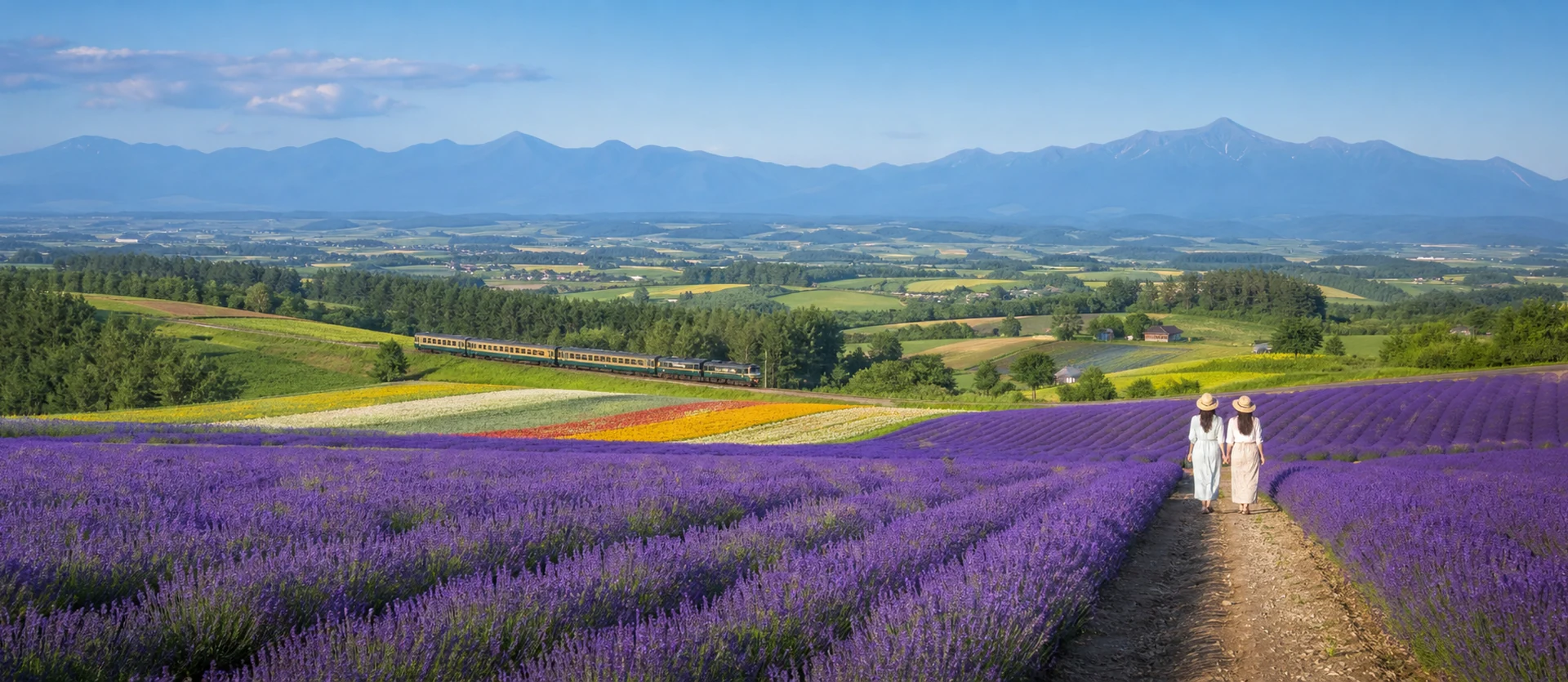
Farm Tomita in Nakafurano is the largest and best known site, free to enter, laid out in bands of different colors alongside a perfume workshop and shops. Lavender peaks from late June to early August, centred on the first half of July, with harvesting starting in late July and noticeably less to see by August. The farm’s separate Lavender East site, the largest lavender field in Japan, opens only during flowering, scheduled for 20 June to 20 July in 2026.
At the time of writing, at the end of July, some flowers remain in the main gardens, with expectations adjusted accordingly. To avoid crowds, opening time and early evening are far quieter than midday, and the light suits photography better.
A train and a station that exist only in summer
One transport option runs seasonally and is worth planning around.
The Furano-Biei Norokko is a temporary sightseeing train on the JR Furano line, with large windows and wooden seats, running slowly, with operating days set between early June and late September in 2026. It stops at Lavender Farm Station, a temporary halt that does not otherwise exist, seven to eight minutes on foot from Farm Tomita and much closer than walking from Nakafurano Station.
It does not run daily, so check the operating calendar on the JR Hokkaido site before you go. Seating splits into reserved and non-reserved, and reserved seats need booking in high season.
Biei: the Blue Pond costs more this year
North of Furano is Biei, an agricultural landscape of rolling hills and windbreak trees, a different picture from Furano’s flower fields.
The Blue Pond in the Shirogane area formed behind an erosion-control structure, and aluminum in the water scatters light into blue, with dead larches standing in it. Parking doubled on 1 July 2026: ¥1,000 for standard, compact, and kei cars, up from ¥500; ¥300 for motorcycles, up from ¥100; and ¥6,000 for large buses, up from ¥2,000. The car park opens 07:00 to 19:00 from May to 22 October.
Arriving by bus avoids the parking question. From in front of Biei Station, the Dohoku Bus Shirogane line, services 39 and 42, reaches the Shirogane Aoiike Iriguchi stop in about 20 minutes for ¥550, with roughly five return services a day. Services are sparse, so check the timetable first; missing one means a two-hour wait.
Three kilometres upstream sits Shirahige Falls in the Shirogane onsen area, where water seeps out of cracks in the rock face in ribbons and drops into the blue river below, with the Blue River Bridge viewpoint about three minutes on foot from the car park. That river is the source of the pond’s color, and the two only make sense seen together.
Choosing how to get around
Sights here are scattered across the hills, and your transport choice determines how much of a day you can cover.
A rental car is the most flexible, and spots like the Patchwork Road and the Seven Star Tree in Biei sit along farm lanes you cannot otherwise reach. Asahikawa city to Biei takes about 50 minutes to an hour by car, and Asahikawa Airport is closer still. The downsides are the queue at the Blue Pond car park in high season and this year’s parking rate.
Without a car there are two combinations. One is the JR Furano line plus route buses: an limited express from Sapporo to Asahikawa takes about an hour and a half, then the Furano line to Biei or Nakafurano, then buses. The other is a local sightseeing bus, with a half-day route from Biei Station in the morning and afternoon lasting about three hours, covering the Blue Pond, Shirahige Falls, and Shikisai no Oka with a guide, which suits anyone who would rather not study timetables.
Sapporo transport and city structure are in Odori and Sapporo Station, and Hokkaido’s outdoor routes in nature around Sapporo.
The fields are private property
One rule differs from mainland tourist areas and deserves stating plainly.
The postcard hills of Biei and Furano are almost entirely private farmland, planted with wheat, potatoes, sugar beet, and beans. They look like scenery and function as a production site. Walking into a field compacts soil and spreads disease, and the poplar known as the Philosophy Tree was cut down by its owner in 2016 after repeated trespassing. Three rules cover it: stay off land other than the farm lanes, do not park on lanes and block machinery, and do not touch crops. The signs say this in several languages, and they are not a formality.
The same applies at Farm Tomita, which has marked paths, and where lavender before harvest is a commercial crop grown for oil rather than an ornamental.
Common mistakes
Underestimating ultraviolet is the first. Hokkaido is cool but the air is clear, the UV index at midday inland approaches 8, and the hills offer no shade at all, so a full day burns easily. Product choice is in drugstore sun protection.
The daily temperature range is the second. Furano runs around 25C in the afternoon in July and drops toward 15C at dawn and after dark, which makes a light jacket essential; the list is in what to wear and carry.
Bus frequency is the third. The Shirogane line from Biei Station runs about five returns a day with the last one often in the afternoon, so build the day backwards from the final service rather than forwards from the sights.
Peak-season accommodation is the fourth. Rooms in Furano, Biei, and Asahikawa tighten and rise in price during lavender season, more so where it overlaps Obon; transport rules are in the Obon crunch. The seasonal plan is in summer travel in Japan.
Useful terms
- Migoro: the best viewing period for flowers or autumn leaves
- Norokko: JR Hokkaido’s slow sightseeing train
- Rinji eki: a station that operates only in certain seasons
- Nodo: farm lane, with private fields on both sides
- Bofurin: the windbreak tree lines that divide the Biei hills