
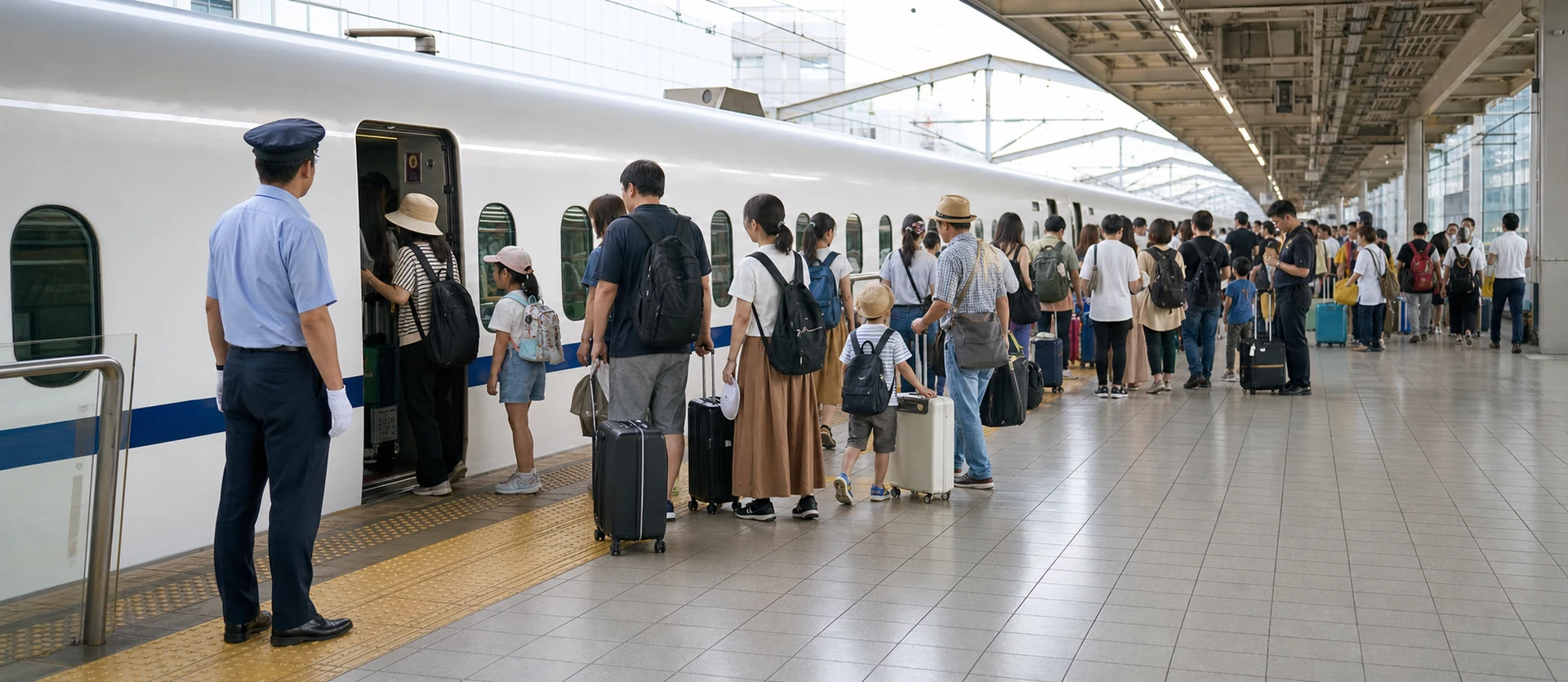
Obon, 7-16 August: Fully Reserved Nozomi and How to Get a Seat
Every Nozomi runs reserved-only for ten days, tickets go on sale one month ahead, and peak days are fixed. What to do when the first round has already sold out.
ARTICLE MAP Reading Map
SERIESJapan Summer TravelHeat, sun, heatstroke, medical care, transport, and routes rebuilt around temperature.13 parts
Obon is when Japanese families return to their home towns to visit graves, and the resulting national movement concentrates into roughly ten days in mid-August. For a visitor the effect lands on three things at once: Shinkansen seats, hotel rates, and motorway journey times. The 2026 dates and rules are already published, so an itinerary built on those numbers avoids most of the trouble.
From 7 to 16 August the Nozomi has no non-reserved cars
JR Central and JR West announced on 21 May that in FY2026 the Nozomi on the Tokaido and Sanyo Shinkansen would run fully reserved during four periods, with Obon falling from Friday 7 August to Sunday 16 August. The other three are Golden Week from 24 April to 6 May, Silver Week from 18 to 23 September, and the New Year period from 25 December to 5 January 2027.
Fully reserved means there are no non-reserved cars on any Nozomi for those ten days. A non-reserved limited express ticket lets you stand in the vestibule between cars and nothing more. The Hikari and Kodama on the same route keep non-reserved cars, but they run less often and stop more, adding 40 minutes to an hour between Tokyo and Shin-Osaka.
Source: JR Central: fully reserved Nozomi periods for FY2026.
When tickets go on sale, and what is left now
Reserved seats go on sale at 10:00 exactly one month before the travel date, peak season included. Tickets for 7 August went on sale on 7 July, and for 16 August on 16 July. On busy routes and peak days they disappear within minutes.
To catch the opening moment, use the advance request feature. On Ekinet from JR East you submit between 14:00 one week before, on the same weekday, and 09:54 one month before, and the system files the request automatically at 10:00. Smart EX and EX Yoyaku offer a similar function for JR Central and JR West routes.
At the time of writing, at the end of July, the first sale round for the whole Obon period has passed. What remains is watching for cancellations, which come back into the system in batches in the week before travel and again the day before. Checking morning and evening beats refreshing constantly, because releases cluster. Both EX Yoyaku and Ekinet show live seat availability.
Three fallbacks when reserved seats are gone
If cancellation-watching does not deliver, there are three levels of alternative.
Riding in the deck comes first. No standing ticket is sold during the fully reserved periods, and without a reservation you cannot take a seat, but a non-reserved limited express ticket lets you use the deck areas of the standard cars. JR states plainly that congestion may leave you unable to board the train you wanted, so treat this as a fallback rather than a plan. Second, switch to a Hikari or Kodama non-reserved car, where trains before 07:00 and after 21:00 are noticeably emptier. Third, change mode: flights between Tokyo and Osaka often have seats during Obon, low-cost carriers run frequently between Narita and Kansai, and overnight buses are cheap but mean eight hours seated, arriving in poor condition in 35C heat.
Do not fall back on turning up at the station. On peak Obon days, queues at the ticket counters in Tokyo and Shin-Osaka routinely exceed 40 minutes.
Build the itinerary backwards from the peaks
The genuinely effective move is to place long-distance travel outside the peaks. In 2026 the southbound wave from Tokyo starts on Saturday 8 August and returns from 11 to 13 August. The northbound return concentrates from 14 to 16 August. Motorway congestion forecasts follow the same shape, worst southbound around 13 August and northbound around 15 August.
That leaves 4 to 6 August and anything from 17 August as the open windows. Put the intercity legs there and spend the middle of Obon inside one city, which is often a better trip anyway: museums, aquariums, and department stores keep normal hours while the crowds sit on trains and motorways.
Accommodation follows the same curve. Hotel rates in major cities during Obon typically run 1.5 to 3 times normal, with tourist destinations such as Kyoto and Kanazawa higher still. The same budget buys a noticeably better room from 17 August.
How a Japan Rail Pass behaves here
Pass holders hit an extra problem. The pass does not cover the Nozomi or Mizuho by itself, and riding one requires buying a separate supplementary ticket. Without paying that, you are limited to Hikari and Kodama, which during Obon means competing for non-reserved seats.
On price, the ordinary 7-day pass currently costs ¥50,000, with 14 days at ¥80,000 and 21 days at ¥100,000. Overseas purchases from 1 October 2026 move to new rates, with the 7-day ordinary pass rising to ¥53,000. Travel this summer still uses current pricing.
Whether a pass pays off is arithmetic. A reserved Nozomi seat from Tokyo to Shin-Osaka costs ¥14,720 in the standard season, so a 7-day pass needs three or more long legs to break even. For a trip confined to Kansai, the JR West regional passes are cheaper.
Source: JAPAN RAIL PASS: types and prices.
Common mistakes
Treating Obon as a public holiday is the first. It is not a national holiday, companies set their own leave, and the actual crowding window shifts by a few days each year. Mountain Day on 11 August is the statutory holiday, and where it falls against the weekend shapes that year’s peaks.
Luggage is the second. Reserved seats with an oversized baggage space must be booked in advance to bring items over 160 cm and up to 250 cm in total dimensions, and turning up without that reservation costs ¥1,000 on the spot. Station coin lockers fill during this period, so a service like ecbo cloak that reserves space in shops is more reliable.
Typhoons stacking on top are the third. August has among the highest typhoon approach counts, and when service resumes after a suspension the backlog fills every following train. Rules and timing are in typhoons and heavy rain.
Ignoring the festival calendar is the fourth. Major August festivals tighten local hotels and last trains further. Dates are in the annual festival calendar, fireworks viewing and paid seating in fireworks festivals, and the seasonal plan in summer travel in Japan.
Useful terms
- Obon: the mid-August ancestral period, not a statutory holiday
- Zenseki shiteiseki: all seats reserved, no non-reserved cars
- Dekki: the vestibule between cars, where a non-reserved ticket lets you stand
- Midori no kenbaiki: the green JR ticket machines
- Tokudai nimotsu okiba: oversized baggage space, reservation required