Tokyo in Summer: Early Shrines, Underground Days, Waterfront Evenings
August normals of 31.3C and 74 percent humidity, a record 261 heatstroke ambulance calls on 21 July. Free mornings, the underground network, Sumida Aquarium at ¥2,700, Skytree from ¥3,000, and day trips to the coast.
ARTICLE MAP Reading Map
SERIESJapan Summer TravelHeat, sun, heatstroke, medical care, transport, and routes rebuilt around temperature.13 parts
Start here
Health
Transport
City routes
Tokyo’s August normals are a daily high of 31.3C, a daily low of 23.5C, and mean relative humidity of 74 percent, measured over 1991-2020. The figures look milder than Kyoto’s, but Tokyo makes up for it in walking distance between stations and in asphalt and concrete underfoot. On 21 July 2026 the city recorded 261 heatstroke ambulance calls in one day, a record. The compensating advantage is that Tokyo has the densest network of underground passages and indoor venues in Japan, and a route built along them makes summer here easier than in most cities.
The first two hours are the valuable ones
From 06:00 to about 08:30 is the only genuinely comfortable outdoor window, and most of what fits in it is free.
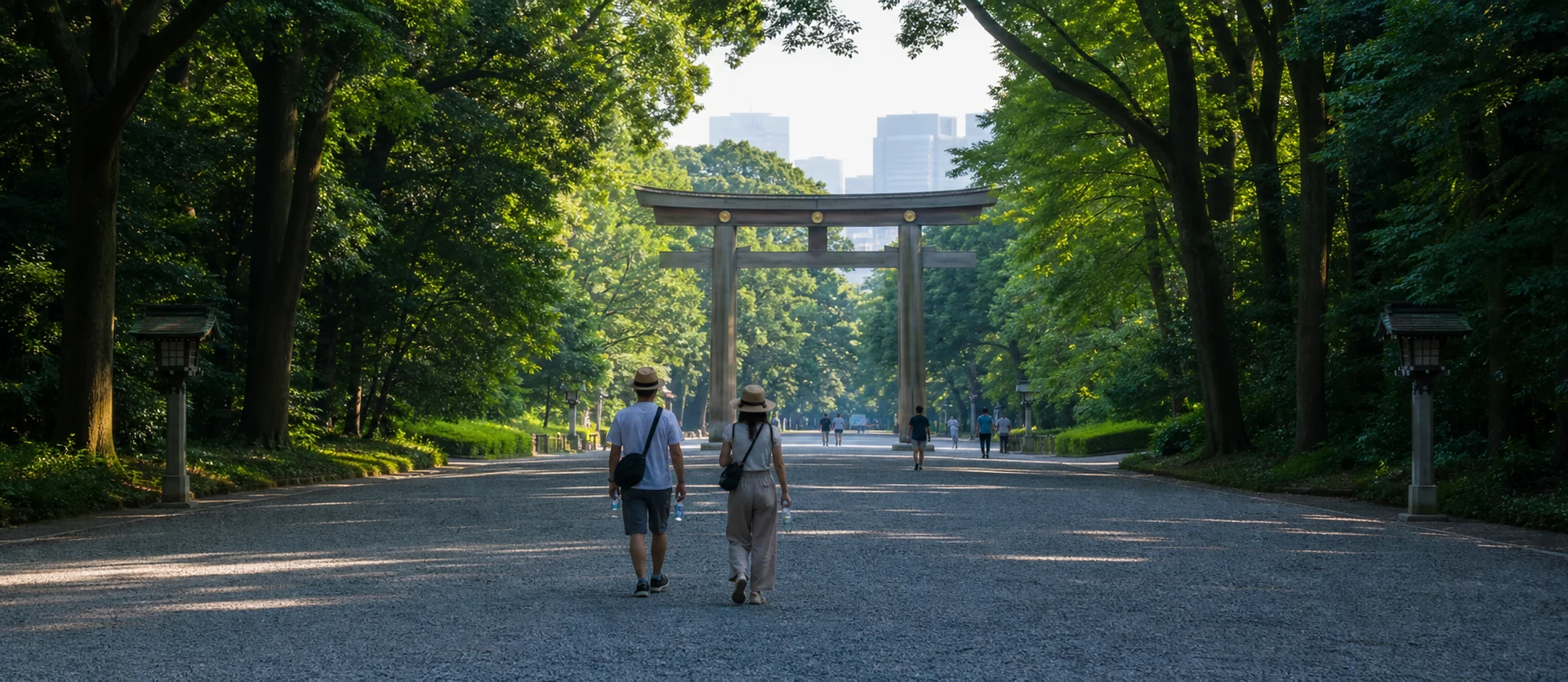
Meiji Jingu opens at sunrise and closes at sunset, so in summer you can enter well before 06:00, and entry costs nothing. The 70-hectare planted forest beside Harajuku Station runs cooler than the streets around it and holds almost nobody but local walkers at that hour. The Imperial Palace outer gardens and the plaza on the Marunouchi side of Tokyo Station work the same way, with no queue in front of the station building before 07:00. Shops in the Tsukiji outer market open early, and the lines for seafood bowls and tamagoyaki do not form until after 09:00.
Put cross-city moves in this window too, since trains are still manageable. From 08:30 the Yamanote and Chuo lines enter the commuter peak; congestion figures and last trains are in commuting in Tokyo.
From 10:00 to 16:00, stay off the surface
After the morning outdoors, the principle for the next six hours is to avoid street level.
Aquariums and museums are the direct option. Sumida Aquarium sits inside Tokyo Skytree Town and from 10 February 2026 charges ¥2,700 for adults, ¥2,000 for high school students, ¥1,400 for elementary and junior high, and ¥900 for children aged three and up, entirely indoors and connected straight to the mall. In Ueno, the Tokyo National Museum and the National Museum of Nature and Science share one park with a short walk between them, enough for a full day. Venue choices are in cultural places in Tokyo.
The underground network is Tokyo’s particular resource. The Yaesu underground mall at Tokyo Station connects several surrounding buildings, so most of the walk toward Nihonbashi and Otemachi never surfaces. At Shinjuku the underground links the west exit, the east exit, and Shinjuku Sanchome, which in summer is both faster and cooler than the street; the layout is in the complete Shinjuku Station guide. Ginza, Shibuya, and Ikebukuro all connect their main department stores to the stations the same way.
Without paying admission anywhere, large bookshops, electronics stores, and department store food floors all tolerate long stays.
Evenings belong to viewpoints and water
After 17:00 the temperature drops and Tokyo gives its best views.
The combined Tembo Deck and Tembo Galleria ticket at Tokyo Skytree starts at ¥3,000 for adults with pricing that varies by date, and slots around sunset go first, so book a time on the official site. The observation floors are strongly air-conditioned, which makes them a good transition from afternoon to evening.
Water runs a degree or two cooler than the middle of the city and catches a breeze. The riverside path along the Sumida from Asakusa to Kuramae, the bayside stretch from Toyosu to Odaiba, and the banks of the Nihonbashi river all walk well. Water buses and yakatabune dinner boats add evening sailings in summer, with Asakusa to Odaiba the common route. This side of the city is covered in east Tokyo.
Rooftop beer gardens are a Japanese summer institution, open on department store and hotel roofs from June to September, mostly two-hour all-you-can-eat-and-drink formats around ¥5,000 to ¥7,000, and they need booking.
Day trips that get you back the same evening
When the forecast turns severe, leaving Tokyo for a day beats enduring it.
For the sea, Enoshima and Kamakura. The Katase-Enoshima beach season in 2026 runs from 1 July to 6 September, 09:00 to 17:00, and Kamakura’s three beaches at Zaimokuza, Yuigahama, and Koshigoe run roughly early July to the end of August on the same hours. A Odakyu Romancecar limited express from Shinjuku reaches Katase-Enoshima in about an hour and ten minutes, and the sea breeze does the rest.
For a valley, Okutama. From Shinjuku on the Chuo Line changing to the Ome Line, about two hours with one transfer, brings you to gravel banks on the upper Tama river where the water is genuinely cold, one of the few natural cooling points inside Tokyo. Last trains back run early, so start returning before 16:00.
Higher and further options are in Karuizawa and Kamikochi.
August festivals and fireworks
Tokyo summer has a second layer after dark. The city and its surroundings hold multiple fireworks festivals in July and August, with viewing spots, paid seating, and yukata rental covered in fireworks festivals. Bon dances and shrine festivals cluster in August, and the small ones held in neighborhood shrine grounds, with food stalls and taiko, can simply be walked into.
Note what happens at the end. When these events finish, everyone moves to the nearest station at once, and entry restrictions of 30 minutes or more are normal after a fireworks display. Identify the second-nearest station in advance; a fifteen-minute walk usually beats the queue.
Common mistakes
Underestimating in-station walking is the first. Tokyo transfers frequently run 300 to 500 m, and while the underground sections are air-conditioned they are crowded and stuffy. Budget ten minutes per transfer rather than the four the app suggests.
The indoor-outdoor gap is the second. Trains and shops are cold, and coming in from 35C means a swing of 10C or more, so a light jacket is not optional. The list is in what to wear and carry.
Relying on vending machines is the third. Density is high, but entire banks sell out at fireworks displays and festivals, so buy at a convenience store before you set out.
Walking through the middle of the day is the fourth. A large share of those 261 ambulance calls on 21 July involved people out on foot. The decision line and first aid are in heatstroke prevention, and the seasonal plan is in summer travel in Japan.
Useful terms
- Okujo beer garden: rooftop summer beer garden on a store or hotel
- Kaisuiyokujo: an officially operated swimming beach with a set season
- Bon odori: summer group dance at a shrine or public square
- Suijo bus: scheduled boat on the Sumida and Tokyo Bay
- Nyujo kisei: station entry restriction after a large event