
Karuizawa and Kamikochi: Two Escapes at 940 m and 1,500 m
Karuizawa averages 20.5C in August, about an hour from Tokyo for around ¥6,020. Kamikochi bans private cars year-round, with a 2026 season of 17 April to 15 November and a ¥2,300 return shuttle.
ARTICLE MAP Reading Map
SERIESJapan Summer TravelHeat, sun, heatstroke, medical care, transport, and routes rebuilt around temperature.13 parts
Start here
Health
Transport
City routes
The most effective way to avoid a Japanese summer is to gain altitude. Temperature falls roughly 0.6C per 100 m, so 1,000 m buys about 6C, and lower humidity and tree cover widen the gap in practice. Two places in Nagano represent two ways of doing it. Karuizawa is a resort town an hour from Tokyo by Shinkansen where you can start walking the moment you step off. Kamikochi is a valley of maintained trails reachable only by changing to a shuttle bus.
What the altitude buys
Karuizawa Station sits at about 940 m, the highest station on the Hokuriku Shinkansen. August there averages 20.5C, roughly 5.5C below Tokyo, and evenings call for long sleeves. Kamikochi lies at about 1,500 m in the Azusa river valley, enclosed by the ridges of the Northern Alps, with cool days and mornings near 10C.
Access differs sharply. Tokyo Station to Karuizawa on the Hokuriku Shinkansen takes about 1 hour 10 minutes to 1 hour 30 minutes at around ¥6,020, with no transfer. Highway buses from Shinjuku, Ikebukuro, and Shibuya run ¥2,000 to ¥3,500 but take over three hours. Kamikochi has no direct rail: from Tokyo you route through Matsumoto or take a direct highway bus, and a same-day return is tight, so most people stay a night.
Karuizawa: half a day around the station
Karuizawa rewards loose planning, because it starts at the station exit.
Kyu-Karuizawa Ginza is the shopping street that grew out of the Meiji-era resort, about 600 m long, roughly 30 minutes on foot from the station or a few minutes by bus, lined with long-established jam, bread, and sausage shops and cafes. Kumoba Pond is about 20 minutes from the station, a narrow pool formed by a widened stream, with a 20-minute loop path and larch forest reflected in the water, and the air at the edge is clearly cooler than on the road.
Rent a bicycle. Shops near the station charge ¥1,000 to ¥1,500 a day, the terrain is gentle, forest lanes are plentiful, and cycling beats both walking and waiting for buses. Both the north and south exits have rental shops.
South of the station is Karuizawa Prince Shopping Plaza, a large outlet where an entire afternoon disappears comfortably in rain or glare.
Water and forest to the west
Northwest of the station is where Karuizawa gets genuinely cold.
Shiraito Falls is 25 minutes and ¥720 by Kusakaru Kotsu bus from Karuizawa Station, alighting at the Shiraito no Taki stop with the entrance directly ahead. The falls run about 70 m wide and around 3 m high, fed by groundwater seeping straight out of the rock face, so the water stays cold year-round and a few minutes in front of it drops your body temperature. The surrounding landform is volcanic, shaped by Mount Asama.
In the Hoshino area, Harunire Terrace is about 15 minutes by bus from the station’s south exit, a cluster of wooden buildings along the Yukawa river with restaurants and shops set on boardwalks between elm trees. Shade plus running water makes it one of the best places to sit out an afternoon. The Stone Church and the Karuizawa Highland Church are in the same area.
Kamikochi: private cars are banned all year
Kamikochi works differently, and the access rules will stop you at the gate if you have not read them.
The 2026 season runs 17 April to 15 November, with the road closed outside those dates. On the prefectural Kamikochi park line, from the entrance of the Kama Tunnel inward, ordinary vehicles are barred year-round. Drivers park at transfer lots outside and take a shuttle bus or fixed-fare taxi: Sawando from the Matsumoto side, with about 2,000 spaces, or Hirayu Onsen and Akandana from the Takayama side. Sawando to the Kamikochi bus terminal costs ¥1,300 one way and ¥2,300 return, about 30 minutes. Shuttles run 05:00 to 19:00 in season, extended to 20:00 in July and August.
On public transport, take the Matsumoto Dentetsu Kamikochi line from Matsumoto to Shin-Shimashima, about 30 minutes and ¥700, then a route bus for 65 minutes at ¥1,950 to Kamikochi. That bus leg has required reservations since fiscal 2025, so book before you travel.
Three trail options by stamina
From the bus terminal the choice is by time and legs, and all of it runs on maintained flat paths that need no climbing equipment.
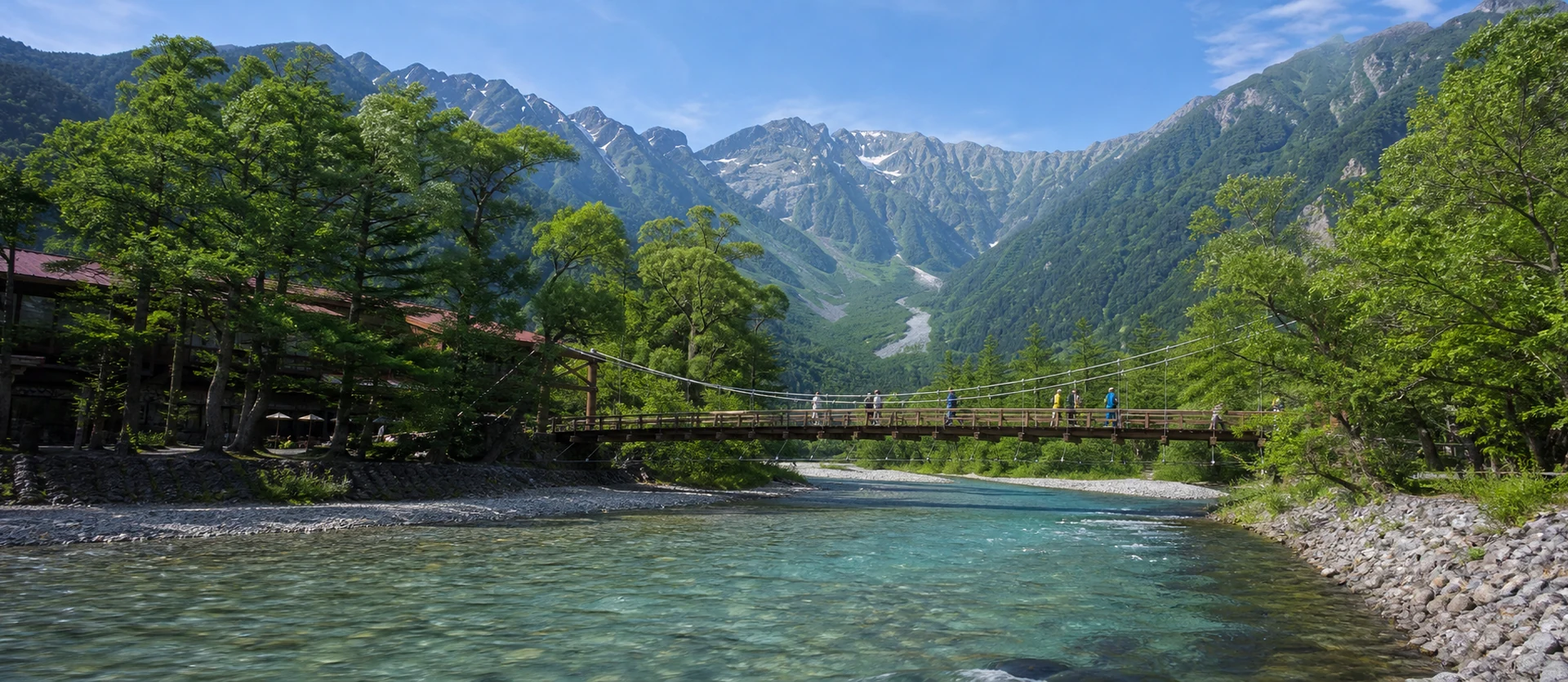
The shortest is Kappa Bridge, a few minutes on foot from the terminal, a wooden bridge over the Azusa river facing the Hotaka peaks, and the defining view of Kamikochi. Under 30 minutes there and back. The middle option runs downstream to Taisho Pond, formed when the 1927 eruption of Mount Yake dammed the Azusa and left dead trees standing in the water, about an hour one way, and you can also ride the bus to Taisho Pond and walk back. The longest runs upstream to Myojin Pond, about an hour each way along the right bank through forest, crossing a suspension bridge.
All three follow the river, where the air stays cool even at midday. Mountain weather turns quickly, so carry a windproof layer even on a clear forecast.
Common mistakes
Treating a cool place as one where sun protection is optional is the first. Ultraviolet intensity rises with altitude, both places run stronger than the lowlands, and the comfortable temperature is exactly what makes people careless. Product choice is in drugstore sun protection.
Last services are the second. Buses in Karuizawa and the Kamikochi shuttles finish early and mountain light goes quickly, so build the day around starting back by 16:00. A same-day return to Tokyo from Kamikochi is not realistic.
Accommodation is the third. Late July through August is peak season for both, and Karuizawa hotels and Kamikochi lodges need booking months ahead over Obon; transport rules for the period are in the Obon crunch.
Bears and insects are the fourth. Nagano’s mountains have bear sightings, so carry a bell or walk with others, and summer brings biting insects, with repellent ingredient rules in what to wear and carry. The seasonal plan is in summer travel in Japan.
Useful terms
- Hishochi: a highland resort used to escape summer heat
- Kaizan: the date a mountain area opens for the season
- Maikaa kisei: private vehicle restriction
- Norikae chushajo: transfer car park for the shuttle bus
- Kappabashi: the landmark wooden bridge at Kamikochi